Country guide
Indian CV format: how to write a resume for jobs in India
In India you will meet three words for the same idea: resume, CV and biodata. For most private-sector jobs, employers want a concise resume focused on what you have done, not the personal-detail page that older biodata formats were built around. This guide covers structure, which details to keep, and what applicants from abroad need to know.
What is the standard resume format in India?
An Indian resume is a one- or two-page, reverse-chronological document in English: contact details, a short profile, work experience with achievements, education, skills and certifications. Freshers lead with education, internships and projects. Personal details such as date of birth, marital status, religion and father's name are not needed for most private-sector jobs, and gender must not be a factor in recruitment.[2]
Indian resume conventions at a glance
| Topic | Usual in India |
|---|---|
| Name of the document | Resume or CV, used interchangeably. "Biodata" survives for personal-detail formats; avoid it for corporate jobs. |
| Length | No official rule. One page for freshers, two for most experienced professionals. |
| Photo | Not required. Leave it out unless the posting or application form asks for one. |
| Personal details | Name, phone, email, city, LinkedIn. Date of birth, gender, marital status, religion, caste and father's name are not needed. |
| Education | Degree, institution, year, and grade or CGPA if strong. Freshers often add Class XII and X results. |
| Dates | Month and year for each role (Jun 2021 – Present). |
| Language | English, unless the posting says otherwise. List Indian and foreign languages you work in. |
| References and declaration | "Available on request" is enough. The closing "I hereby declare" line is not needed. |
| Cover letter | Send a short one when the posting asks or you apply by email; mention your notice period there if asked. |
| Application software | Employers and job portals may parse resumes automatically; a single-column layout reads most reliably. |
Layout and structure of an Indian resume
Use a reverse-chronological layout in one column, with your strongest, most relevant achievements in the top half of the first page. Freshers move education, internships and projects above work experience.
| Section | What to include | Tip |
|---|---|---|
| Header | Name, mobile, email, city, LinkedIn, GitHub or portfolio if relevant. | No full postal address or date of birth. |
| Profile | Two to four lines: role, years of experience, domain, strongest result. | Replace a generic "career objective" with what you offer this employer. |
| Work experience | Title, company, city, dates, three to five achievements. | Most recent first. Give scale: users, revenue, team size. |
| Education | Degree, institution, year, CGPA or percentage if strong. | Experienced candidates can drop school results. |
| Skills and certifications | Tools, languages, certifications with year. | Use the posting's wording for the same skills. |
| Projects (freshers) | Two or three projects: problem, what you built, result. | Link to code or a demo if you can. |
For phrasing by role, browse resume examples such as the software engineer example or the data analyst example.
Resume, CV or biodata, and which personal details to keep
Biodata formats put date of birth, gender, height, religion, caste, marital status and parents' names at the top. A resume for a private-sector job does not need any of these. Under the Code on Wages, 2019, as summarised by the Government of India's Press Information Bureau, employers shall not discriminate on the basis of gender, including transgender identity, in recruitment, wages and employment conditions for similar work, so there is no reason to state your gender either.
Government recruitment is a separate case: official application forms ask for specific details, and you should follow the form exactly. For private employers, keep the space for skills and results, and let the employer collect identity documents after an offer.[2]
A skeleton Indian resume
A one-page outline for an experienced professional. All data is placeholder text.
Header
[Name Surname]
Bengaluru · +91 9xxxx xxxxx · your-name@example.com
linkedin.com/in/your-name
Profile
Backend engineer with five years in fintech payments. Builds services that stay fast at peak load. Looking for a senior engineer role.
Work experience
Jul 2022 – Present · Software Engineer II, [Company], Bengaluru
Rebuilt the refund service in Go; cut failed refunds and support tickets during festive-season peaks.
Jun 2020 – Jun 2022 · Software Engineer, [Company], Pune
Education
2020 · B.Tech, Computer Science, [Institute] · CGPA 8.4/10
Skills and certifications
Go · Java · PostgreSQL · Kafka · AWS Certified Developer (2023) · English, Hindi, Kannada
Example with placeholder details, not a real person
No photo, date of birth, father's name or declaration line. The figures are illustrative; use only results you can explain at interview.
How to write an Indian resume in six steps
- 01
Read the job description closely
Note the skills, tools and certifications it names. The job description keyword matcher shows which of them your resume does not mention yet.
- 02
Drop the biodata details
Remove date of birth, gender, religion, caste, marital status, father's name and the declaration line. Keep name, phone, email, city and LinkedIn.
- 03
Pick the right order
Experienced: work experience first. Freshers: education, internships and projects first.
- 04
Write achievements with scale
Three to five points per role, starting with a verb and ending with a measurable result.
- 05
Tailor it to each posting
Reorder points around what the employer asks for. You can optimise your resume for one job straight from the posting link.
- 06
Check it before you apply
Save as PDF unless a portal asks for Word, and run the free resume checker.
Templates that suit Indian applications
Photo-free, single-column designs that keep the structure above. All designs are in the template gallery.
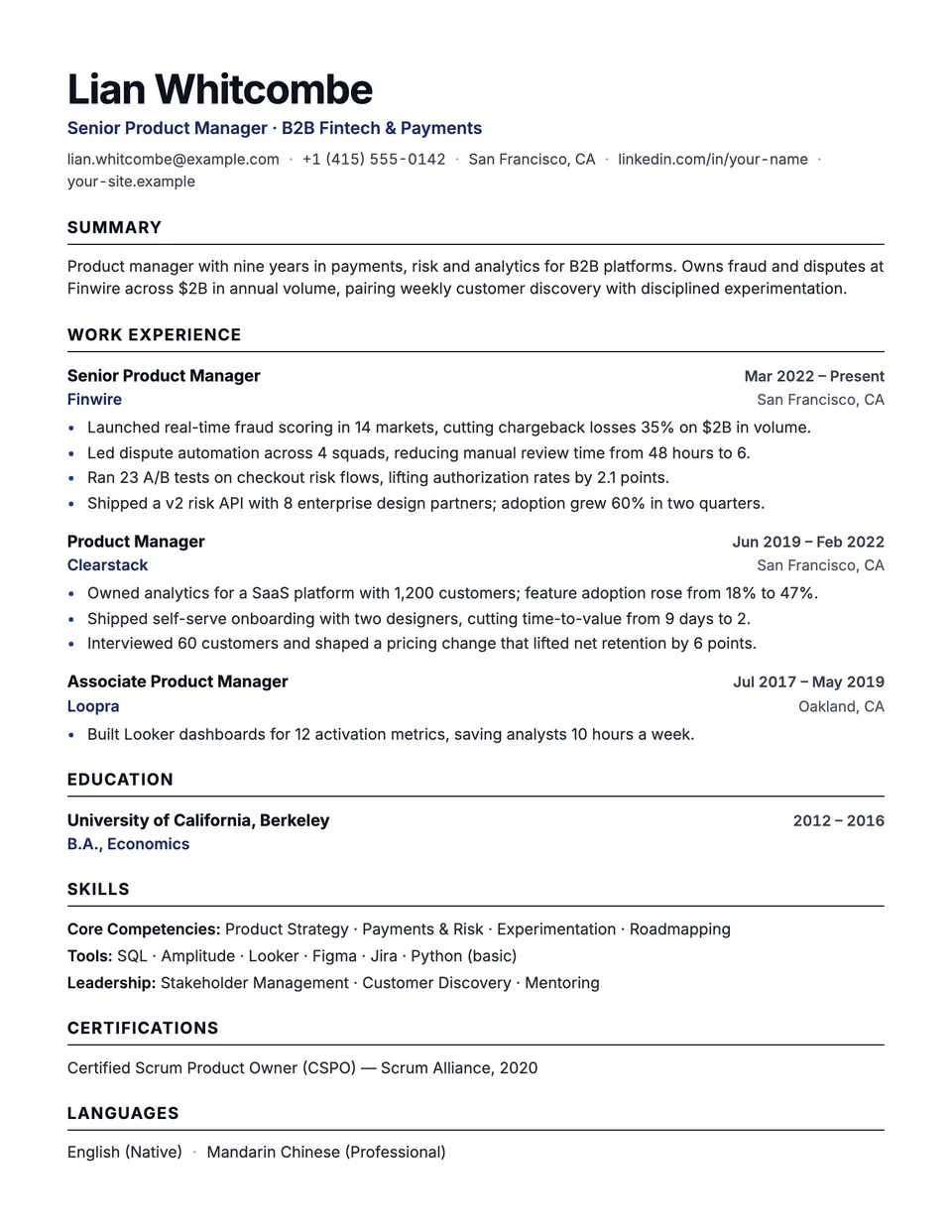
Beacon
A clean default for IT, consulting, finance and multinational roles.
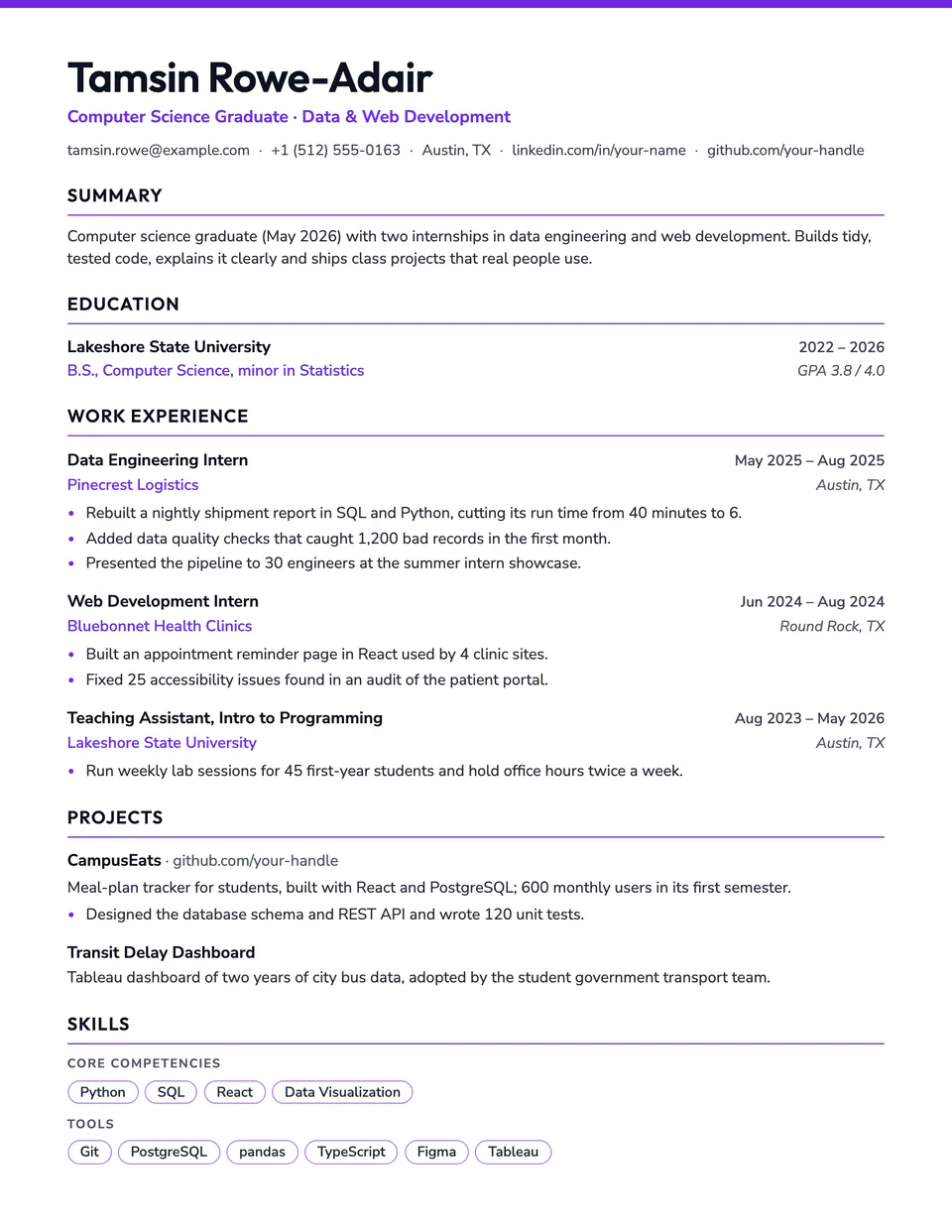
Campus
Puts education, internships and projects first, for freshers and campus placements.
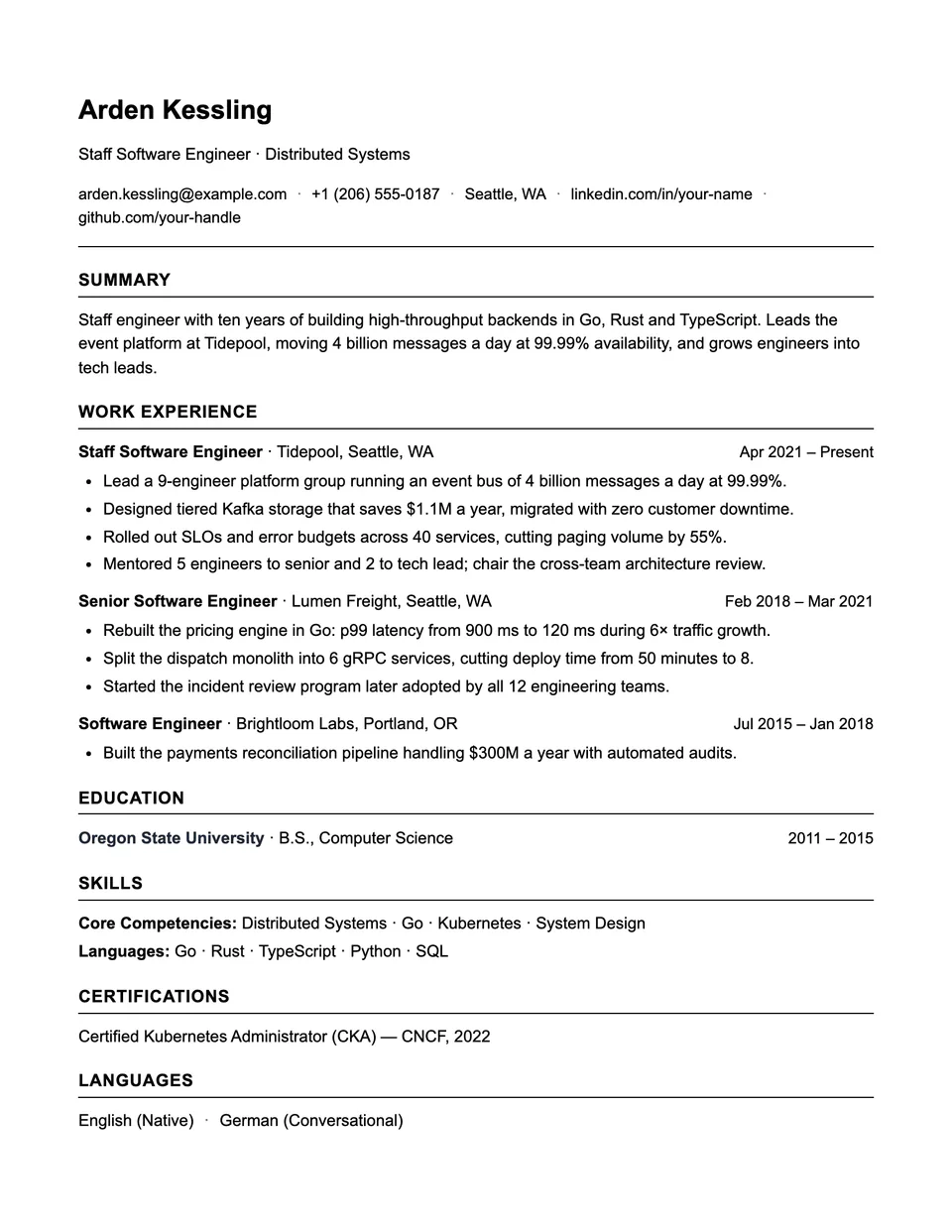
ATS Plain
The plainest layout, for job portals and large employers that parse resumes automatically.
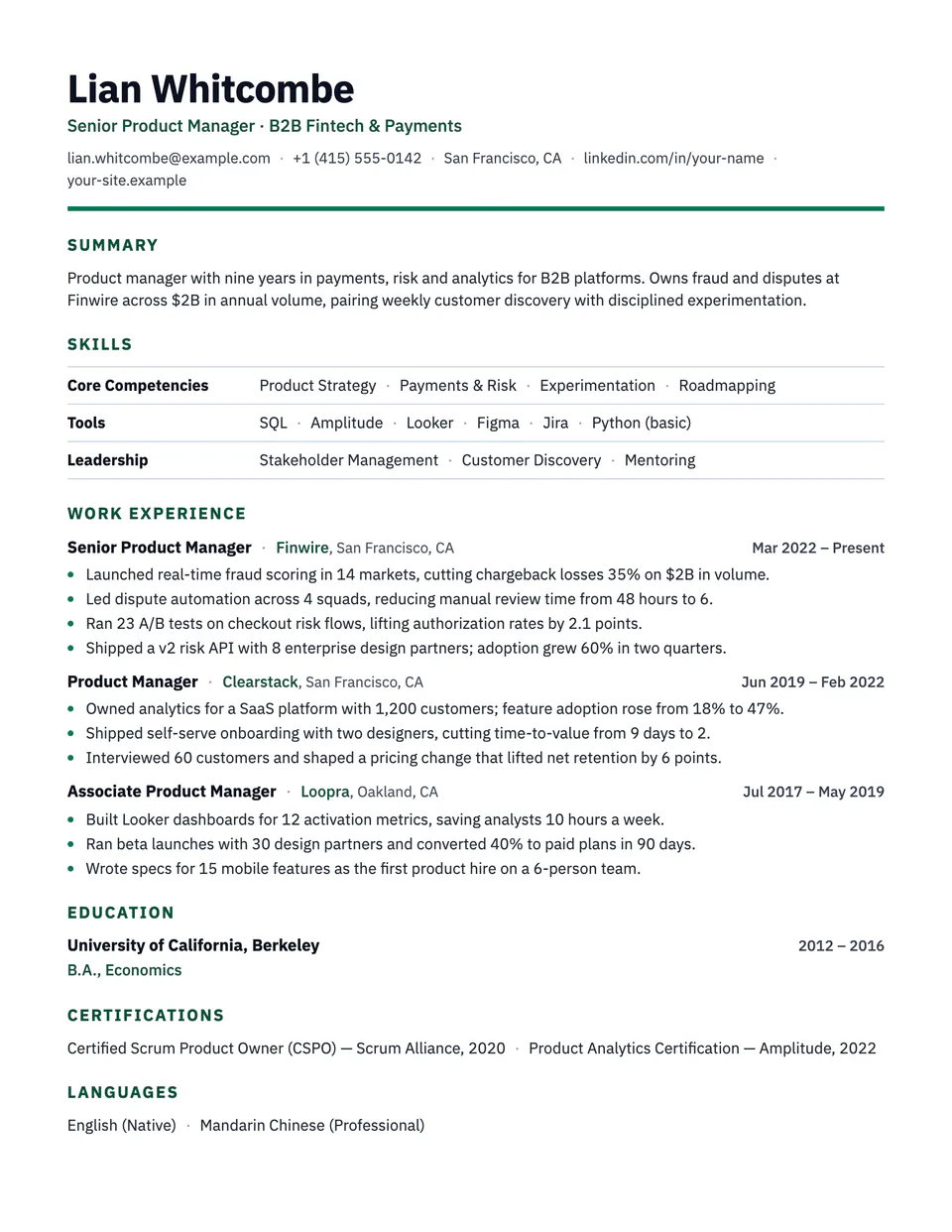
Strata
Puts skill areas up front, for career changers whose transferable skills matter more than past titles.
Cover letters and the application package
A cover letter is not compulsory for most private-sector applications in India. When the posting asks for one, or when you apply by email, write a short note: the role, two or three achievements that match it, and your notice period if the employer wants to know. The cover letter generator drafts one from the posting in the same design as your resume, and interview prep builds practice questions for the same role.
Where to find jobs in India
The National Career Service (NCS) portal, an initiative of the Ministry of Labour & Employment, offers job search, job matching, career counselling and job fair information, with government, private and international jobs, free of charge. Register at ncs.gov.in to apply and receive matching vacancies.
Private boards such as Naukri, LinkedIn, Indeed and foundit also list many Indian roles, and large employers recruit through their own careers pages and campus placement drives.[1]
Applying from abroad
Foreign nationals taking up a job in India apply for an employment visa. The Bureau of Immigration lists proof of employment, an appointment document with its terms and conditions, as the supporting document, so you apply once you hold an appointment. Check current rules on the official Indian Visa Online portal rather than figures quoted elsewhere.
If you studied abroad, whether you are an Indian citizen returning home or a foreign national, an employer, university or government body may ask how your degree compares with an Indian one. The Association of Indian Universities (AIU) Evaluation Division accords academic equivalence to degrees from accredited foreign universities and boards; applications are accepted online only. On your resume, give the degree exactly as awarded, with the country, and add the Indian equivalent once you have it.[3][4]
Common mistakes on Indian resumes
- Sending a biodata with date of birth, religion, caste and family details for a corporate job.
- A generic "career objective" instead of a profile aimed at this role.
- Listing every school mark when you have years of work experience.
- Duties instead of results, with no sense of scale.
- Ending with an "I hereby declare" line and signature that add nothing.
- Sending one generic resume to every posting without matching its keywords.
Frequently asked questions
- What is the difference between a resume, a CV and a biodata in India?
- In Indian hiring, resume and CV are used for the same document: a summary of your experience, education and skills. A CV sometimes means a longer academic version. Biodata refers to a format built around personal details such as date of birth, religion and family. For private-sector jobs, send a resume or CV, not a biodata.
- Should I include my date of birth and marital status?
- Not for most private-sector jobs. They tell the employer nothing about how well you can do the work, and they take space from your achievements. The Code on Wages, 2019 bars gender discrimination in recruitment, so you do not need to state your gender. Government application forms are different: fill in exactly what they ask.
- Do I need a photo on an Indian resume?
- No. No rule requires a photo on a private-sector resume in India. Add it only when a posting or application form asks for a photograph, and use a recent, plain-background portrait. Otherwise use the space for another achievement or a relevant project, and keep photos off resumes you upload to job portals, where they are seen by many people you do not know.
- How long should a resume be for a fresher in India?
- One page. Lead with your degree and CGPA, then internships, projects, certifications and skills. Class XII and X results can go in the education section if the employer asks or they are strong. Two or three well-described projects, each with what you built and the result, say more than a long list of courses or extracurriculars.
- Is an Indian resume different from a US or UK one?
- The structure is close: reverse-chronological, no photo, tailored to the job. The main local differences are leftover biodata habits, which you should drop, and the fresher format with projects and campus placements. Compare with the UK CV format guide or the Singapore guide if you are applying abroad as well.
Sources
Statements about rules and official guidance rely on these pages. We opened and read each source ourselves on the date shown.
- [1]National Career Service portal · Ministry of Labour & Employment, Government of Indiawww.ncs.gov.in/ ·
- [2]India's Labour Reforms: Simplification, Security, and Sustainable Growth (Code on Wages, 2019) · Press Information Bureau, Government of Indiastatic.pib.gov.in/WriteReadData/specificdocs/documents/2025/nov/doc20251121701501.pdf ·
- [3]Visa provision (employment visa) · Bureau of Immigration, Ministry of Home Affairs (Indian Visa Online)indianvisaonline.gov.in/visa/visa-provision.html ·
- [4]Equivalence of Degree · Association of Indian Universities (AIU)aiu.ac.in/frontpage/equivalence-of-degree/ ·
Keep reading
Applying in India? Check your resume first
The free checker reviews contact details, headings, dates and length, and lists what to fix before a recruiter sees it.