Country guide
Singapore CV format: how to write a resume for jobs in Singapore
In Singapore "resume" and "CV" are used for the same document. Older habits, such as a photo, NRIC number and date of birth at the top, still show up, but official fair-hiring guidance now points the other way. This guide sets out what to include, what to leave out, and what applicants from abroad should know.
What is the standard resume format in Singapore?
A Singapore resume is a concise, reverse-chronological document in English, tailored to each job, with your strongest achievements in the top half of the first page. Leave out your photo, NRIC number, date of birth, race, religion and marital status: official fair-employment guidance tells employers not to ask for them when screening, and career guidance warns they can create bias.[1][2]
Singapore resume conventions at a glance
| Topic | Usual in Singapore |
|---|---|
| Name of the document | Resume or CV; both terms are used. Government career guidance says "resume". |
| Length | No official rule. Keep descriptions short and put your best accomplishments in the top half of page one. |
| Photo | Leave it out. Fair-employment guidance tells employers to remove photo fields from application forms. |
| Personal details | Name, phone, email, LinkedIn. No NRIC number, date of birth, race, religion, marital status or family details. |
| Order | Most recent and most relevant experience first, then education and skills. |
| Dates | Month and year for each role and qualification. |
| Language | English. Work pass applications need English translations of any non-English documents. |
| Tailoring | Expected. A one-size-fits-all resume can suggest you did not read the job description. |
| Style | Consistent fonts and spacing, short bullet points, no generic adjectives like "team player". |
| Application software | Employers may screen resumes through online portals or applicant tracking systems; a clean single-column layout reads most reliably. |
Layout and structure: what goes where
CareersCompass, the government's career guidance site linked to the MyCareersFuture portal, advises organising the resume so your relevant best points come first, placed high on the first page. A reverse-chronological layout in one column does that for most applicants.
| Section | What to include | Tip |
|---|---|---|
| Header | Name, mobile number, email, LinkedIn URL. | A district or "Singapore" is enough; no full address. |
| Summary | Two to four lines: your role, years of experience, strongest result. | Aim it at this job, not your whole career. |
| Work experience | Job title, company, dates, three to five achievements. | Most recent first. Start bullets with a verb, end with the outcome. |
| Education | Degree or diploma, institution, year. | Name the institution exactly as on your certificate. |
| Skills and certifications | Software, languages, professional certifications. | Use the job advert's wording for the same skills. |
For phrasing by role, browse resume examples such as the software engineer example or the financial analyst example.
Photo, NRIC and personal data: what fair-hiring guidance says
The Tripartite Guidelines on Fair Employment Practices, promoted by TAFEP, set out what employers must do as fair employers. TAFEP's guidance on job application forms tells employers to remove fields on age (including NRIC number and date of birth), gender, race, religion, marital status and family responsibilities, disability, photographs and National Service liability. It notes that NRIC numbers can reveal a person's age; where an employer genuinely needs an NRIC number or a photo, it should ask at the job offer stage or state its reasons clearly.
CareersCompass gives job seekers the same advice from the other side: information such as race, religion, marital status or even your address may create bias against you, so it does not belong on a resume. Where an employer genuinely needs such details, TAFEP's guidance is to request them at the job offer stage.[1][2]
A skeleton Singapore resume
A one-page outline for a mid-career professional. All data is placeholder text.
Header
[Name Surname]
Singapore · +65 9xxx xxxx · your-name@example.com
linkedin.com/in/your-name
Summary
Supply chain analyst with six years in regional distribution. Builds demand forecasts that planners actually use. Looking for a planning lead role.
Work experience
Apr 2022 – Present · Supply Chain Analyst, [Company], Singapore
Rebuilt the weekly forecast model for three markets; cut manual adjustments by half.
Jul 2019 – Mar 2022 · Planning Executive, [Company], Singapore
Education
2019 · Bachelor of Business (Operations), [University]
Skills and certifications
SAP IBP · SQL · Power BI · APICS CPIM · English, Mandarin
Example with placeholder details, not a real person
No photo, NRIC, date of birth or race. The figures are illustrative; use only results you can explain at interview.
How to write a Singapore resume in six steps
- 01
Read the job description closely
Note the skills, tools and certifications it names. The job description keyword matcher shows which of them your resume does not mention yet.
- 02
Use a clean one-column layout
Consistent fonts, clear headings, no photo, tables or text boxes that screening software may misread.
- 03
Strip sensitive personal data
Remove NRIC, date of birth, race, religion, marital status and family details. Keep name, phone, email and LinkedIn.
- 04
Lead with achievements
Put your best accomplishments in the top half of page one. Replace "responsible for" with what changed because of your work.
- 05
Tailor it to each posting
Reorder bullets around the employer's priorities. You can optimise your resume for one job straight from the posting link.
- 06
Proofread and check
Ask a mentor to proofread, then run the free resume checker before you apply.
Templates that suit Singapore applications
Photo-free, single-column designs that keep the structure above. All designs are in the template gallery.
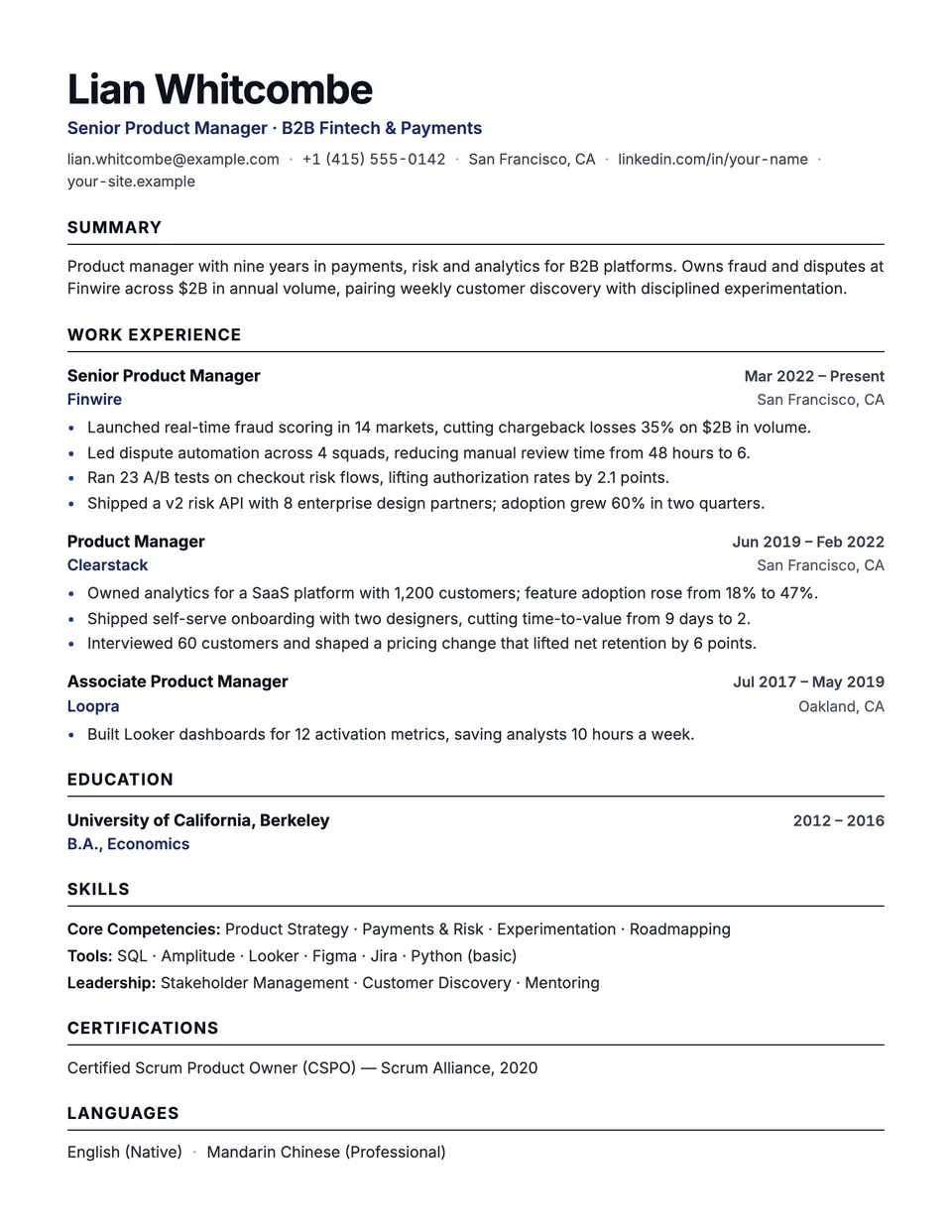
Beacon
A clean default for finance, technology and multinational roles.
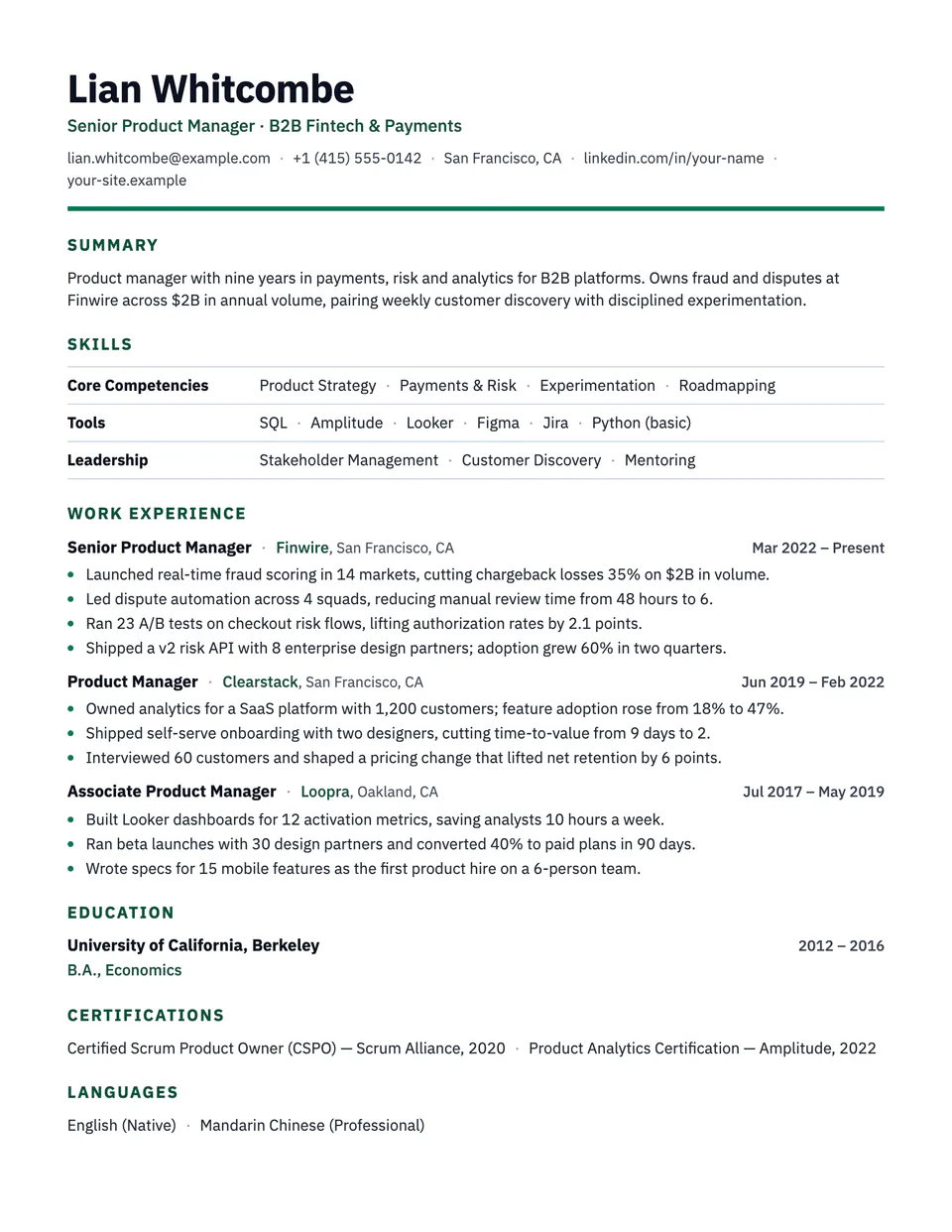
Strata
A skills-based layout with your skill areas up front, for career changers whose transferable skills matter more than past titles.
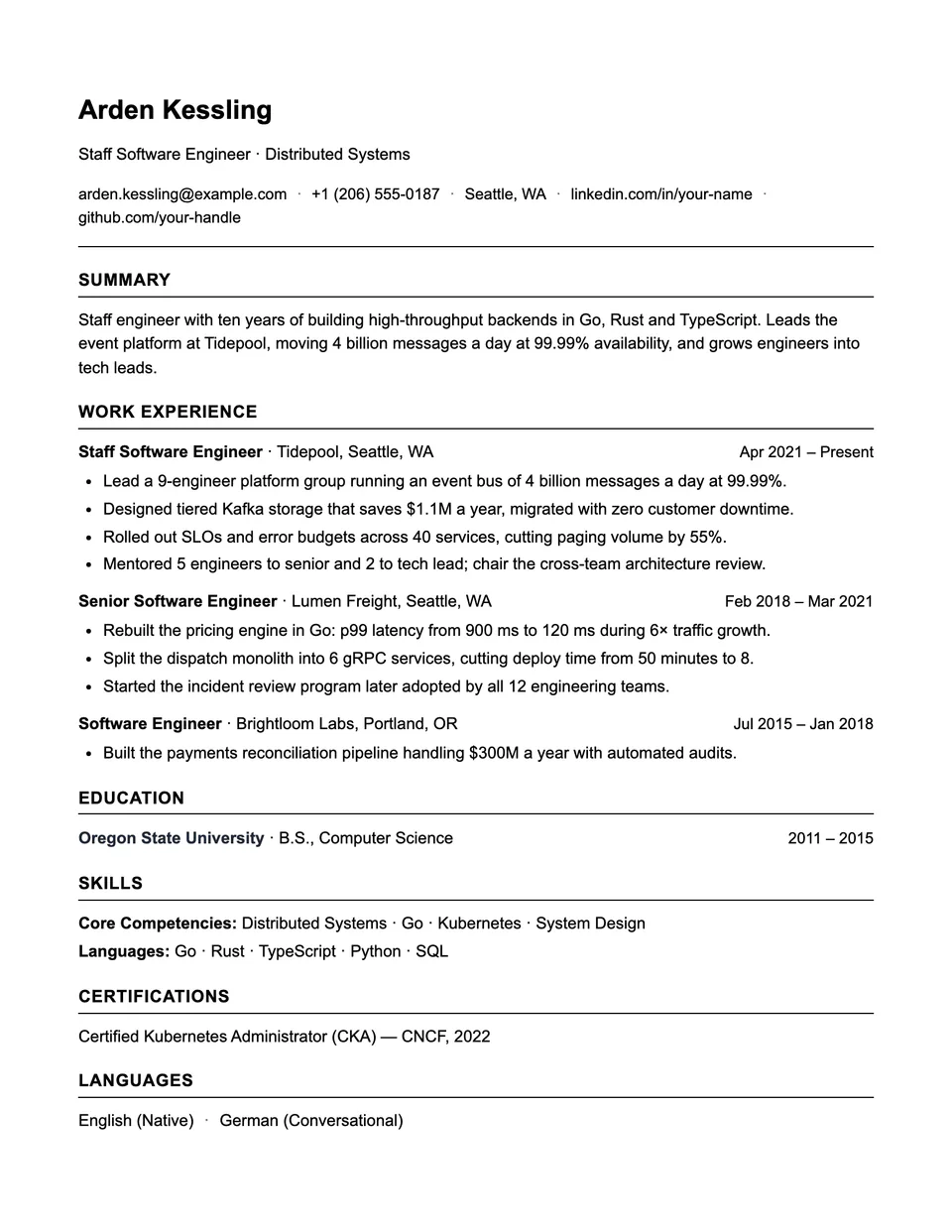
ATS Plain
The plainest layout, for large employers and portals that parse resumes automatically.
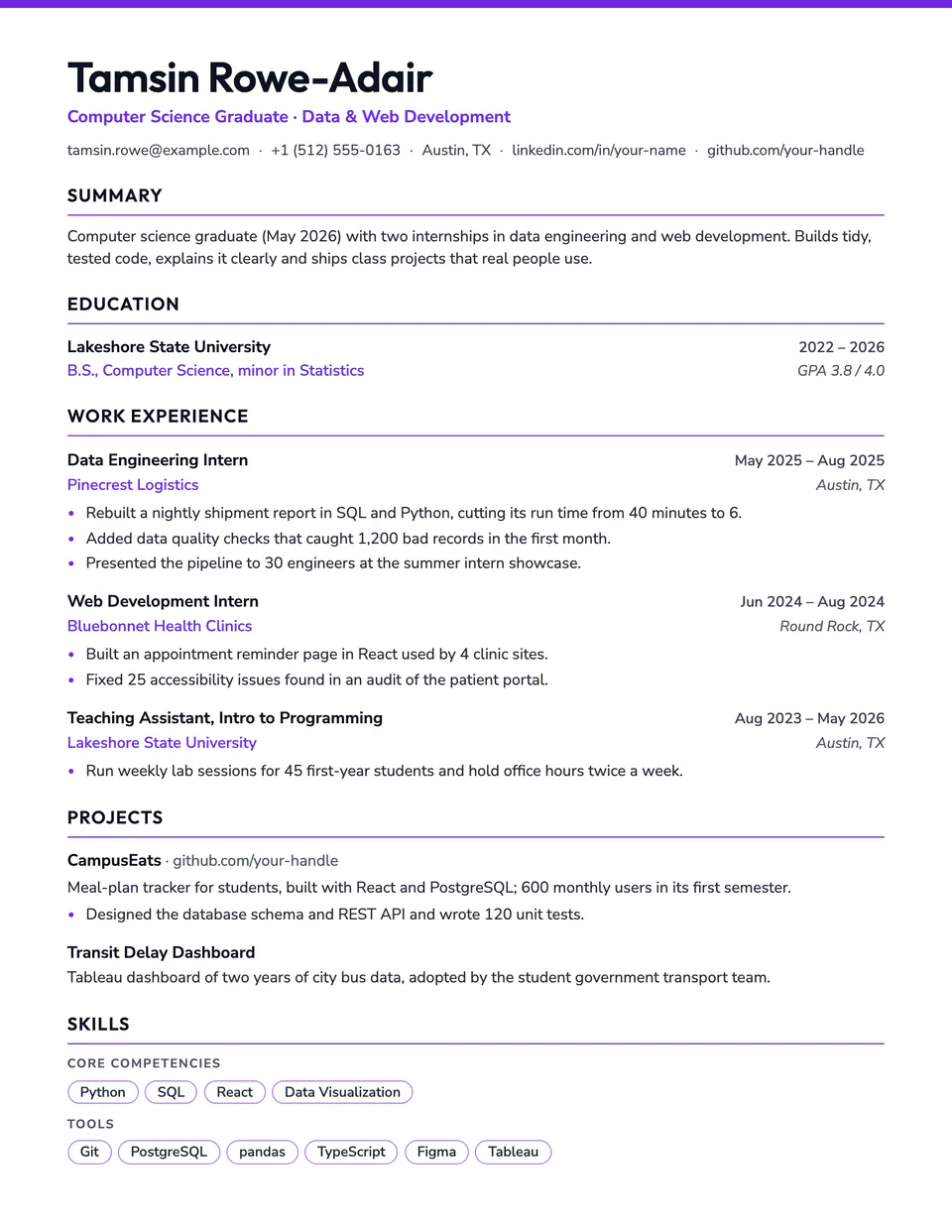
Campus
Gives education, projects and internships the same weight as jobs, for fresh graduates and internship applicants.
Cover letters and the application package
No official guidance makes a cover letter compulsory in Singapore. Send a short one when the posting asks for it or when you apply by email: name the role, connect two or three achievements to its requirements and keep it to one page. The cover letter generator drafts one from the posting in the same design as your resume, and interview prep builds practice questions for the same role.
Where to find jobs in Singapore
MyCareersFuture is the government's online career portal for job seekers. Employers who want to hire a foreign professional on an Employment Pass must normally advertise the role on MyCareersFuture first, under the Fair Consideration Framework. Private boards such as JobStreet, LinkedIn and Indeed also list many Singapore roles.[3][5][6]
Applying from abroad
Employers engaging foreigners to work in Singapore must make sure they hold a valid work pass. The Ministry of Manpower lists the options; the Employment Pass is for foreign professionals, managers, executives and technicians. The employer or its appointed employment agent applies, with your written consent, and eligibility is assessed in stages that include the COMPASS points framework. Check current criteria on the MOM work passes pages rather than relying on figures quoted elsewhere.
Your qualifications matter in that assessment. Employers must make sure a candidate's qualifications are authentic and awarded by accredited institutions, and non-English documents must be uploaded with an English translation. List your degree exactly as it appears on the certificate, with the institution's full name, so the details match.[4][5][6][7][8]
Common mistakes on Singapore resumes
- Including a photo, NRIC number, date of birth, race or religion out of old habit.
- Listing daily duties instead of achievements.
- Heavy blocks of text where short bullet points would do.
- Generic words like "motivated", "team player" and "passionate" without evidence.
- Sending one generic resume to every posting.
- Overstating results: exaggeration is easy to spot and hard to defend at interview.
Frequently asked questions
- Should I put a photo on my resume in Singapore?
- No. TAFEP's guidance tells employers to remove photo fields from job application forms and to ask for a photo only at the job offer stage, or with a clear reason. A photo can reveal age, gender and race, which TAFEP also lists among the fields employers should remove. Use the space for another achievement instead.
- Do I need to include my NRIC number or date of birth?
- No. TAFEP tells employers not to ask for age-related details such as NRIC number and date of birth on application forms, because an NRIC number can reveal a person's age. If an employer needs your NRIC for a specific purpose, it should ask at the offer stage. Keep personal details to name and contact information.
- How long should a Singapore resume be?
- There is no official length. Government career guidance focuses on what reads well: short, concise descriptions and your best achievements in the top half of the first page. For most professionals that means one to two pages. Fresh graduates can usually fit everything on one page.
- Should I mention my nationality or work pass status?
- Race does not belong on a resume. If you are applying from overseas, though, a short line such as "Requires Employment Pass" or your current pass type helps the employer plan, because they apply for the pass on your behalf. Check the Ministry of Manpower's pages for which pass fits the role.
- Is a Singapore resume different from a UK or US one?
- The structure is close: reverse-chronological, no photo and tailored to the job. The main local differences are the leftover habit of adding NRIC, race and date of birth, which you should drop, and the work pass questions for foreign applicants. Compare with the UK CV format guide if you are adapting an existing CV.
Sources
Statements about rules and official guidance rely on these pages. We opened and read each source ourselves on the date shown.
- [1]Preparing job application forms · Tripartite Alliance for Fair and Progressive Employment Practices (TAFEP)www.tal.sg/tafep/employment-practices/recruitment/preparing-job-application-forms ·
- [2]Writing a Resume: Dos and Don'ts to Keep it Interesting for Employers · CareersCompass by MyCareersFuture (Skills & Workforce Development Agency)www.content.mycareersfuture.gov.sg/writing-a-resume-dos-and-donts-to-keep-it-interesting-for-employers ·
- [3]MyCareersFuture · Government Technology Agency (GovTech)www.tech.gov.sg/products-and-services/for-citizens/employment/mycareersfuture/ ·
- [4]Work passes and permits · Ministry of Manpowerwww.mom.gov.sg/passes-and-permits ·
- [5]Employment Pass · Ministry of Manpowerwww.mom.gov.sg/passes-and-permits/employment-pass ·
- [6]Employment Pass eligibility · Ministry of Manpowerwww.mom.gov.sg/passes-and-permits/employment-pass/eligibility ·
- [7]Apply for an Employment Pass · Ministry of Manpowerwww.mom.gov.sg/passes-and-permits/employment-pass/apply-for-a-pass ·
- [8]Employment Pass: documents required · Ministry of Manpowerwww.mom.gov.sg/passes-and-permits/employment-pass/documents-required ·
Keep reading
Applying in Singapore? Check your resume first
The free checker reviews contact details, headings, dates and length, and lists what to fix before a recruiter sees it.