Country guide
UK CV format: how to write a CV for jobs in the United Kingdom
British employers expect a CV, not a resume, and they expect it short, tailored and free of personal details that have nothing to do with the job. Here are the conventions UK careers services publish, what equality law means for your CV, and what to know when applying from abroad.
What is the standard CV format in the UK?
A UK CV is usually no longer than two A4 pages. It opens with your name and contact details and a few lines that sum up who you are, then lists work history and education with the most recent first. Leave out your photo, age, date of birth, marital status and nationality, and send a tailored cover letter with it.[1][2][3]
UK CV conventions at a glance
| Topic | Usual in the UK |
|---|---|
| Name of the document | CV (curriculum vitae). Public careers services use "CV"; "resume" is the American term. |
| Length | No longer than two A4 pages for most roles; shorter for part-time jobs, sometimes longer for academic or very senior roles. |
| Photo | Not needed unless you are applying for acting or modelling work. |
| Personal details | Name, phone, email and location. Leave out age, date of birth, marital status and nationality. |
| Order | Most recent experience first. Move work history above education once you have substantial experience. |
| Dates | Include the dates of each job and course; month and year is enough. |
| References | Optional. Never list a referee's contact details; "references available on request" is assumed. |
| Cover letter | Expected with every CV application, usually 3 to 5 paragraphs, written fresh for each job. |
| Application software | Large-volume recruiters often screen CVs with an applicant tracking system, so use the advert's keywords and avoid images and graphics. |
Layout and structure: what goes where
There is no official template, but the National Careers Service and Prospects describe the same building blocks. A reverse-chronological layout, one column and plain headings is the safest choice for most UK applications.
| Section | What to include | Tip |
|---|---|---|
| Contact details | Name, phone number, email, town or city. A LinkedIn URL if it is up to date. | Prospects advises against putting your home address on a CV you post online. |
| Profile (introduction) | A few short lines under your name that sum up who you are and what you want to do next. | Write it for the sector you are applying to, not for every job at once. |
| Work history | Job title, employer, dates, then achievements as bullet points. | Most recent first. Show results, not a list of duties. |
| Education | Qualifications, institution, dates; grades where they help. | Early in your career, education can sit above work history. |
| Skills and achievements | Software, languages, licences and certifications the advert asks for. | Name qualifications specifically, as they appear in the job advert. |
| Interests | Optional: only interests that show a relevant skill. | Leave them out if space is short. |
| References | Optional line, no referee contact details. | Drop it if you need the space. |
Want to see the structure filled in? Browse resume examples by job, such as the project manager example, and adapt the spelling and terminology to British English.
Photo, age and personal data: what the law says
UK careers guidance is clear: do not include your age, date of birth, marital status or nationality, and leave out a photo unless you are applying for acting or modelling work. The reason is partly legal. Under the Equality Act 2010, age, disability, gender reassignment, marriage and civil partnership, pregnancy and maternity, race, religion or belief, sex and sexual orientation are protected characteristics.
GOV.UK's guidance for employers says they must not ask candidates about protected characteristics, or whether they are married, in a civil partnership or have or plan to have children. An employer can only ask for your date of birth on an application form if you must be a certain age for the job; otherwise it belongs on a separate equality monitoring form that the people selecting candidates should not see.
The Equality Act does not, in general, extend to Northern Ireland, which has its own equality law.[1][3][4][5][6]
A skeleton UK CV
A one-page outline for an experienced professional. All data is placeholder text.
Header
[Name Surname]
Manchester · 07700 900123 · your-name@example.com
linkedin.com/in/your-name
Profile
Operations manager with seven years in logistics. Runs multi-site teams and cuts cost without cutting service. Looking for a regional role in the North West.
Work history
Mar 2021 – Present · Operations Manager, [Company], Manchester
Led a team of 24 across two warehouses; reduced late deliveries by redesigning the shift pattern.
Sep 2017 – Feb 2021 · Shift Supervisor, [Company], Bolton
Education
2017 · BSc (Hons) Business Management, [University]
Skills
SAP · Power BI · Health and safety (IOSH Managing Safely) · Full UK driving licence
References
Available on request
Example with placeholder details, not a real person
The figures are illustrative; use only numbers you can explain at interview.
How to write a UK CV in six steps
Start from the job advert, not from your old CV.
- 01
Read the advert like a recruiter
Highlight the skills and qualifications the employer names. The free job description keyword matcher shows which of them are missing from your CV.
- 02
Pick a clean, single-column layout
Two A4 pages at most, a standard font at size 11 or above, plain headings. No photo, logos or text boxes.
- 03
Write a short profile
Three or four lines under your name: who you are professionally, what you are good at, what you want next, in the employer's terms.
- 04
List your experience, most recent first
Job title, employer, month and year, then three to five achievements per role. Start bullets with a verb and show the result.
- 05
Remove what UK employers should not see
Delete date of birth, age, marital status, nationality and photo. Keep referees' details off the page.
- 06
Tailor, check and send with a cover letter
Adjust the CV for each job; optimise your resume for one posting to do it quickly. Run it through the free CV checker, then save it with a clear file name and the format the advert asks for.
Templates that suit UK applications
Photo-free, single-column layouts that read cleanly for recruiters and application software. See every design in the template gallery.
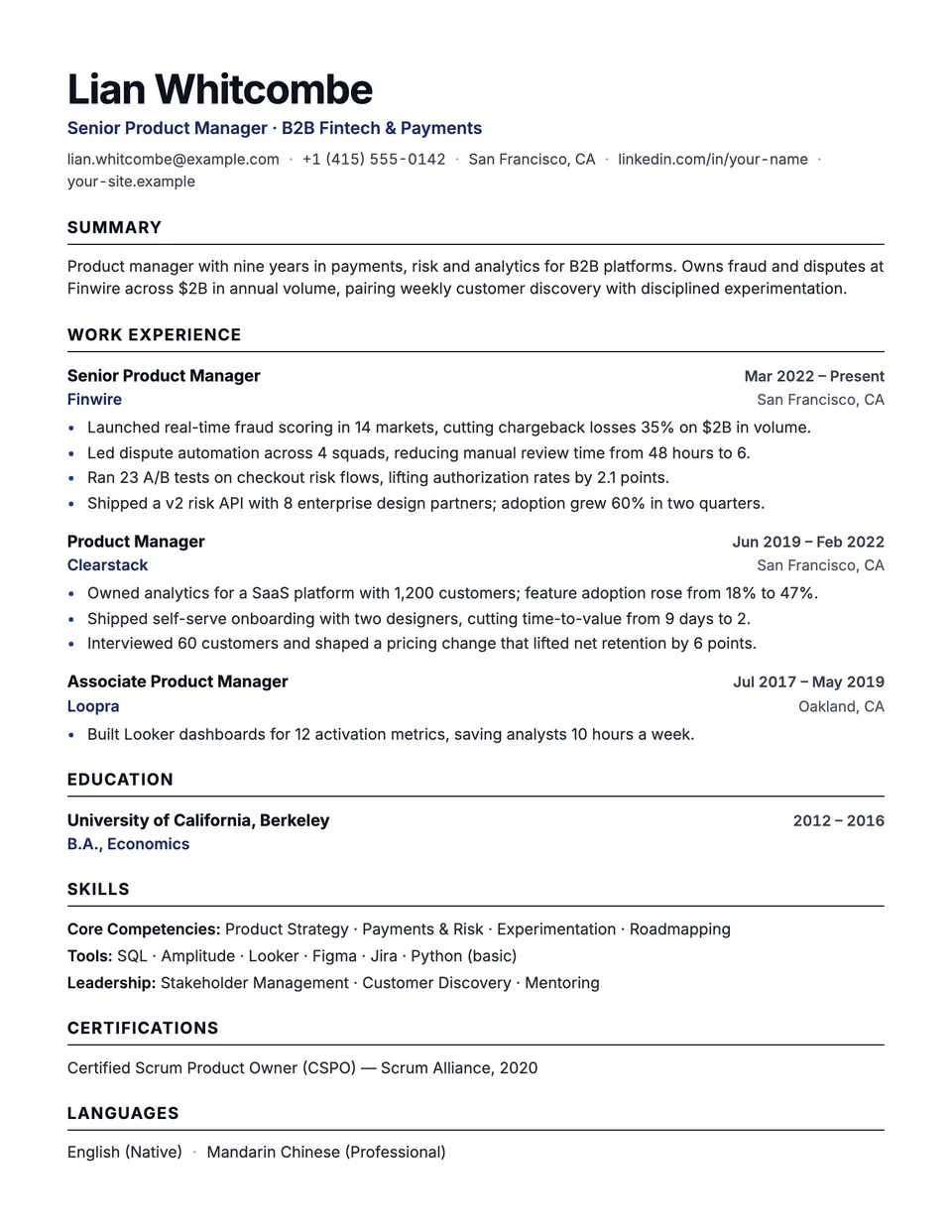
Beacon
A calm one-column layout with clear headings, suited to most office, public-sector and graduate roles.
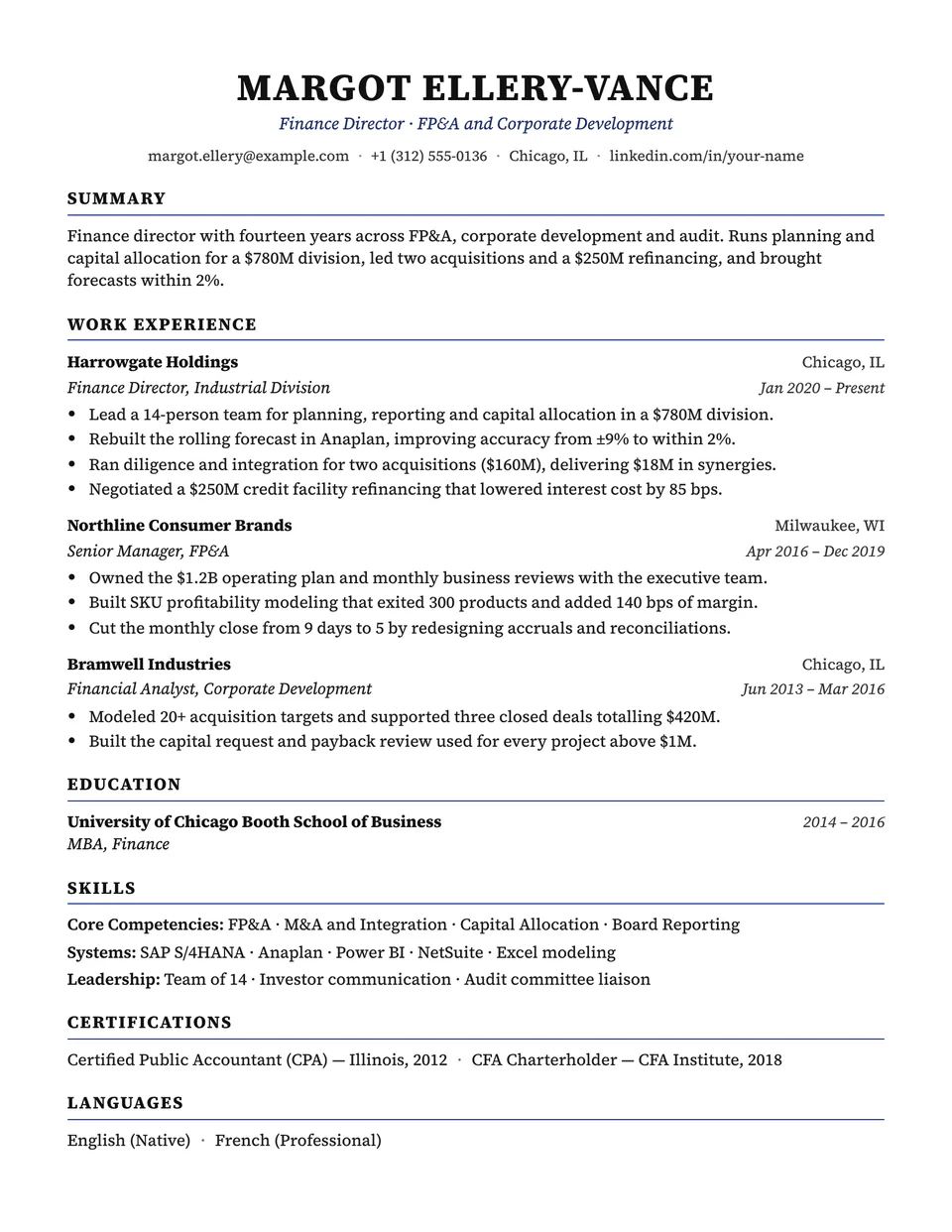
Charter
Traditional serif styling that fits law, finance and other conservative sectors.
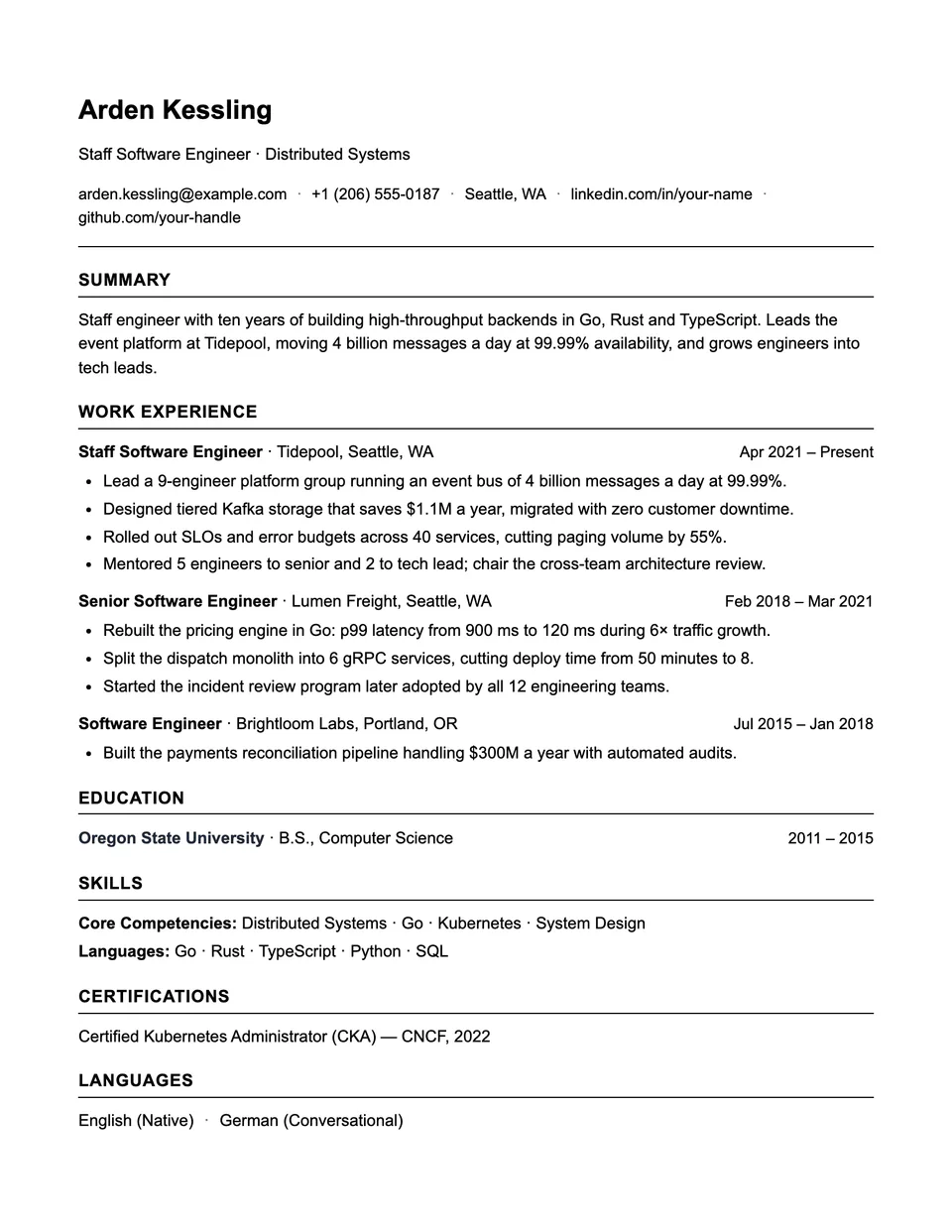
ATS Plain
The plainest structure, for large employers and agencies that screen CVs through online systems.
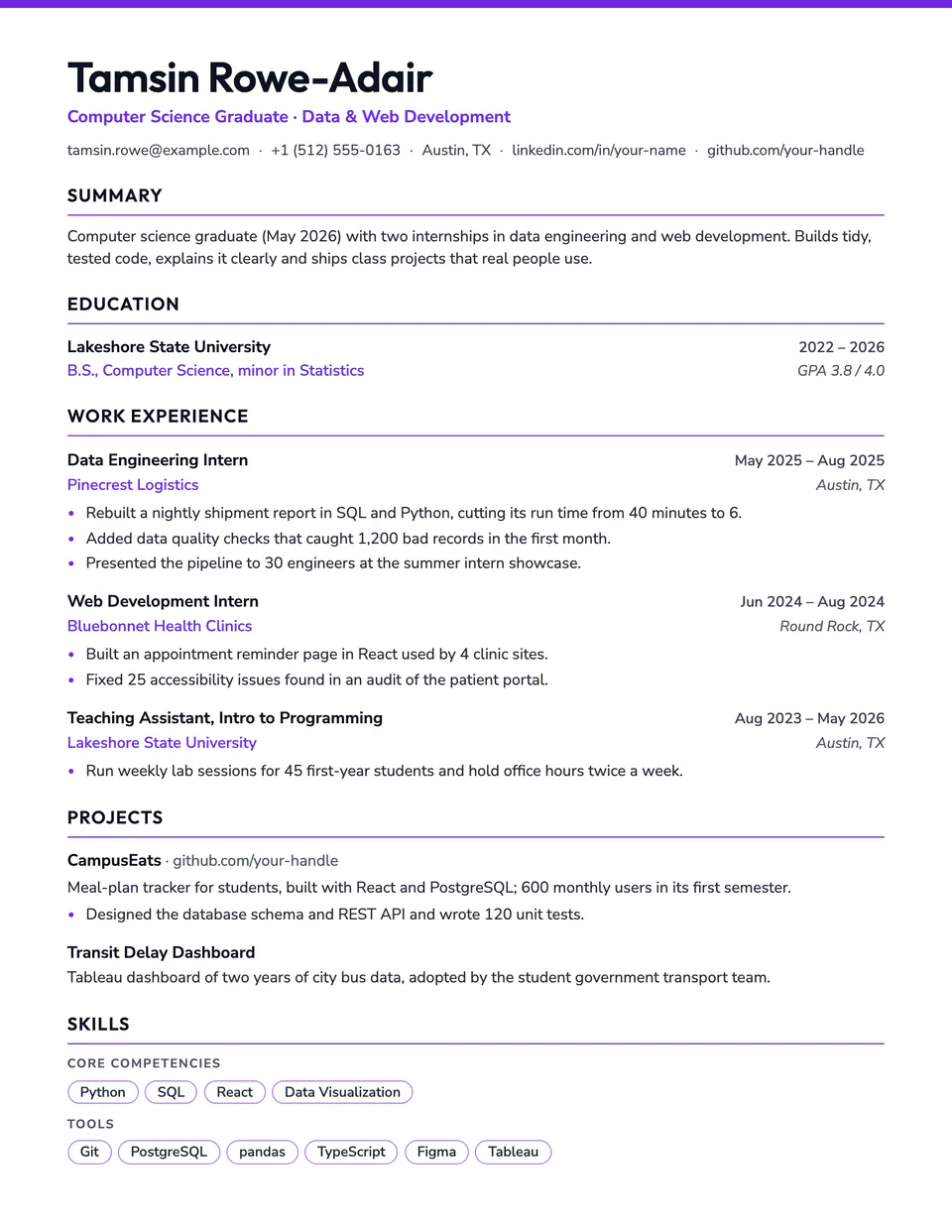
Campus
Gives education, projects and internships the same weight as jobs, for students and graduates applying to graduate schemes.
The cover letter: expected, not optional
The National Careers Service says you should always include a cover letter when you apply for a job with a CV. Keep it to three to five paragraphs: introduce yourself and the role (with the reference number if there is one), show how your skills match what the employer wants, add anything useful such as context for a career gap, and close by pointing to your CV.
Address a named person where you can; otherwise "Dear Sir or Madam" with "Yours faithfully". Write a new letter for each job. In Ruubu the cover letter generator drafts one from the job advert in the same design as your CV.[2]
Where to find jobs in the UK
The government's Find a job service lists full and part-time vacancies in England, Scotland and Wales; Northern Ireland has its own service, JobApplyNI. Both are linked from GOV.UK Find a job. Private boards such as Indeed, Reed, Totaljobs and LinkedIn also list many UK roles.[7]
Applying from abroad
Every UK employer must check that an applicant is allowed to work in the UK before employing them, and GOV.UK's guidance tells employers they must not discriminate against anyone because of where they are from. If you need sponsorship, the main route is the Skilled Worker visa: you need a confirmed job offer from a UK employer approved by the Home Office, a certificate of sponsorship from that employer, and you must usually prove your English. Other routes, some of which do not need a job offer, are listed on the GOV.UK work visas page. Check eligibility there; rules change.
If your degree is from outside the UK, UK ENIC, the official agency for recognising international qualifications, issues a Statement of Comparability that compares it with the UK system. Put the UK equivalent next to the original title, and state your visa status in one line if you have one.[8][9][10][11]
Common mistakes on UK CVs
- Adding a photo, date of birth or marital status out of habit from another country.
- Listing duties ("responsible for…") instead of results.
- Sending the same CV and letter to every employer instead of tailoring both.
- Burying key skills in images, text boxes or two-column graphics that screening software may not read.
Frequently asked questions
- Should I put a photo on my CV in the UK?
- No. UK careers guidance says you do not need a photograph unless you are applying for acting or modelling work. GOV.UK tells employers not to ask about protected characteristics under the Equality Act 2010, such as age, race or sex, and a photo reveals several of them at once.
- How long should a UK CV be?
- Prospects recommends no longer than two A4 pages. A graduate or someone applying for a part-time job can often fit everything on one page; senior and academic CVs sometimes run longer. Over two pages? Cut older roles to one line each.
- Do I need to include my date of birth or nationality?
- No. The National Careers Service says not to include your age, date of birth, marital status or nationality. Employers may ask for your date of birth on an application form only where the job has an age requirement. Your right to work is checked separately; if you have a visa, you can mention your status briefly.
- Should I write "references available on request"?
- It is optional. The National Careers Service suggests it as an alternative to listing referees, and stresses that you should not put someone else's contact details on your CV. Prospects notes that employers usually assume references are available, so you can drop the line if you need the space for more relevant content.
- Is a CV for the UK different from a US resume?
- Mostly in conventions. A UK CV is usually up to two A4 pages, uses British spelling and comes with a cover letter; both leave out photos and personal data. Adapting a US resume? Our US resume format guide covers the differences.
Sources
Statements about rules and official guidance rely on these pages. We opened and read each source ourselves on the date shown.
- [1]How to write a CV · National Careers Servicenationalcareers.service.gov.uk/careers-advice/cv-sections ·
- [2]How to write a cover letter · National Careers Servicenationalcareers.service.gov.uk/careers-advice/covering-letter ·
- [3]How to write a CV · Prospects (Jisc)www.prospects.ac.uk/careers-advice/cvs-and-cover-letters/how-to-write-a-cv ·
- [4]Equality Act 2010, section 4: The protected characteristics · legislation.gov.ukwww.legislation.gov.uk/ukpga/2010/15/section/4 ·
- [5]Equality Act 2010, section 217: Extent · legislation.gov.ukwww.legislation.gov.uk/ukpga/2010/15/section/217 ·
- [6]Employers: preventing discrimination – Recruitment · GOV.UKwww.gov.uk/employer-preventing-discrimination/recruitment ·
- [7]Find a job · GOV.UKwww.gov.uk/find-a-job ·
- [8]Check a job applicant's right to work · GOV.UKwww.gov.uk/check-job-applicant-right-to-work ·
- [9]Skilled Worker visa · GOV.UKwww.gov.uk/skilled-worker-visa ·
- [10]Work visas · GOV.UKwww.gov.uk/browse/visas-immigration/work-visas ·
- [11]UK ENIC: recognition of international qualifications · UK ENIC (managed by Ecctis for the UK government)www.enic.org.uk/ ·
Keep reading
Ready to send your UK CV?
Check it first. The free checker reviews your contact details, headings, dates and length, then lists what to fix before a recruiter sees it.