Country guide
Spanish CV format: how to write a CV for Spain
In Spain the CV, usually called the currículum, is a concise document of up to two A4 pages that travels with a short cover letter. This guide covers layout, photos and personal data, the application package and what changes when you apply from abroad.
What is the standard CV format in Spain?
A Spanish CV is typed, in Spanish unless the ad says otherwise, and ideally no longer than two A4 pages. There is no single template: put experience first if it matters more than your studies, and adapt the CV to each offer. A photo is not compulsory but can help for some jobs, and certificates are usually brought to the interview rather than attached.[1]
Spanish CV rules at a glance
| Topic | Usual in Spain |
|---|---|
| Name of the document | Currículum (vitae) or CV. The cover letter is the carta de presentación. |
| Length | Ideally no more than two A4 pages. |
| Language | Spanish, unless the job offer indicates another language. |
| Order | Most recent first if you have a lot of experience; functional order if you have worked in very different sectors. |
| Photo | Not compulsory; EURES notes it may be useful for some jobs. |
| Personal details | Name, city, phone, email and LinkedIn. Marital status and ID numbers are not needed. |
| Dates | Keep one format throughout; month and year (03/2022 – present) is common. |
| Certificates | Not attached unless requested; they are usually brought to the interview. |
| Europass | The EU's free CV editor, which EURES points to for Spanish applications. |
| Applicant tracking | Some companies use their own application forms; use the words of the offer and avoid acronyms. |
Layout and structure of a Spanish CV
EURES, the EU's job mobility network, states that there is no single template for a Spanish CV and that it should be adapted to each job offer. You may change the order of the sections, for example putting experience before education when experience matters more for the role. It describes three basic orders: ascending chronological to show progress when you have little experience, descending chronological (most recent first) when you have a lot of experience or want a similar job, and functional when you have worked in sectors that are not clearly linked.
The CV should be typed, well laid out, clear and concise, ideally within two A4 pages. EURES recommends direct language, simple sentences and no acronyms or abbreviations. A typical order is contact details and a short profile, work experience with two to four achievements per job, education, languages with CEFR levels (A1 to C2) and skills.
Because each version should answer one offer, rebuild your profile and achievements around the posting with the job-specific resume optimizer.[1]
Photo and personal data: custom versus law
Article 4.2.c of Spain's Workers' Statute (Estatuto de los Trabajadores) gives workers the right not to be discriminated against, directly or indirectly, in access to employment on grounds of marital status, age, racial or ethnic origin, social condition, religion or beliefs, political ideas, sexual orientation and identity, trade union membership, language within Spain, disability or sex. Article 17 declares null and void any employer decision that causes such discrimination.
EURES says it is not compulsory to attach a photograph, although it may be useful for some jobs. You can leave out details the law protects and the employer does not need at this stage: marital status, children, religion, and identity numbers such as your DNI, NIE or social security number. If you add a photo for a customer-facing role, keep it recent and professional; the AI headshot generator can create one from your own selfies.[1][2]
Sample skeleton: a Spanish CV
A one-page structure with placeholder data. Replace every line with your own details.
Datos de contacto (contact details)
[Nombre Apellido] · Accounts Assistant
Valencia · +34 6xx xxx xxx · your-name@example.com
linkedin.com/in/your-name
Perfil (profile)
Accounts assistant with four years in supplier accounting and invoicing, used to SAP and month-end closing.
Experiencia profesional
03/2022 – actualidad · Accounts Assistant, [Company A], Valencia
· Reconciled supplier accounts monthly and flagged duplicate invoices before payment
09/2019 – 02/2022 · Administrative Assistant, [Company B], Porto (Portugal)
Formación
2019 · Bachelor's degree in Business Administration, [University], Porto
Idiomas y competencias
Portuguese (native) · Spanish (C1) · English (B2)
SAP FI, Excel (pivot tables)
Example with placeholder details, not a real person
No signature, no ID numbers, no marital status. The sample data is illustrative only.
The application package: carta de presentación
Some companies use their own application form, but EURES notes that it is common practice to send a CV and a cover letter, both for advertised jobs and speculative applications. Unless otherwise indicated, both should be in Spanish, typed and on A4. The letter should be concise and formal, written for the company and the offer: avoid standard letters that could go to any employer. Highlight the parts of your CV that answer the company's needs.
Selection is usually based on interviews, sometimes with psychometric or job-related tests, and EURES warns that companies often only contact candidates who pass the selection stage. The cover letter builder writes your letter in the same design as your CV, and interview prep prepares likely questions from the offer.[1]
Where to find jobs in Spain
The State Public Employment Service, SEPE, works with the employment services of the autonomous communities, whose websites publish vacancies, training courses and job-search guides. Empléate brings together vacancies from public and private job sites in one place. Private boards such as InfoJobs, Indeed and LinkedIn list many roles.[1]
How to write a CV for Spain in six steps
Use these steps for a first Spanish CV or to adapt a resume written for another country.
- 01
Read the offer closely
Note the language, the tasks, tools and requirements. The JD keyword matcher lists the terms your CV is missing.
- 02
Pick the order
Most recent first if you have solid experience, ascending if you are starting out, functional if your sectors are unrelated.
- 03
Write the header and profile
Name, target role, city, phone, email and LinkedIn, then three lines on who you are professionally. No ID numbers.
- 04
Describe achievements, not duties
Two to four lines per job, starting with a verb. Use simple sentences and spell out acronyms.
- 05
Add education, languages and skills
Give language levels on the CEFR scale and explain foreign degrees in one line if the name is not known in Spain.
- 06
Check, export and write the letter
Run the free resume checker, save as PDF and add a short, formal carta de presentación for this company.
Templates that suit Spanish applications
All of these keep a clean, two-page-maximum structure and work with or without a photo. See every layout in the template gallery.
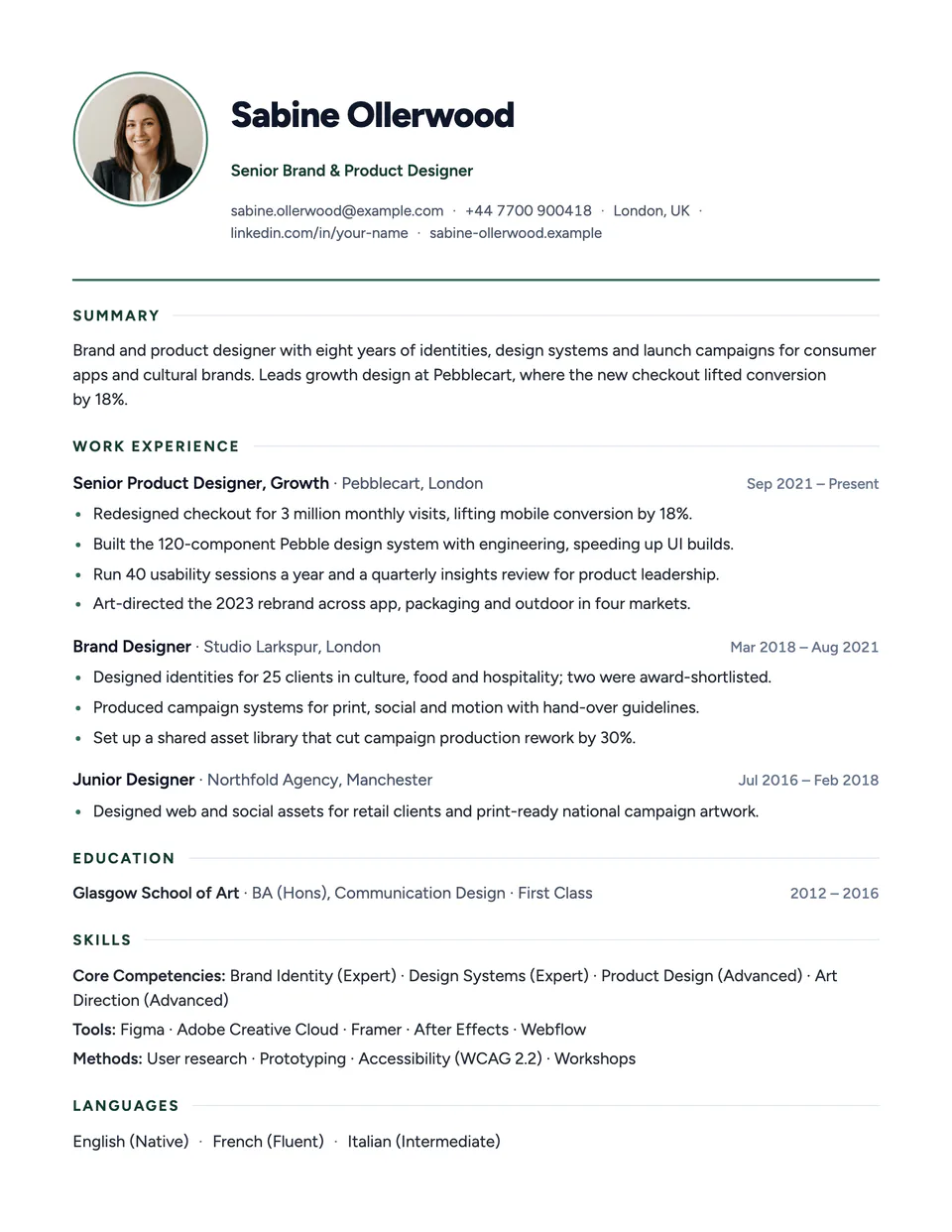
Profile
A round portrait beside your name, for customer-facing roles where a photo can help.
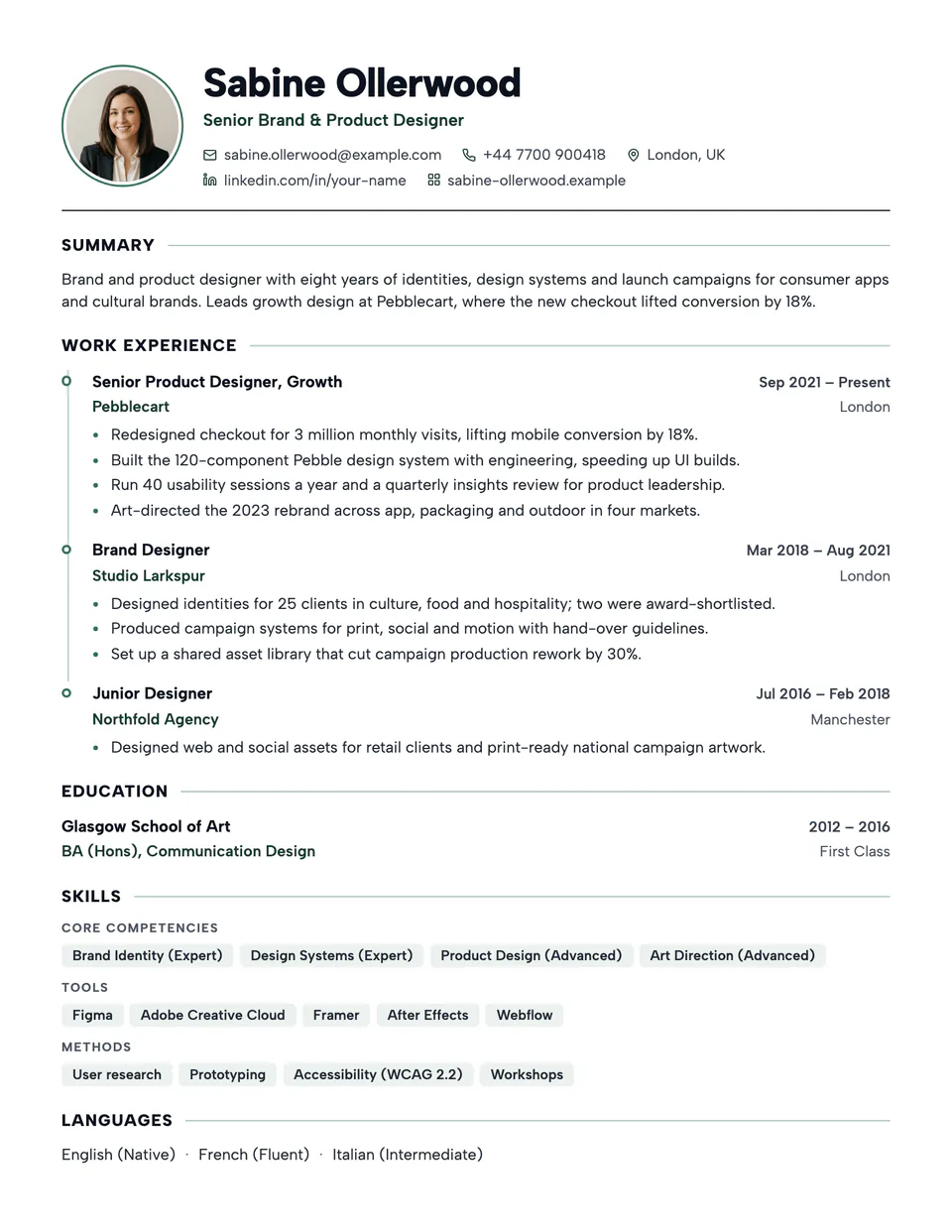
Lumen
Photo, contact icons and a fine career line, for candidates who want some design.
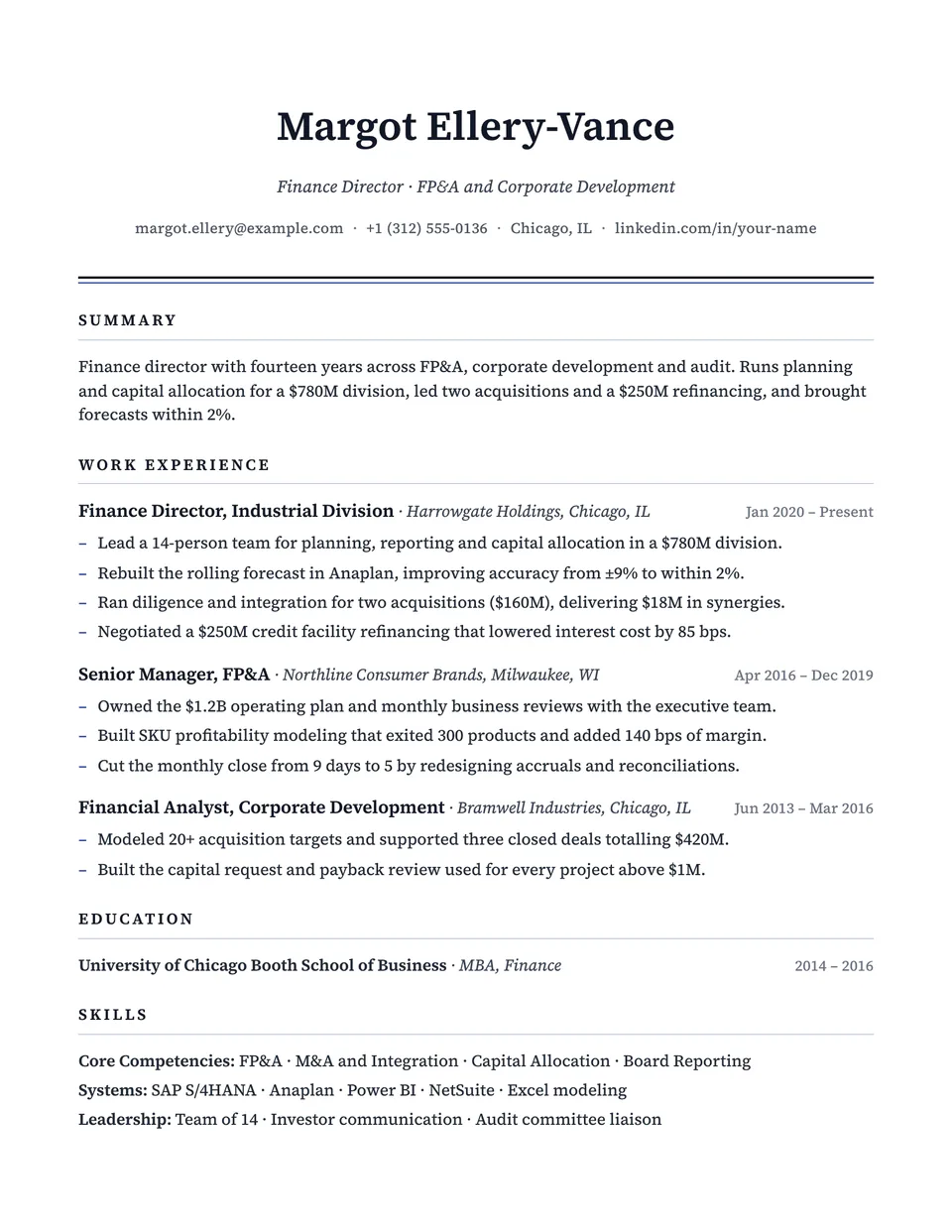
Executive
A sober single-column layout without a photo field, for conservative sectors and formal applications.
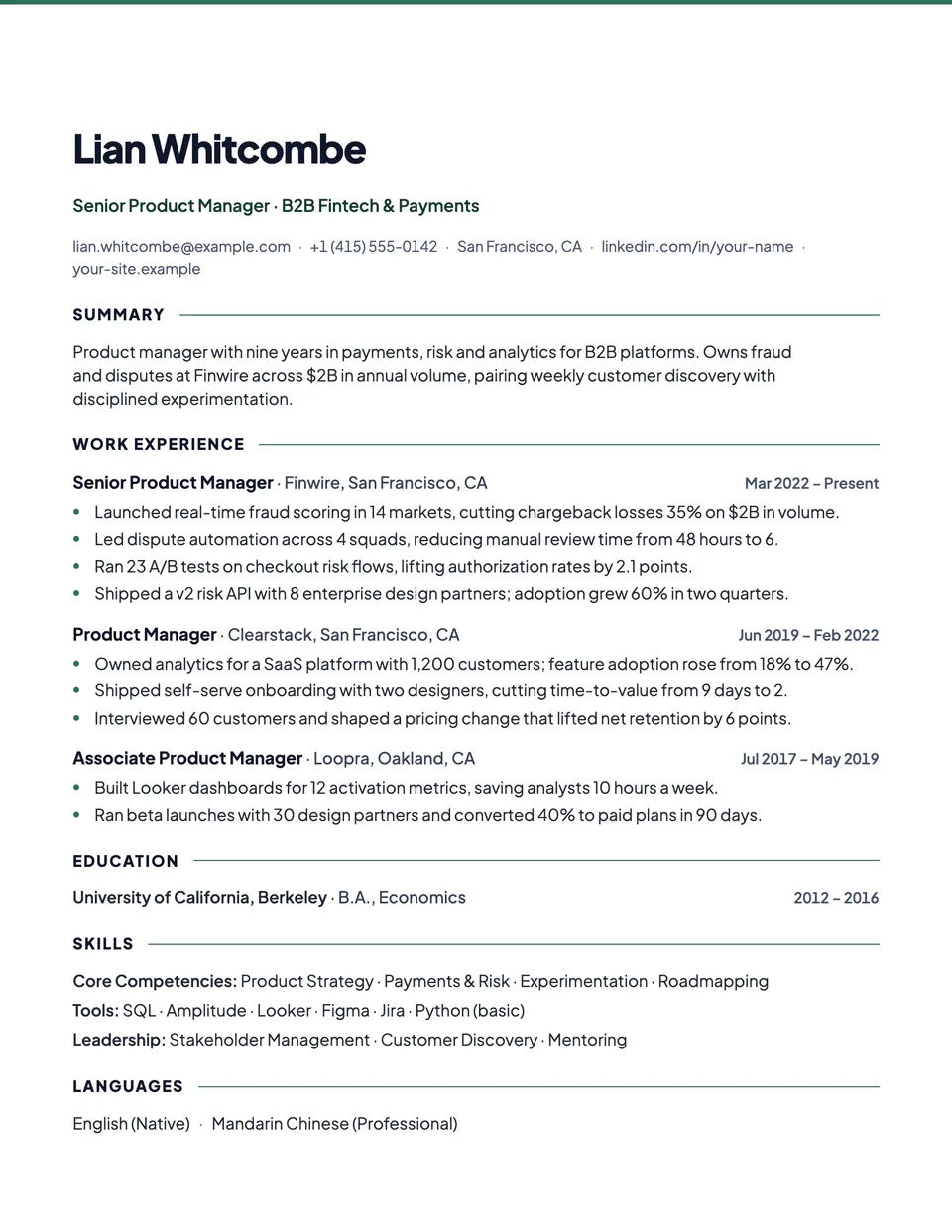
Contemporary
No photo, clear headings and plenty of white space for online forms and large employers.
Applying from abroad: language, recognition and permits
Before travelling to Spain for a job search or interview, EURES suggests carrying a CV in Spanish (in an editable format so you can update it), cover letters, references from previous jobs, your qualifications and, where appropriate, a certified translation of them. Resume translation converts your CV into Spanish while keeping the layout.
Foreign university degrees are recognised under Royal Decree 889/2022 in three ways: homologación, which qualifies you to practise a regulated profession in Spain; a declaration of equivalence, which certifies the academic level (bachelor's or master's); and convalidación, which validates subjects so you can continue studying. EU, EEA and Swiss nationals with qualifications for a regulated profession can apply for recognition under Directive 2005/36/EC, handled by the ministry responsible for that profession.
Citizens of the EU, the EEA and Switzerland can enter with a valid ID card or passport and stay to look for work; anyone with economic or professional interests in Spain needs a foreign resident identification number (NIE). EURES states that people who are not from Switzerland or an EEA country need a residence permit to live in Spain and should contact the Spanish embassy in their country of origin or the Spanish government's immigration portal.[1][3]
Common mistakes on a Spanish CV
- Sending a CV in English when the offer is written in Spanish and does not ask for another language.
- Going beyond two A4 pages or listing every job in detail.
- Adding a DNI, NIE or social security number, marital status or children.
- Attaching photocopies of certificates that nobody asked for.
- Using internal acronyms and job titles that nobody outside your company understands.
- Sending a standard cover letter that could go to any employer.
Frequently asked questions
- Do I need a photo on a Spanish CV?
- No. EURES states that it is not compulsory to attach a photograph to a Spanish CV, although it may be useful for some jobs. The Workers' Statute protects applicants against discrimination on grounds such as age, origin and sex. If you add a photo, use a recent, professional one, and leave it out when the employer asks for a CV without a picture.
- How long should a CV be in Spain?
- Ideally no more than two A4 pages, according to EURES. What matters is that the parts relevant to the offer are visible immediately. Summarise older or unrelated jobs in one line, and keep sentences simple and direct.
- Should my CV for Spain be in Spanish?
- Yes, unless the job offer indicates otherwise. EURES advises that both the CV and the cover letter be written in Spanish, typed and on A4, and suggests travelling with a Spanish CV in an editable format. If an advert asks for another language, follow it, and state your Spanish level on the CEFR scale.
- Do I need to get my degree recognised to work in Spain?
- Only in some cases. Homologación is required to practise a regulated profession in Spain, while a declaration of equivalence certifies the academic level of your degree, which can help employers understand it. Both are set out in Royal Decree 889/2022. For a non-regulated job, explaining your degree in one line on the CV is usually enough for the application stage.
- Can I use a Europass CV in Spain?
- Yes. EURES mentions the Europass tool for creating a CV online, and the editor is free and available in 31 languages. It works well if you apply in several EU countries. For a single Spanish employer, a concise two-page CV adapted to the offer, as EURES describes, is just as suitable.
Sources
Statements about rules and official guidance rely on these pages. We opened and read each source ourselves on the date shown.
- [1]Living and working conditions: Spain · European Commission, EURESeures.europa.eu/living-and-working/living-and-working-conditions-europe/living-and-working-conditions-spain_en ·
- [2]Workers' Statute (Estatuto de los Trabajadores, Real Decreto Legislativo 2/2015), articles 4.2.c and 17 · Agencia Estatal Boletín Oficial del Estado (BOE)www.boe.es/buscar/act.php?id=BOE-A-2015-11430 ·
- [3]¿Cómo reconocer un título universitario extranjero en España? · Ministry of Science, Innovation and Universitieswww.ciencia.gob.es/Universidades/validate/como_reconocer.html ·
- [4]About Europass · European Commission, Europasseuropass.europa.eu/en/about-europass ·
Keep reading
Applying in Spain? Check your CV first
Upload your CV for a free check of structure, length and contact details, then tailor it to the offer you want.