Country guide
Portuguese CV format: how to write a CV for Portugal
A Portuguese CV is short, reverse-chronological and often carries a photo, and many employers receive it through online forms or a brief email. This guide covers layout, photos and personal data, the cover letter and what changes when you apply from abroad.
What is the standard CV format in Portugal?
A Portuguese CV is usually reverse chronological and one or two pages long, with your strongest achievements in the top half of the first page. Give your town and country rather than a full address. A photo is often appreciated but optional. If you do not speak Portuguese, you can write it in English. Copies of certificates are only needed later in the recruitment.[1]
Portuguese CV rules at a glance
| Topic | Usual in Portugal |
|---|---|
| Name of the document | CV or currículo; the cover letter is the carta de apresentação or carta de candidatura. |
| Length | One or two pages. |
| Order | Reverse chronological; functional and one-page infographic CVs are increasingly used. |
| Photo | Often appreciated, not required. |
| Personal details | Town and country (not the full address), mobile, email, LinkedIn or portfolio if relevant. |
| Dates | Month and year for each job (03/2022 – present) is the usual practice. |
| Language | Portuguese, or English if you do not speak Portuguese. |
| Cover letter | Short and never more than one A4 page; increasingly replaced by the email text. |
| References | Not attached; bring diplomas, work certificates and recommendations to the interview. |
| Europass | The EU's free CV editor in 31 languages; fine for multi-country applications. |
| Applicant tracking | Online application forms are widely used; mirror the keywords of the posting. |
Layout and structure of a Portuguese CV
EURES, the EU's job mobility network, describes the Portuguese CV as generally reverse chronological and one or two pages long. Functional CVs for broad experience and one-page infographic CVs for young people are increasingly used. Because the aim is to catch the recruiter's attention, put your greatest achievements in the top half of the first page.
It lists six blocks: personal information and contact details; work experience; education, meaning your highest level of schooling; vocational training as a separate category, with courses, traineeships and professional cards; other skills such as languages, IT and a driving licence where the job requires one; and optional interests or volunteering. Video CVs of two to three minutes are also increasingly used in some recruitment processes.
Since employers compare your CV with a specific profile, rewrite the top half for each posting with the job-specific resume optimizer.[1]
Photo and personal data: what the Labour Code says
Article 17 of Portugal's Labour Code (Código do Trabalho) states that an employer may not require a job applicant to provide information about their private life, unless it is strictly necessary to assess their suitability for the job and the reasons are given in writing, or about their health or pregnancy, unless the nature of the work justifies it, again with written reasons. Articles 24 and 25 give applicants equal access to employment and ban direct or indirect discrimination on grounds including age, sex, marital status, family situation, nationality, ethnic origin, language, religion and political beliefs. Article 24 explicitly applies to decisions made by algorithms or other artificial intelligence systems as well.
EURES says the inclusion of a photograph is often appreciated, but it remains your choice. Keep personal details to what EURES lists: town and country, phone, email and online profiles. Leave out marital status, date of birth and tax or ID numbers. If you add a photo, make it recent and professional; the AI headshot generator creates one from your own selfies.[1][2]
Sample skeleton: a Portuguese CV
A one-page structure with placeholder data. Replace every line with your own details.
Dados pessoais (personal details)
[Nome Apelido]
Lisboa, Portugal · +351 9xx xxx xxx · your-name@example.com
linkedin.com/in/your-name · Available for video interviews
Perfil (profile)
Front-end developer with four years in e-commerce, used to React, accessibility audits and remote teams.
Experiência profissional
02/2023 – presente · Front-end Developer, [Company A], Lisbon
· Rebuilt the checkout flow and fixed the main accessibility issues found in an audit
07/2021 – 01/2023 · Junior Developer, [Company B], Madrid (Spain)
Formação académica
2021 · Bachelor's degree in Computer Engineering, [University], Madrid
Formação profissional
2022 · Web accessibility course, [Training provider], 40 hours
Outras competências
Spanish (native) · English (C1) · Portuguese (B1)
React, TypeScript, Figma
Example with placeholder details, not a real person
Note the separate vocational training block, which EURES lists as its own category. The sample data is illustrative only.
The application package: short letter, then interview
Application letters in Portugal are short and simple, never more than one A4 page, and highlight with keywords how your experience matches the profile. EURES notes that they are increasingly replaced by the text of the email that carries your CV, and that application forms, often online, are widely used. Copies of qualification certificates are only required later, at recruitment.
The interview is the main selection method and is increasingly held by video call. Bring diplomas, work certificates and recommendations, but present them only when asked. The cover letter builder drafts a short letter or email text in your CV's design, and interview prep prepares likely questions from the posting.[1]
Where to find jobs in Portugal
IEFP, the public employment service for mainland Portugal, runs the iefponline portal, where you can register one or more versions of your CV and browse vacancies. The Azores and Madeira have their own employment services. EURES lists many private boards, among them Net-Empregos, Indeed, Landing.jobs and ITJobs.[1][3]
How to write a CV for Portugal in six steps
Use these steps for a first Portuguese CV or to adapt a resume written for another country.
- 01
Read the posting
Note the language, the profile and how to apply. The JD keyword matcher shows which terms your CV is missing.
- 02
Fill the top half first
Contact details, a short profile and your strongest achievements, all visible without scrolling.
- 03
List experience, newest first
Month and year, position, company and city, then two to four results per job.
- 04
Separate education and training
Highest degree under education; courses, traineeships and professional cards under vocational training.
- 05
Decide on photo and language
A professional photo is often appreciated. Write in Portuguese, or English if you do not speak it.
- 06
Check and send
Run the free resume checker, export a PDF and write a short email or letter for this employer.
Templates that suit Portuguese applications
These layouts keep everything important in the top half of page one and work with or without a photo. See them all in the template gallery.
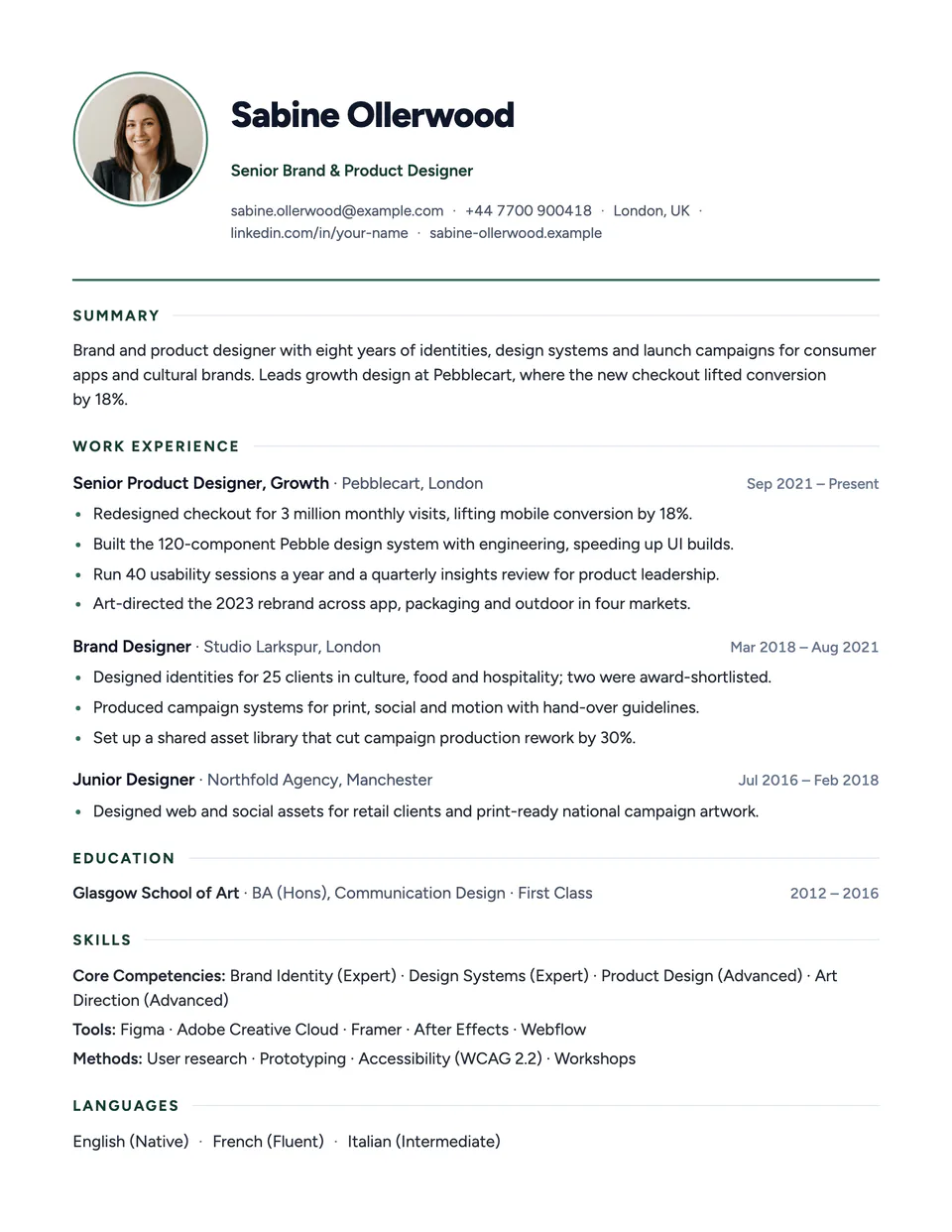
Profile
A round portrait beside your name, the simplest way to add the photo Portuguese recruiters often appreciate.
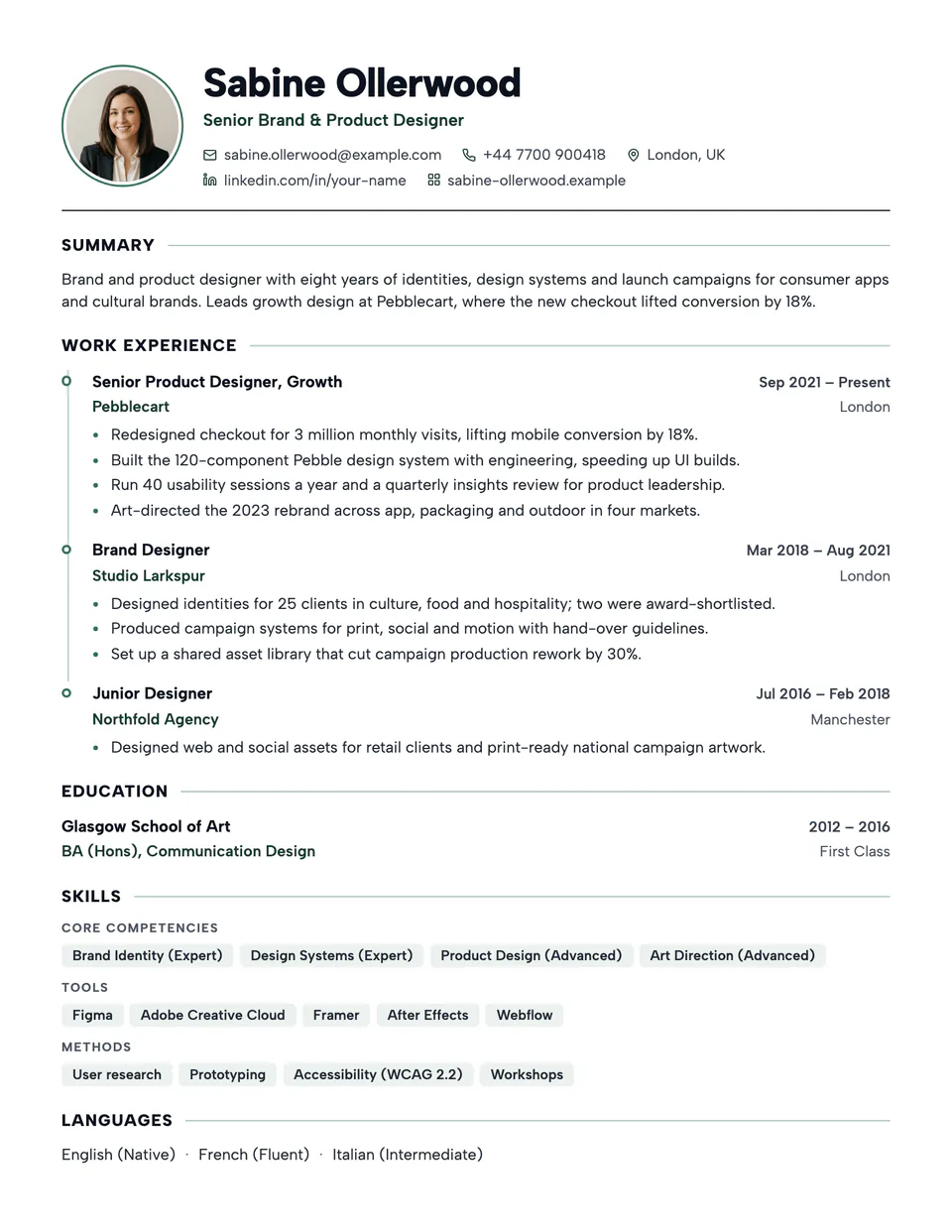
Lumen
Photo, contact icons and a fine career line, close to the infographic style used by younger candidates.
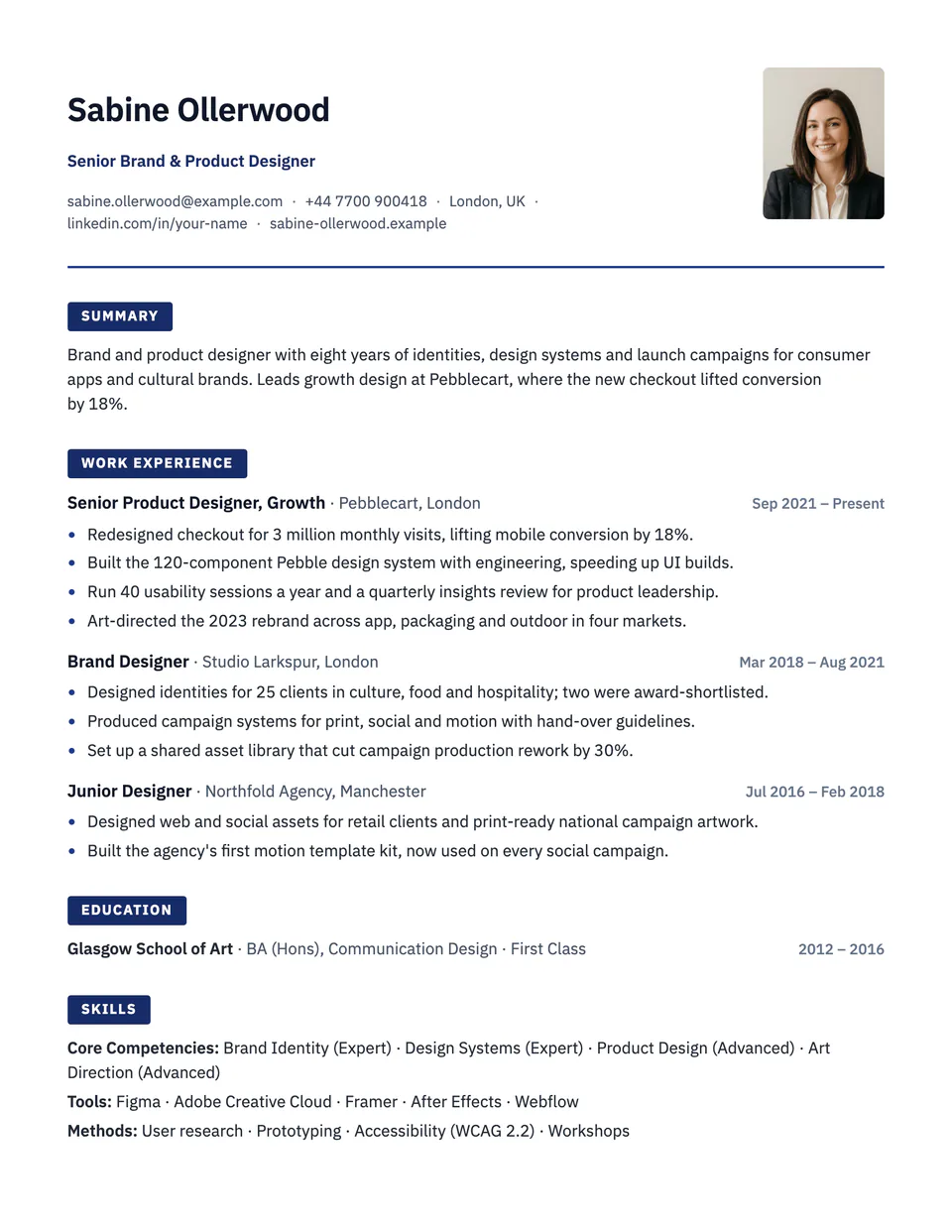
European
Passport-style photo and bold section labels for formal sectors and multi-country applications.
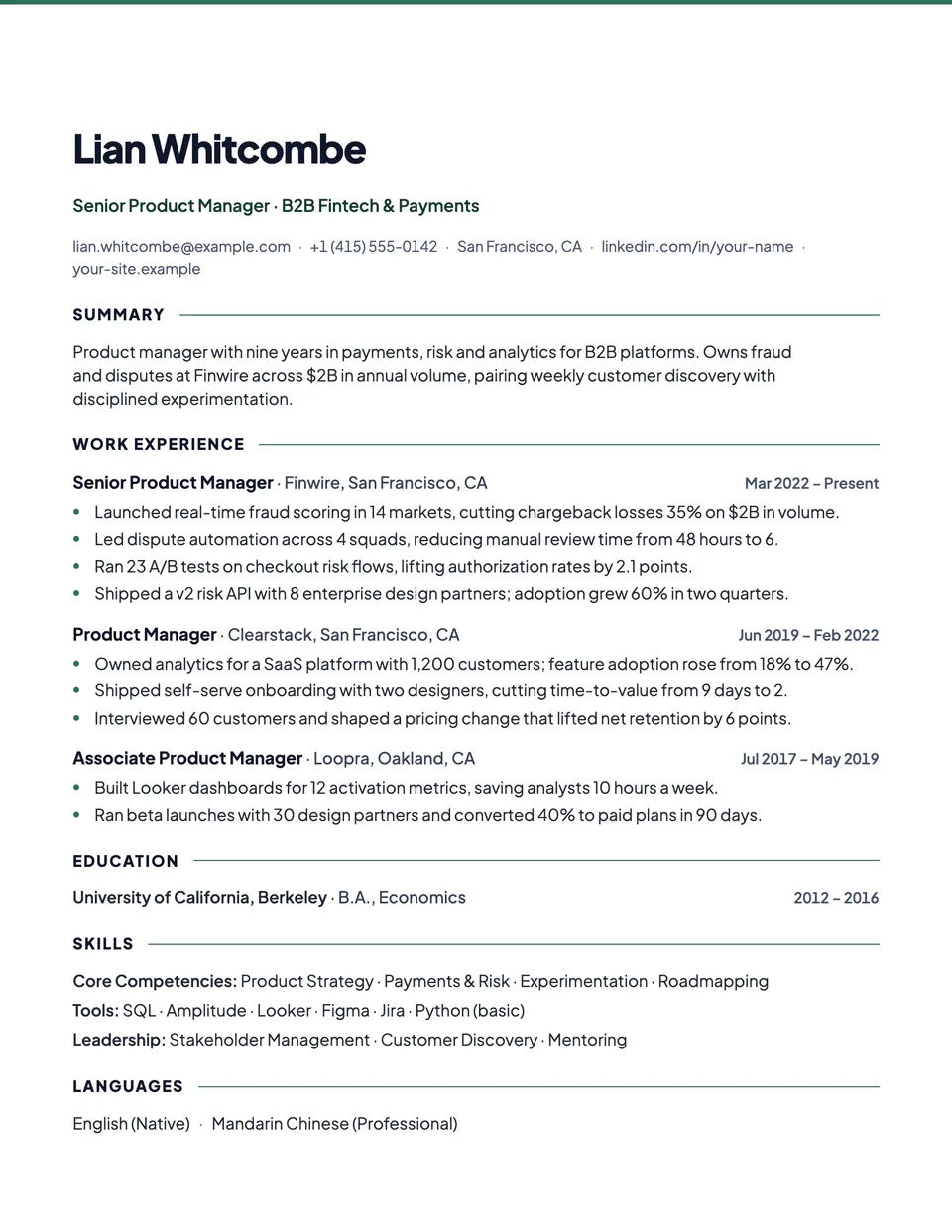
Contemporary
No photo field and clear headings, for online forms and international companies.
Applying from abroad: language, recognition and permits
EURES notes that you can write your CV in English if you do not speak Portuguese. For Portuguese-language postings, resume translation converts your CV while keeping the layout.
Recognition gives a foreign higher-education degree legal validity in Portugal under Decree-Law 66/2018, and may be needed to present a qualification to an employer. The Instituto para o Ensino Superior (IES, formerly DGES) describes three routes: automatic recognition for degrees on an approved list, recognition of level (licenciado, mestre or doutor), and specific recognition in a given field after a jury review. Academic and professional recognition are separate: for a regulated profession, also check the requirements of the competent authority.
EU, EEA and Swiss nationals can live and work in Portugal; for stays over three months they register with the local council. Other nationals generally need a residency visa for work; the Foreign Ministry's visa portal lists the types, including a visa for skilled job seekers. Residence matters are handled by AIMA, the Agency for Integration, Migration and Asylum.[1][4][5][6]
Common mistakes on a Portuguese CV
- Hiding your best achievements on page two instead of the top half of page one.
- Writing your full street address instead of town and country.
- Mixing courses and traineeships into education rather than giving them their own block.
- Sending a long cover letter when a short email would do.
- Attaching diplomas and references with the first application.
- Adding marital status, health details or tax and ID numbers.
Frequently asked questions
- Do I need a photo on a Portuguese CV?
- No, but EURES notes that a photograph is often appreciated in Portugal. The Labour Code protects applicants from discrimination on grounds such as age, sex and ethnic origin, so a photo is never a condition. If you add one, use a recent, professional portrait, not a holiday picture or a selfie.
- How long should a CV be in Portugal?
- One or two pages, according to EURES. Put your greatest achievements in the top half of the first page to catch the recruiter's attention. Young candidates with little experience increasingly use a one-page infographic CV, while experienced professionals may prefer a functional layout.
- Can I write my CV in English for Portugal?
- Yes, if you do not speak Portuguese: EURES says you can write your CV in English. For postings written in Portuguese, consider sending a Portuguese version. Either way, state your language levels on the CEFR scale, from A1 to C2.
- What can a Portuguese employer ask me during recruitment?
- Under Article 17 of the Labour Code, an employer may not require information about your private life, health or pregnancy unless it is strictly necessary for the job or justified by its nature, and the reasons must be given in writing. Health information, where justified, goes to a doctor, who only tells the employer whether you are fit for the work.
- Do I need my degree recognised to work in Portugal?
- Not always. Recognition gives your foreign degree legal validity in Portugal and can be needed to present the qualification to an employer, continue studying or work in a regulated profession. The IES offers automatic, level and specific recognition; professional recognition for regulated professions is a separate procedure with the competent authority.
Sources
Statements about rules and official guidance rely on these pages. We opened and read each source ourselves on the date shown.
- [1]Living and working conditions: Portugal · European Commission, EURESeures.europa.eu/living-and-working/living-and-working-conditions-europe/living-and-working-conditions-portugal_en ·
- [2]Labour Code (Código do Trabalho, Lei 7/2009), articles 17, 24 and 25 · Procuradoria-Geral Regional de Lisboa (Public Prosecutor's Office), legislation databasewww.pgdlisboa.pt/leis/lei_mostra_articulado.php?nid=1047&tabela=leis ·
- [3]Como procurar emprego · IEFP, Instituto do Emprego e Formação Profissionalwww.iefp.pt/procurar-emprego ·
- [4]Reconhecimento de graus e diplomas estrangeiros · IES, Instituto para o Ensino Superior (formerly DGES)iesuperior.pt/reconhecimento/ ·
- [5]Type of visa: national visas · Ministry of Foreign Affairs of Portugal, Portal das Comunidades / Vistosvistos.mne.gov.pt/en/national-visas/general-information/type-of-visa ·
- [6]AIMA: Agência para a Integração, Migrações e Asilo · AIMA (Agency for Integration, Migration and Asylum)aima.gov.pt/pt ·
- [7]About Europass · European Commission, Europasseuropass.europa.eu/en/about-europass ·
Keep reading
Applying in Portugal? Check your CV first
Upload your CV for a free check of structure, length and contact details, then tailor the top half to the job you want.