Country guide
Italian CV format: how to write a CV for Italy
An Italian CV is tailored to the position and sent with a cover letter, often through a company's 'Lavora con noi' page, and traditionally ends with a data-processing line. This guide covers layout, photos and personal data, what that privacy line actually requires, and applying from abroad.
What is the standard CV format in Italy?
An Italian CV is an up-to-date document tailored to the position, sent with a cover letter by email or through the company's channels. EURES points to the Europass template, and a photo, certificates and references are not needed unless requested. EURES still advises a closing line authorising data processing, but Italian law no longer requires consent for CVs you send.[1][2]
Italian CV rules at a glance
| Topic | Usual in Italy |
|---|---|
| Name of the document | Curriculum vitae or CV; the cover letter is the lettera di presentazione or lettera motivazionale. |
| Length | No official limit. Keep only what serves the position; a CV tailored to the job is the rule. |
| Format | EURES points to the Europass template; a clean reverse-chronological CV works too. |
| Photo | Not needed unless the employer asks for one. |
| Personal details | Name, city, phone, email. Marital status, family plans and opinions are not the employer's business. |
| Dates | Month and year for each entry (03/2022 – present) is the common practice. |
| Language | Italian for Italian employers; EURES calls knowledge of Italian indispensable at work. |
| Privacy line | Advised by EURES, optional by law for CVs you send yourself; include it when the job ad asks. |
| References | Not attached unless requested, like copies of diplomas and certificates. |
| Applicant tracking | Larger companies first search their online candidate databases, so use the posting's own terms. |
Layout and structure of an Italian CV
EURES, the EU's job mobility network, advises always having an up-to-date CV tailored to the position, sent with a cover or motivation letter by email or through the channels the company indicates. For speculative applications, company websites usually have a 'Lavora con noi' (work with us) section, and EURES notes that medium-sized and large companies first consult their online candidate databases when they look for staff.
Among the many CV models, EURES singles out the Europass template: after registering on the free EU portal, you fill it in and download it in several formats. A clean, reverse-chronological CV with contact details, a short profile, experience, education, languages on the CEFR scale and IT skills is just as acceptable. Either way, rewrite the profile and achievements for each application; the job-specific resume optimizer does this around one posting.[1][9]
Photo and personal data: what Italian law says
Article 8 of the Workers' Statute (Statuto dei lavoratori, Law 300/1970) forbids employers, for hiring purposes, to inquire into a worker's political, religious or trade union opinions or into facts not relevant to assessing professional aptitude. Article 27 of the Equal Opportunities Code (D.Lgs. 198/2006) bans discrimination in access to work, including through references to marital or family status or pregnancy. For employment agencies, Article 10 of D.Lgs. 276/2003 bans any inquiry or data processing based on beliefs, sex, marital status, pregnancy, age, disability, ethnic or national origin, health and similar grounds, even with the worker's consent.
EURES adds that, unless specifically requested, there is no need to attach a photograph or documents on qualifications, certificates or references. Keep the header to name, city, phone, email and LinkedIn. If an employer asks for a photo, use a recent, professional one; the AI headshot generator creates a business portrait from your own selfies.[1][3][4][5]
The data-processing line: what the law actually requires
EURES says CVs sent to companies must contain a permission for data processing, typically a sentence such as "Autorizzo il trattamento dei miei dati personali ai sensi del D.Lgs. 196/2003 e del Regolamento UE 2016/679". The law has moved on: since 2018, Article 111-bis of the Personal Data Protection Code states that, for CVs sent spontaneously to start an employment relationship, consent to processing the personal data in them is not required, within the purpose of steps taken before entering a contract (GDPR Article 6(1)(b)). Instead, the employer must give you the information notice of GDPR Article 13 at the first useful contact after receiving your CV.
In practice the line is harmless, and leaving it out does not make your application unlawful. Include it when a job ad or recruitment portal asks for it, because some still do, and keep it to one short sentence at the bottom of the last page.[1][2]
Sample skeleton: an Italian CV
A one-page structure with placeholder data. Replace every line with your own details.
Informazioni personali (personal information)
[Nome Cognome]
Milano · +39 3xx xxx xxxx · your-name@example.com
linkedin.com/in/your-name
Profilo (profile)
Logistics coordinator with five years in e-commerce fulfilment, used to SAP and multilingual carrier teams.
Esperienza professionale
04/2022 – oggi · Logistics Coordinator, [Company A], Milan
· Reorganised return handling for two warehouses and cut open tickets per week
09/2019 – 03/2022 · Operations Assistant, [Company B], Barcelona (Spain)
Istruzione e formazione
2019 · Bachelor's degree in Economics, [University], Barcelona
Competenze linguistiche e digitali
Spanish (native) · Italian (B2) · English (C1)
SAP MM, Excel, Power BI
Privacy (optional)
Autorizzo il trattamento dei dati personali ai sensi del Regolamento UE 2016/679.
Example with placeholder details, not a real person
The sample data is illustrative only.
The application package: cover letter
EURES describes the cover or motivation letter as the way to personalise your application: highlight your strengths and goals and explain why you match the profile the company wants. Send it with the CV by email or through the company's online form. The cover letter builder writes the letter in the same design as your CV.[1]
Where to find jobs in Italy
The Ministry of Labour's portal Cliclavoro publishes vacancies from across the country; you upload your CV to apply. Public employment centres (Centri per l'impiego) offer guidance and CV advice once you hold a SPID digital identity and declare your availability for work. Private boards such as InfoJobs and Indeed list many roles.[1]
How to write a CV for Italy in six steps
Use these steps for a first Italian CV or to adapt a resume written for another country.
- 01
Read the posting
Note the language, required skills and how to apply. The JD keyword matcher lists terms your CV is missing.
- 02
Choose Europass or a clean layout
Europass suits multi-country applications; a short reverse-chronological CV works for one employer.
- 03
Keep the header lean
Name, city, phone, email and LinkedIn. Add a photo only if the employer asks for one.
- 04
Show results for each job
Dates in month/year, position, company and city, then two to four achievements that match the posting.
- 05
Add languages and the privacy line if asked
Give CEFR levels, and add the one-line data-processing authorisation when the ad requests it.
- 06
Check and send
Run the free resume checker, export a PDF and send it with a tailored cover letter.
Templates that suit Italian applications
Each layout keeps a clean structure and leaves room for a short privacy line at the end. Browse the template gallery for more.
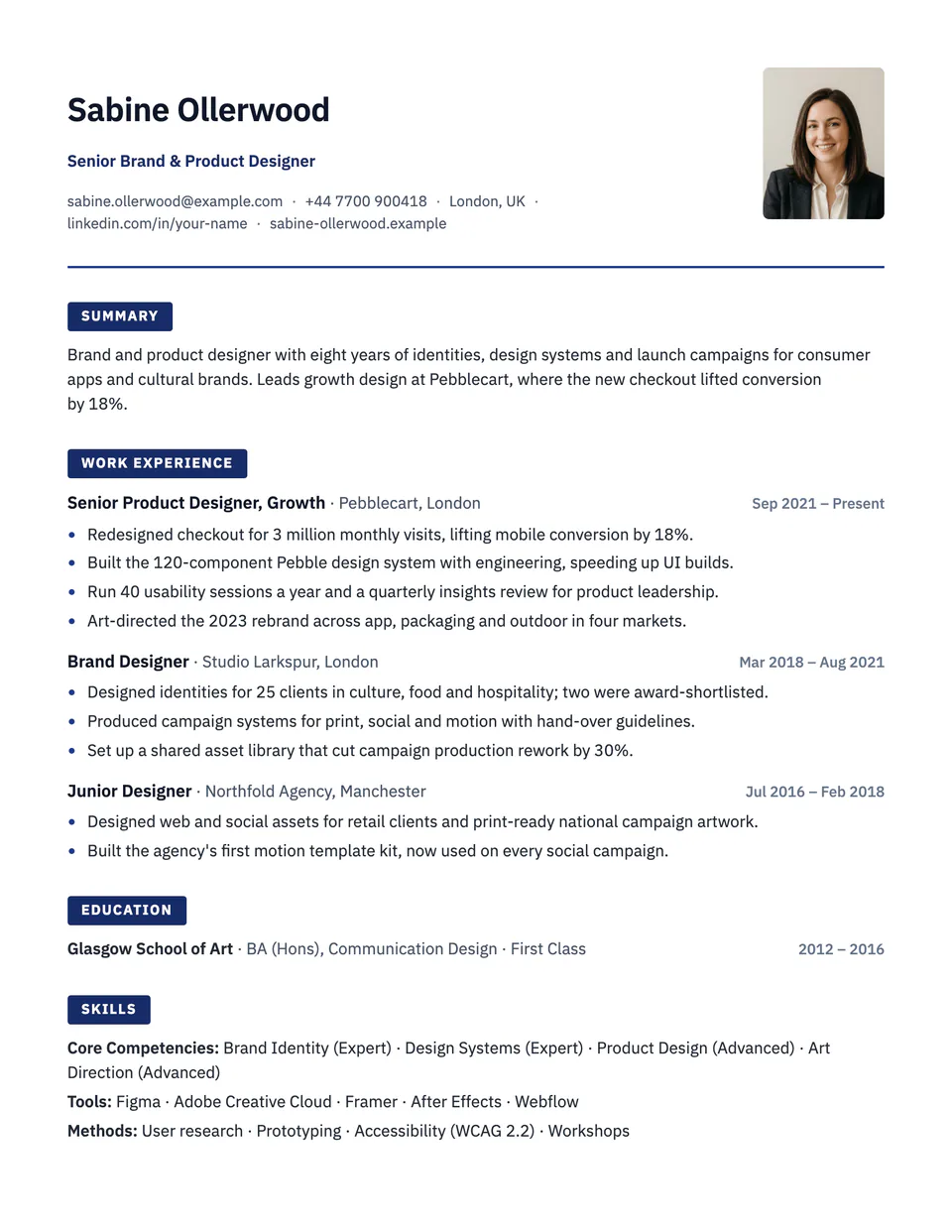
European
Bold section labels and an optional passport-style photo, close to the Europass look.
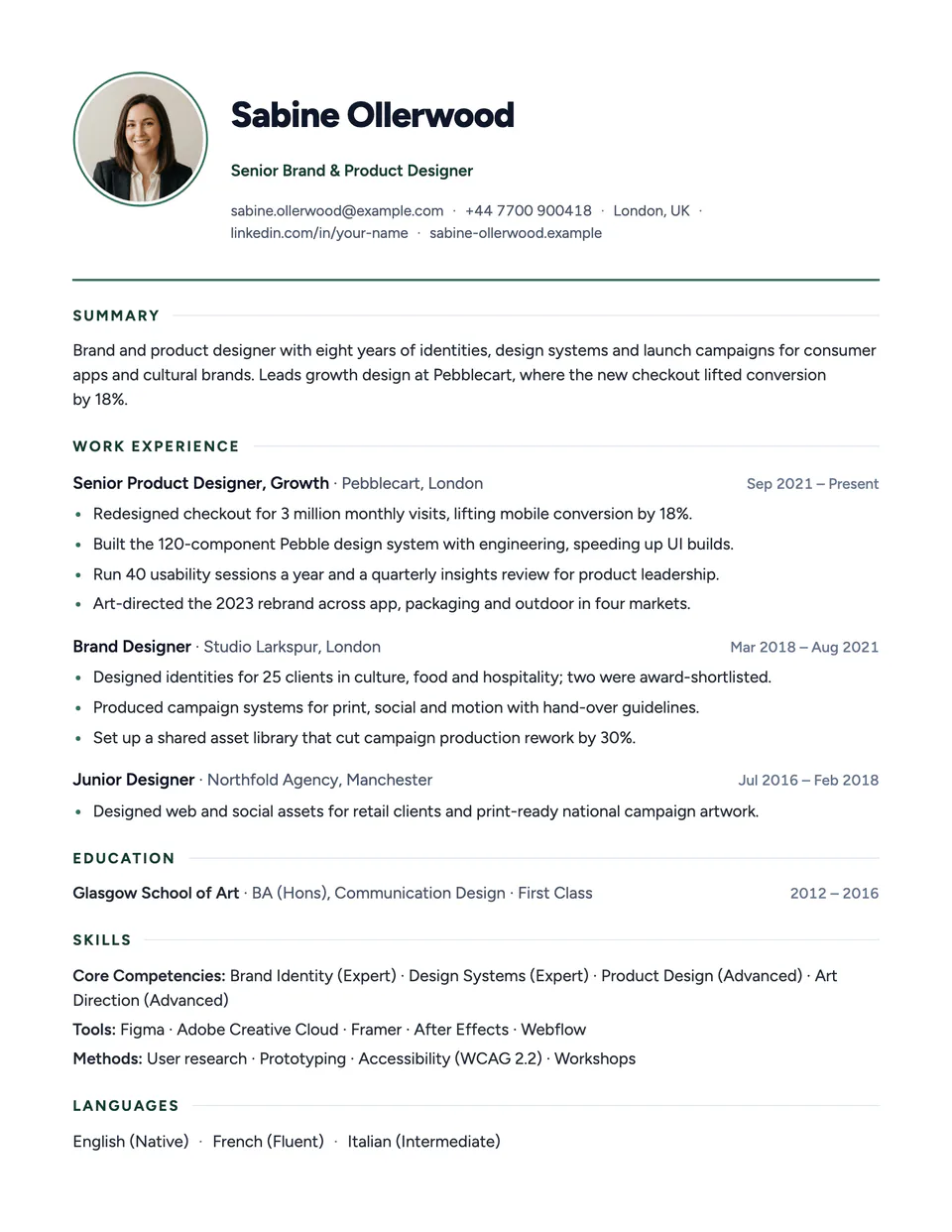
Profile
A round portrait beside your name, for roles where the employer asks for a photo.
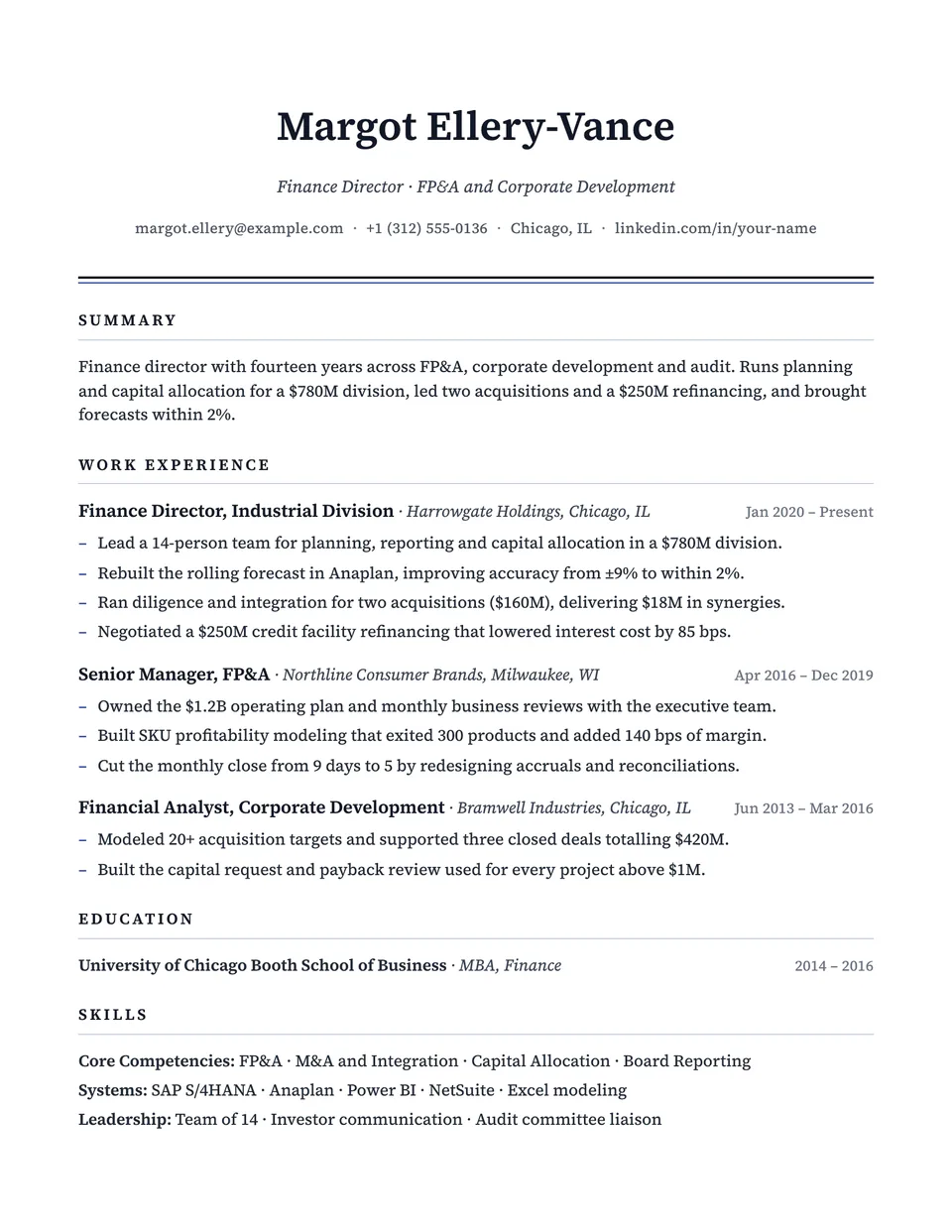
Executive
A sober single-column layout without a photo, suited to formal applications.
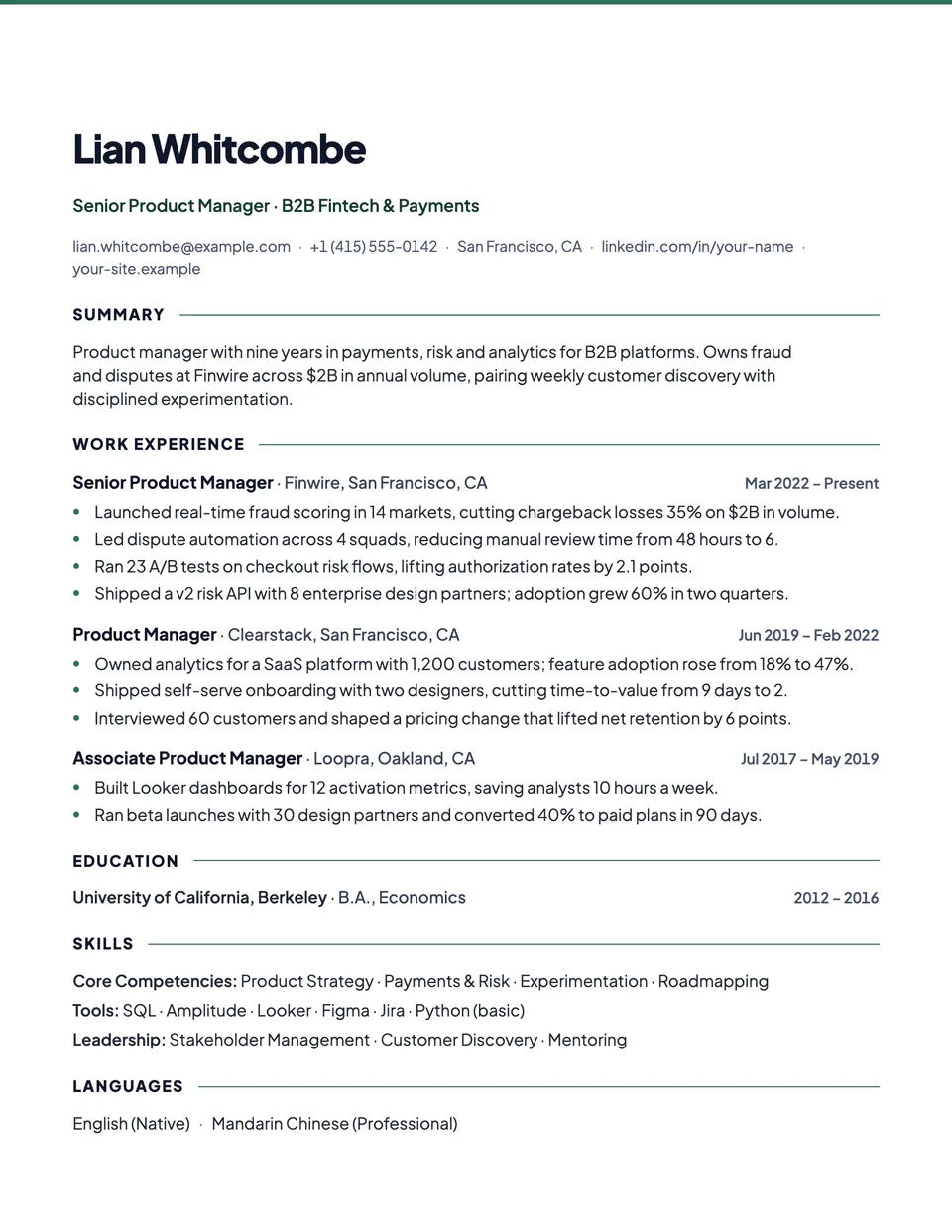
Contemporary
No photo, clear headings and white space for online forms and candidate databases.
Applying from abroad: language, recognition and permits
EURES describes knowledge of Italian as indispensable in the workplace, so write to Italian employers in Italian unless the advert is in another language. Resume translation converts your CV while keeping the layout.
Italy applies 'recognition according to the purpose', introduced when it ratified the Lisbon Recognition Convention by Law 148/2002. CIMEA, the information centre on academic mobility and equivalence, advises on recognition procedures and issues statements of comparability and verification for foreign qualifications.
EU citizens can work in Italy without a work permit, apart from a few public functions. For other nationals, the Italian consulate explains that the employer must request a nulla osta (work clearance) from the Sportello Unico per l'Immigrazione in Italy before the worker applies for a work visa. After arrival, third-country nationals must apply for a residence permit within eight working days. The Foreign Ministry's portal Il visto per l'Italia shows which visa applies.[1][6][7][8]
Common mistakes on an Italian CV
- Sending one generic CV instead of a version tailored to the position.
- Adding a long, outdated privacy paragraph that cites only the pre-2018 law.
- Listing marital status, children or religion, which employers may not ask about.
- Attaching certificates and references nobody requested.
- Writing in English to an Italian company that advertised in Italian.
- Letting the Europass template grow to several pages of minor details.
Frequently asked questions
- Do I need to put a GDPR consent line on my Italian CV?
- Not by law. Article 111-bis of the Italian Personal Data Protection Code says consent is not required to process the personal data in a CV you send spontaneously to seek a job; the employer must instead give you its GDPR Article 13 information notice at the first useful contact. EURES still recommends the line, so add one short sentence when a job ad asks.
- Do I need a photo on an Italian CV?
- No. EURES states that, unless specifically requested, there is no need to attach a photograph. Italian law also protects applicants: employers may not inquire into facts unrelated to professional aptitude, and the Equal Opportunities Code bans discrimination in access to work. If an employer asks for a photo, use a recent, professional portrait.
- Should I use the Europass CV in Italy?
- You can. EURES Italy points to the Europass template, which is free and available in 31 languages. It suits candidates applying in several EU countries. Keep it short by deleting empty fields and minor details, and tailor the content to each position, as EURES advises.
- Can I send my CV in English to an Italian company?
- Only if the job ad is in English or asks for it. EURES describes knowledge of Italian as indispensable for working life in Italy, so write your CV and cover letter in Italian for Italian employers. State your Italian level on the CEFR scale.
- How do I get my foreign degree recognised in Italy?
- Italy recognises qualifications according to their purpose, so the body that needs your qualification, such as a university or a public employer, evaluates it. CIMEA, the information centre on academic mobility and equivalence, issues statements of comparability and verification that explain your degree to Italian institutions and employers.
Sources
Statements about rules and official guidance rely on these pages. We opened and read each source ourselves on the date shown.
- [1]Living and working conditions: Italy · European Commission, EURESeures.europa.eu/living-and-working/living-and-working-conditions-europe/living-and-working-conditions-italy_en ·
- [2]Personal Data Protection Code (D.Lgs. 196/2003), art. 111-bis: information when CVs are received · Normattiva (Istituto Poligrafico e Zecca dello Stato)www.normattiva.it/uri-res/N2Ls?urn:nir:stato:decreto.legislativo:2003-06-30;196~art111bis ·
- [3]Equal Opportunities Code (D.Lgs. 198/2006), art. 27: no discrimination in access to work · Normattiva (Istituto Poligrafico e Zecca dello Stato)www.normattiva.it/uri-res/N2Ls?urn:nir:stato:decreto.legislativo:2006-04-11;198~art27 ·
- [4]Workers' Statute (Law 300/1970), art. 8: ban on inquiries into opinions · Normattiva (Istituto Poligrafico e Zecca dello Stato)www.normattiva.it/uri-res/N2Ls?urn:nir:stato:legge:1970-05-20;300~art8 ·
- [5]D.Lgs. 276/2003, art. 10: ban on inquiries and discriminatory processing by employment agencies · Normattiva (Istituto Poligrafico e Zecca dello Stato)www.normattiva.it/uri-res/N2Ls?urn:nir:stato:decreto.legislativo:2003-09-10;276~art10 ·
- [6]Visas to enter Italy: subordinate work · Consulate General of Italy in New York, Ministry of Foreign Affairs and International Cooperationconsnewyork.esteri.it/en/servizi-consolari-e-visti/servizi-per-il-cittadino-straniero/visti/visas-to-enter-italy/subordinate-work/ ·
- [7]Il visto per l'Italia · Ministry of Foreign Affairs and International Cooperationvistoperitalia.esteri.it/ ·
- [8]CIMEA: Information Centre on Academic Mobility and Equivalence · CIMEAwww.cimea.it/EN/ ·
- [9]About Europass · European Commission, Europasseuropass.europa.eu/en/about-europass ·
Keep reading
Applying in Italy? Check your CV first
Upload your CV for a free check of structure, contact details and length, then tailor it to the position you want.