Country guide
Swiss CV format: how to write a CV for Switzerland
In Switzerland the CV is one part of a dossier: a covering letter, a tabular CV and copies of your work references and diplomas. This guide follows the public employment service (SECO) and EURES, explains the Arbeitszeugnis, and covers language regions and permits for applicants from abroad.
What is the standard CV format in Switzerland?
A Swiss CV is tabular and no longer than two A4 pages, with the most recent entries first and dates as month and year. It usually includes a photo and personal details such as date of birth and nationality. It is sent with a one-page covering letter and copies of work references (Arbeitszeugnisse) and diplomas, to which Swiss employers attach great importance.[1][2]
Swiss CV rules at a glance
| Topic | Usual in Switzerland |
|---|---|
| Name of the document | Lebenslauf or CV (German), curriculum vitae (French and Italian). The package is the Bewerbungsdossier. |
| Length | At most two A4 pages. |
| Layout | Tabular, most important information in the first third, latest entries first. |
| Photo | Usual: EURES describes a Swiss application as a CV including a photograph. |
| Personal details | Name, address, phone, email, date of birth; SECO also lists marital status and children, EURES nationality. |
| Dates | Month and year on the left, no days: 05.2021 – 11.2023. |
| Language | The language of the job ad and the region: German, French or Italian. |
| Cover letter | One A4 page, typed, written for the specific job. |
| References | Copies of all Arbeitszeugnisse in the dossier; referee contacts only on request, not on the CV. |
Layout and structure of a Swiss CV
SECO's guide for job seekers says a tabular CV is normally enough, created on a computer. The most important information goes into the first third, and within each block the relevant items come first: for one person that is the vocational qualification, for another the languages or IT skills. List the most recent entries first, but group further training by topic rather than by date. Put the dates on the left in month and year, without days.
The typical blocks are personal details, work experience, schools and training, further training, languages, IT skills and other skills. For each role, give the job title first, then the employer and place, and take titles and dates from your work references so that both match. SECO advises backing claims with figures and naming your area of responsibility in every role.
To match one posting precisely, the job-specific resume optimizer compares your CV with the ad and shows what to bring forward.[1]
Photo and personal data: practice and legal limits
Swiss practice is more traditional than in many countries. SECO's list of personal details includes date of birth, marital status and the number and birth years of children, with the place of origin optional; EURES adds nationality. A photo is part of the usual application, and SECO notes that a CV with photo plus a covering letter is enough for a first email contact.
The law limits what an employer may do with that information. Under Article 328b of the Code of Obligations, an employer may process data about an employee only where it concerns suitability for the job or is needed to perform the employment contract. The Gender Equality Act prohibits discrimination on the basis of sex, including by reference to marital status, family situation or pregnancy, and the ban applies expressly to hiring. If you need a professional photo, the AI headshot generator creates one from your own selfies.[1][2][3][4]
Sample skeleton: a Swiss CV
A one-page structure with placeholder data for the German-speaking region. For Romandie or Ticino, write the same structure in French or Italian.
Personalien (personal details)
[Name Surname]
Musterstrasse 1, 8000 Zürich
+41 79 xxx xx xx · your-name@example.com
Date of birth · nationality · permit, if you hold one
Berufserfahrung (work experience)
04.2022 – today · Software Engineer, [Company A] AG, Zürich
· Responsible for the payment module; cut release time from monthly to weekly
09.2018 – 03.2022 · Developer, [Company B], Lyon (France)
Ausbildung (education)
2018 · Master in Computer Science, [University], Lyon
Sprachen (languages)
French (native), German (B2), English (C1)
Example with placeholder details, not a real person
All data is a placeholder and the results are illustrative. Referees are not listed; they are named on request.
The application dossier and the Arbeitszeugnis
According to SECO, a complete dossier always contains a covering letter, a tabular CV, copies of all work references, a copy of your vocational or university qualification and copies of further diplomas. A certificate of good conduct, an extract from the criminal record or a handwriting sample are enclosed only on request. Send copies, which do not need to be certified. The covering letter should fit on one A4 page; build it in your CV's design with the cover letter builder.
The Arbeitszeugnis (certificat de travail, certificato di lavoro) carries a lot of weight. Under Article 330a of the Code of Obligations, employees may request at any time a reference on the nature and duration of the job, the quality of their work and their conduct; on request it is limited to nature and duration. SECO advises always asking for a reference, or at least that confirmation, when you leave, because your references should cover your career without gaps.
Referees are different: SECO says they do not belong on the CV. Name them when asked, usually your last two employers. For email, send PDFs; when you send everything at once, SECO suggests one document of no more than five pages and 2 MB.[1][3]
Where to find jobs in Switzerland
EURES points job seekers to Job-Room, the online service of the public employment service, and notes that people living in Switzerland can register free of charge with their regional employment office (RAV, ORP or URC). Private employment agencies are normally free for job seekers. Private boards such as jobs.ch and jobup.ch list many roles.[2]
How to write a CV for Switzerland in six steps
Use these steps for a first Swiss CV or to adapt one written for another country.
- 01
Pick the language
Write in the language of the ad and the region. Need a second language version? Resume translation keeps the layout.
- 02
Set up the table
Dates on the left in month and year, latest first, the most relevant block in the first third, two A4 pages at most.
- 03
Fill in personal details
Contact details, date of birth and nationality; add marital status and a photo as is customary, and state a Swiss permit if you hold one.
- 04
Align with your references
Take job titles and dates from your Arbeitszeugnisse so CV and references tell the same story.
- 05
Assemble the dossier
A one-page covering letter, the CV, copies of all work references and diplomas, with Swiss equivalents of foreign degrees where you know them.
- 06
Check and send
Run the free resume checker, then send PDFs from a professional email address.
Templates that suit Swiss applications
These keep a clear date column and a place for your photo. Browse every layout in the template gallery.
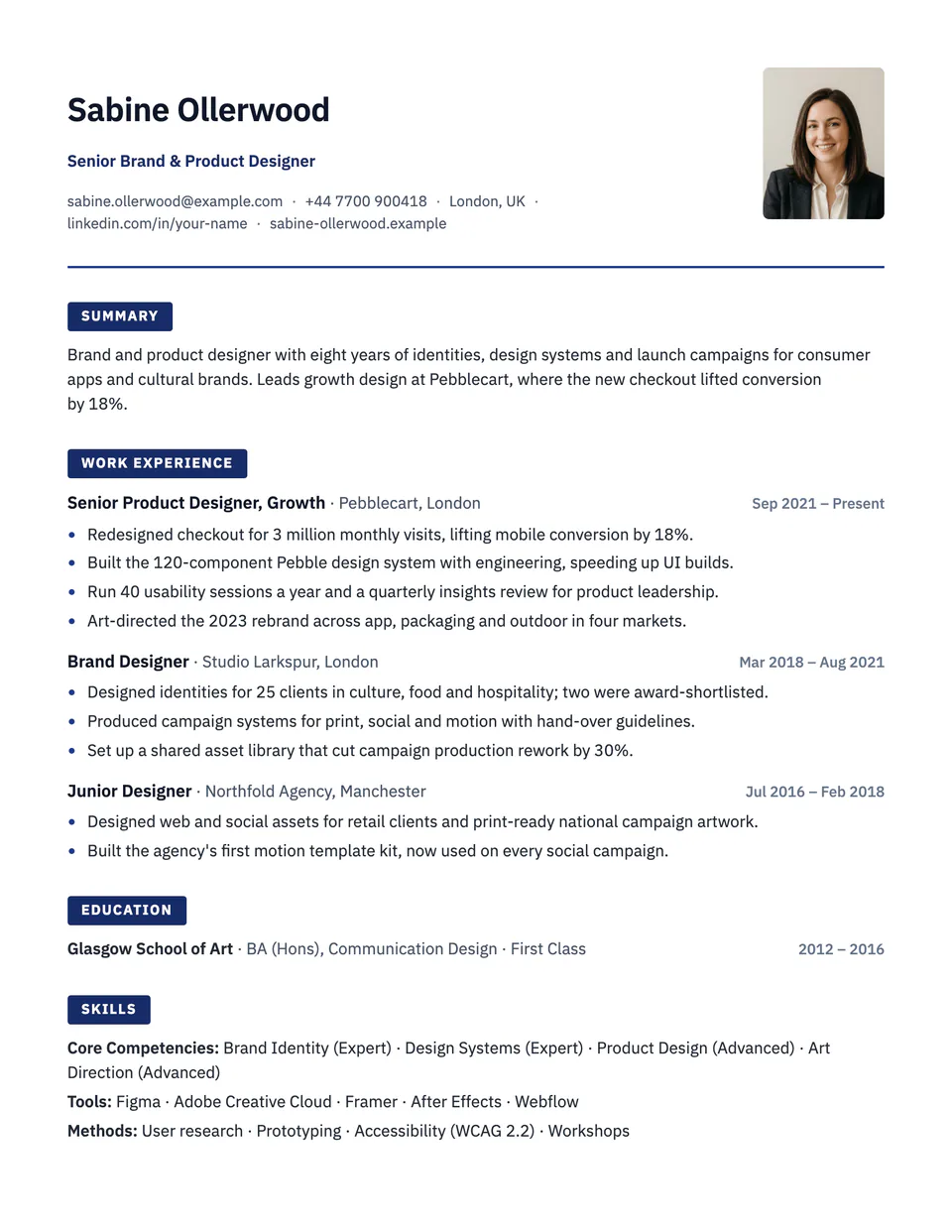
European
Passport-style photo and bold section labels, close to the traditional tabular Swiss CV.
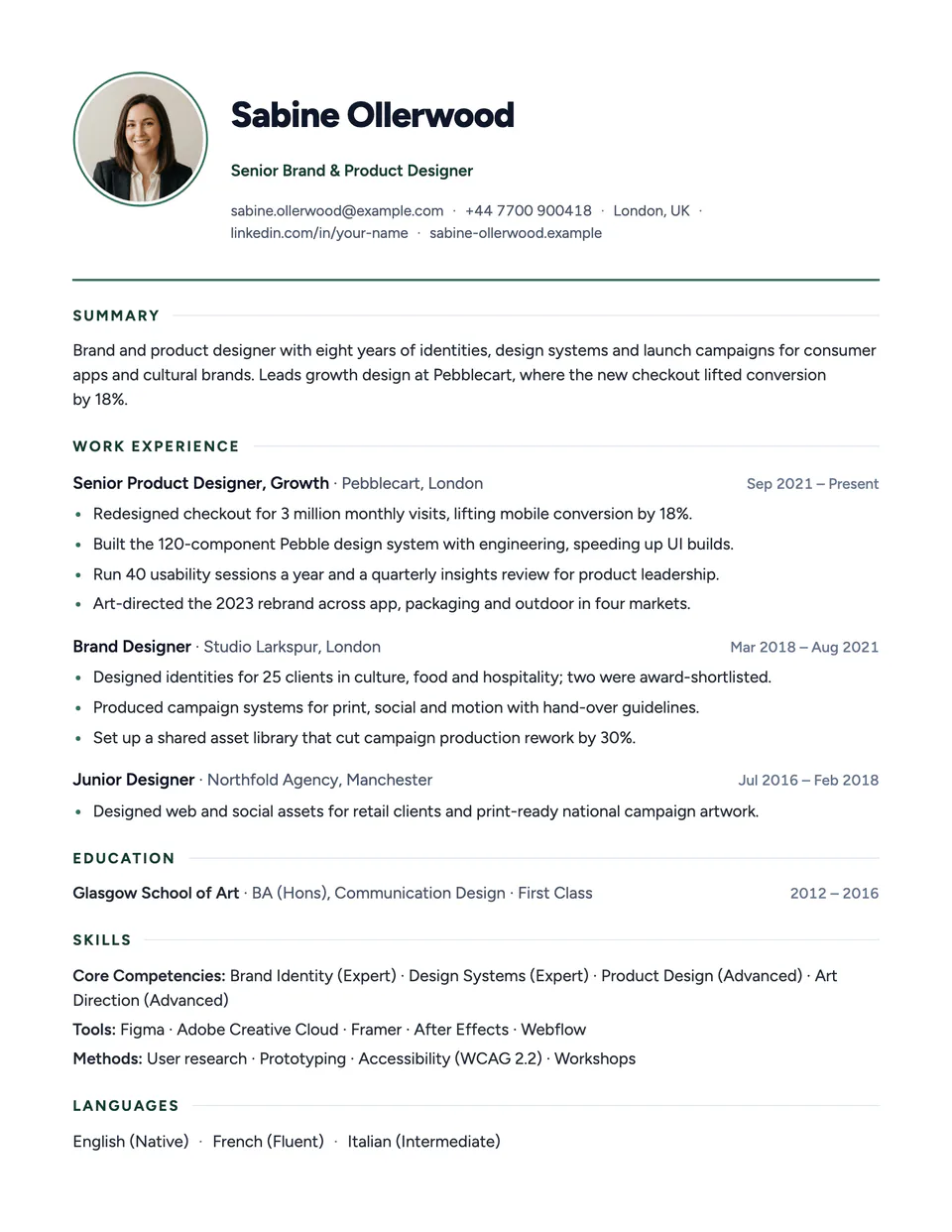
Profile
A round portrait beside your name, a cleaner look for modern companies.
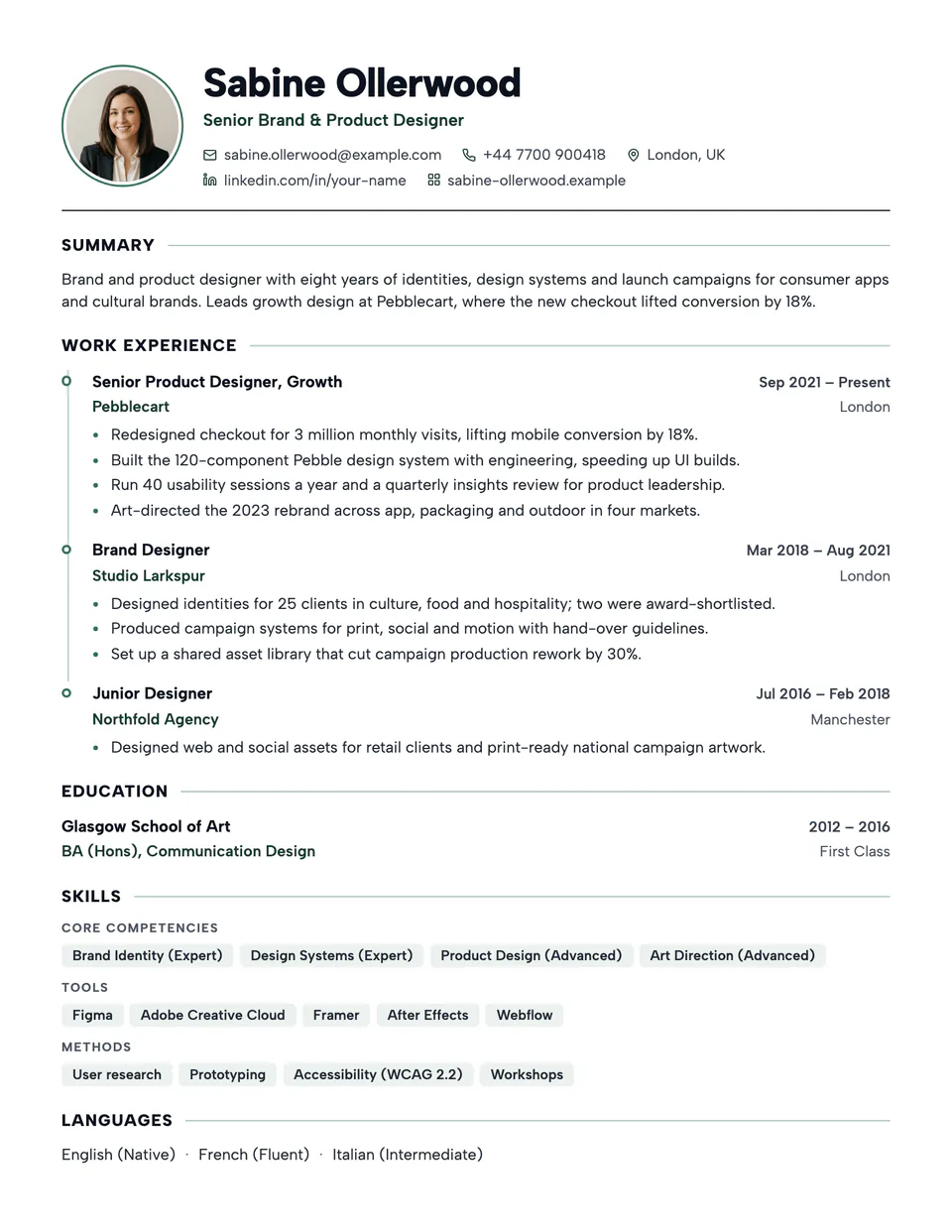
Lumen
Round photo and a fine career line, which suits long careers backed by many references.
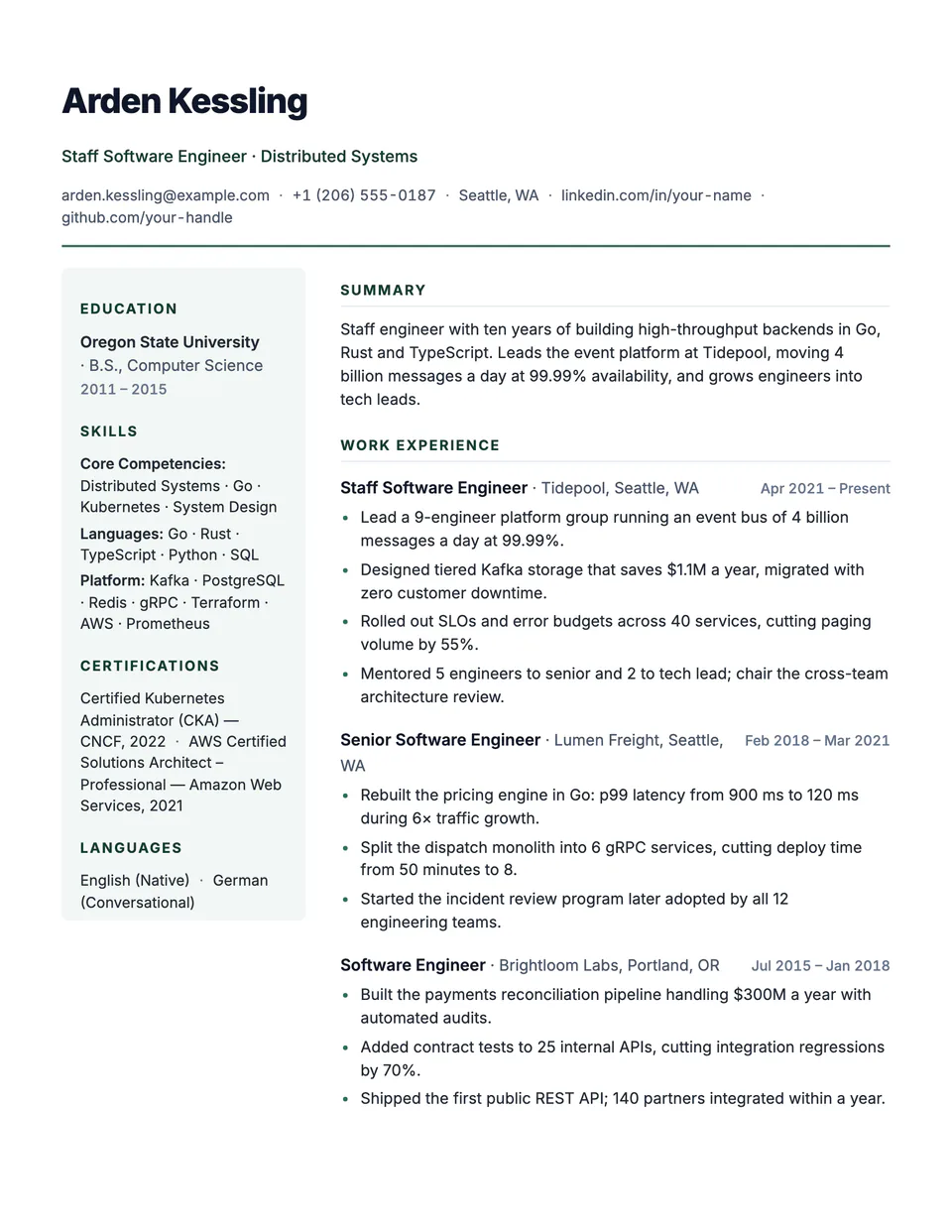
Sidebar
Languages and IT skills in a side column, useful when several languages are part of the job.
Applying from abroad: languages, recognition and permits
Switzerland has four national languages. German is the most widely spoken, French is the main language of Romandie, Italian of Ticino and parts of Graubünden, and Romansh is spoken in parts of Graubünden. Bern, Fribourg, Valais, Graubünden and the city of Biel/Bienne are officially multilingual, so read each ad for the language it expects.
Recognition is required to practise certain professions, and the responsible body depends on the qualification. EURES adds that great importance is attached to diplomas in Switzerland, so name the Swiss qualification your diploma corresponds to where you can.
Foreign workers need a residence permit, and the cantons issue permits. EU and EFTA nationals have easier access thanks to the Agreement on the Free Movement of Persons; from other states only a limited number of workers are admitted, mainly managers, specialists and other qualified employees. Check the current rules with the State Secretariat for Migration.[2][5][6][7][8]
Common mistakes on a Swiss CV
- Job titles or dates that differ from those in your work references.
- Gaps in your references because you never asked for a Zeugnis when you left.
- Referee names and phone numbers on the CV instead of on request.
- A degree with no completion noted: SECO warns this can be read as a failed exam.
- A CV in German for a role in Romandie that was advertised in French.
- A mass email to many employers instead of one tailored application each.
Frequently asked questions
- Do I need a photo on a Swiss CV?
- It is customary. EURES describes a typical Swiss application as a covering letter and a CV including a photograph, and SECO's guide treats a CV with photo as the minimum for a first email contact. Use a recent, professional picture.
- What is an Arbeitszeugnis and do I need one?
- An Arbeitszeugnis is a written reference from your employer. Under Article 330a of the Code of Obligations, you can request one at any time; it covers the nature and duration of the job, your work and your conduct, or only nature and duration if you ask. Swiss employers attach great importance to these references, so include copies of all of them and ask for one whenever you leave a job.
- Should I list references on my Swiss CV?
- No. SECO says referee details do not belong on the CV but should be supplied on request or brought to the interview. If an ad asks for references, mention in your covering letter that you will gladly provide them. Name your last two employers, and if you worked for the same employer for many years, add contacts outside the company, such as clients or business partners.
- Which language should my CV be in?
- Use the language of the job ad, which usually follows the language region: German in most of the country, French in Romandie, Italian in Ticino. In officially multilingual cantons, read each ad. If you apply in several regions, keep one version per language with identical dates and titles.
- How is a Swiss CV different from a German one?
- Both are tabular, reverse chronological and limited to two pages. Swiss CVs usually give more personal details, the dossier relies on copies of all work references, referees are named only on request, and the language depends on the region. See the German CV guide for comparison.
Sources
Statements about rules and official guidance rely on these pages. We opened and read each source ourselves on the date shown.
- [1]Wie bewerbe ich mich richtig? Praktische Tipps (PDF) · SECO, Arbeitsmarkt / Arbeitslosenversicherung (arbeit.swiss)www.arbeit.swiss/api/media/fileservice/sdweb-docs-prod-arbeitswiss-files/files/2026/06/03/06ed7935-ac82-4aa8-a2a6-29ae54ce9f2f.pdf ·
- [2]Living and working conditions: Switzerland · European Commission, EURESeures.europa.eu/living-and-working/living-and-working-conditions/living-and-working-conditions-switzerland_en ·
- [3]Code of Obligations, Art. 328b and Art. 330a · Swiss Confederation, Fedlexwww.fedlex.admin.ch/eli/cc/27/317_321_377/en ·
- [4]Gender Equality Act, Art. 3 · Swiss Confederation, Fedlexwww.fedlex.admin.ch/eli/cc/1996/1498_1498_1498/en ·
- [5]Working in Switzerland · State Secretariat for Migration (SEM)www.sem.admin.ch/sem/en/home/themen/arbeit.html ·
- [6]Living and working in Switzerland: EU/EFTA citizens · State Secretariat for Migration (SEM)www.sem.admin.ch/sem/en/home/themen/fza_schweiz-eu-efta/eu-efta_buerger_schweiz.html ·
- [7]Recognition of professional qualifications · State Secretariat for Education, Research and Innovation (SERI)www.sbfi.admin.ch/sbfi/en/home/education/recognition-of-foreign-qualifications.html ·
- [8]Language · Federal Department of Foreign Affairs, aboutswitzerlandwww.aboutswitzerland.eda.admin.ch/en/language ·
Keep reading
Applying in Switzerland? Check your CV first
Upload your CV for a free check of structure, dates, contact details and length, then tailor it to the job you want.