Country guide
German CV format: how to write a CV for Germany
A German CV, the Lebenslauf, is a short, tabular document that travels with a cover letter and copies of your certificates. This guide covers the expected layout, photos and personal data, and what changes when you apply from abroad.
What is the standard CV format in Germany?
A German CV is tabular and at most two A4 pages: personal details at the top, then work experience, education, training and skills in reverse chronological order with month and year for every entry. A professional photo is customary but cannot be demanded. Sign and date the CV, and send it with a one-page cover letter and copies of your certificates.[1][2][3]
German CV rules at a glance
| Topic | Usual in Germany |
|---|---|
| Name of the document | Lebenslauf (CV). The whole package is the Bewerbung or Bewerbungsunterlagen. |
| Length | At most two A4 pages; one page for a short application. |
| Layout | Tabular, two columns: dates on the left, entries on the right, most recent first. |
| Photo | Customary, but employers may not demand one. Leave it out when an anonymised application is requested. |
| Personal details | Name, address, phone, email. The Federal Employment Agency's guide also lists date and place of birth, nationality and marital status. |
| Dates | Month and year for every entry, for example 04/2022 – today. |
| Signature | Place, date and signature at the end; a scanned signature for email and online applications. |
| Cover letter | Anschreiben of no more than one A4 page, written for the specific job. |
| References | Arbeitszeugnisse (written work certificates) enclosed as copies; referee lists are not in the agency's standard package. |
| Europass | The EU's free CV editor; EURES recommends it to applicants from abroad. |
Layout and structure of a German CV
The Federal Employment Agency (Bundesagentur für Arbeit) describes the CV as tabular, logically structured, clear and complete, in two columns and two blocks. The first block holds your personal details. The second lists, each with month and year, your jobs with employer and place plus a short description, then university, further training, school and finally skills such as languages, IT and mobility. The current job comes first.
Its guide adds two points that surprise many newcomers: gaps of less than three months between jobs no longer need explaining, and the CV should be tailored to each posting, putting the skills the job asks for first and dropping what is irrelevant.
Coming from a US-style resume, the big changes are the date column, the personal details block and the signature. To shape each version around one posting, use the job-specific resume optimizer.[1][2]
Photo and personal data: custom versus law
Germany's General Equal Treatment Act (Allgemeines Gleichbehandlungsgesetz, AGG) aims to prevent discrimination on grounds of race or ethnic origin, sex, religion or belief, disability, age or sexual identity. The Federal Employment Agency states that employers may no longer demand an application photo, while noting that photos are still entirely customary.
In practice you choose. The agency's guide still lists date and place of birth, nationality and marital status in the personal details block. Some employers ask for anonymised CVs with no photo and no details that reveal gender or origin; follow that request exactly. If you include a photo, use a recent, professional one, slightly larger than a passport picture (about 4 × 6 cm), placed at the top right of the CV. Selfies are, in the agency's words, a no-go. If you have no suitable picture, the AI headshot generator creates a business portrait from your own selfies.[1][2][3][4]
Sample skeleton: a German CV
A one-page structure with placeholder data. Keep the order and the date column; replace every line with your own details.
Persönliche Daten (personal details)
[Name Surname]
Musterstraße 1, 12345 Berlin
+49 151 xxxx xxxx · your-name@example.com
linkedin.com/in/your-name
Optional: date of birth, nationality
Berufserfahrung (work experience)
03/2023 – today · Data Analyst, [Company A] GmbH, Berlin
· Built a weekly sales dashboard used by four regional teams
09/2020 – 02/2023 · Junior Analyst, [Company B], Lisbon (Portugal)
Ausbildung (education)
10/2016 – 07/2020 · BSc Economics, [University], Lisbon
Kenntnisse (skills)
Languages: English (C1), German (B2), Portuguese (native)
IT: SQL, Python, Power BI
Abschluss
Berlin, [date] [signature]
Example with placeholder details, not a real person
Give language levels on the CEFR scale (A1 to C2). The sample data is illustrative only.
The application package: Anschreiben and Anlagen
When an employer asks for complete application documents, the Federal Employment Agency lists a cover letter, an optional cover sheet, the CV and certificates. The cover letter (Anschreiben) should fill no more than one A4 page and explain why you fit this job; EURES adds that applicants from abroad should also say why they want to work in Germany. Write it in the same design as your CV with the cover letter builder.
The attachments (Anlagen) carry real weight. Enclose your Arbeitszeugnisse, ideally from every former employer, plus your degree and relevant training certificates, always as copies, never originals. Employees in Germany are entitled to a written work certificate when they leave, and on request it covers performance and conduct as well as the type and duration of the job. For email applications, EURES recommends one PDF with all documents, kept under 2 MB.[1][2][3][5]
How to write a CV for Germany in six steps
Use these steps for a first German CV or to adapt a resume written for another country.
- 01
Read the job ad closely
Note the language, the required skills and whether it asks for an anonymised application. The JD keyword matcher lists the terms your CV is missing.
- 02
Set up the tabular layout
Two columns, dates on the left in month/year, most recent entry first, at most two A4 pages.
- 03
Decide on photo and personal details
Contact details are standard. Photo, date of birth and nationality are your choice; leave them out for anonymised applications.
- 04
Describe results, not duties
Three to five points per job, starting with a verb. Give the German equivalent of foreign job titles and degrees where it helps.
- 05
Write the Anschreiben and collect your Anlagen
One page for the letter, then copies of work certificates and diplomas, translated into German where the employer needs it.
- 06
Check, sign and send as one PDF
Run the free resume checker, add place, date and a scanned signature, and send a single, clearly named PDF.
Templates that suit German applications
All of these keep a clear date column and work with or without a photo. See every layout in the template gallery.
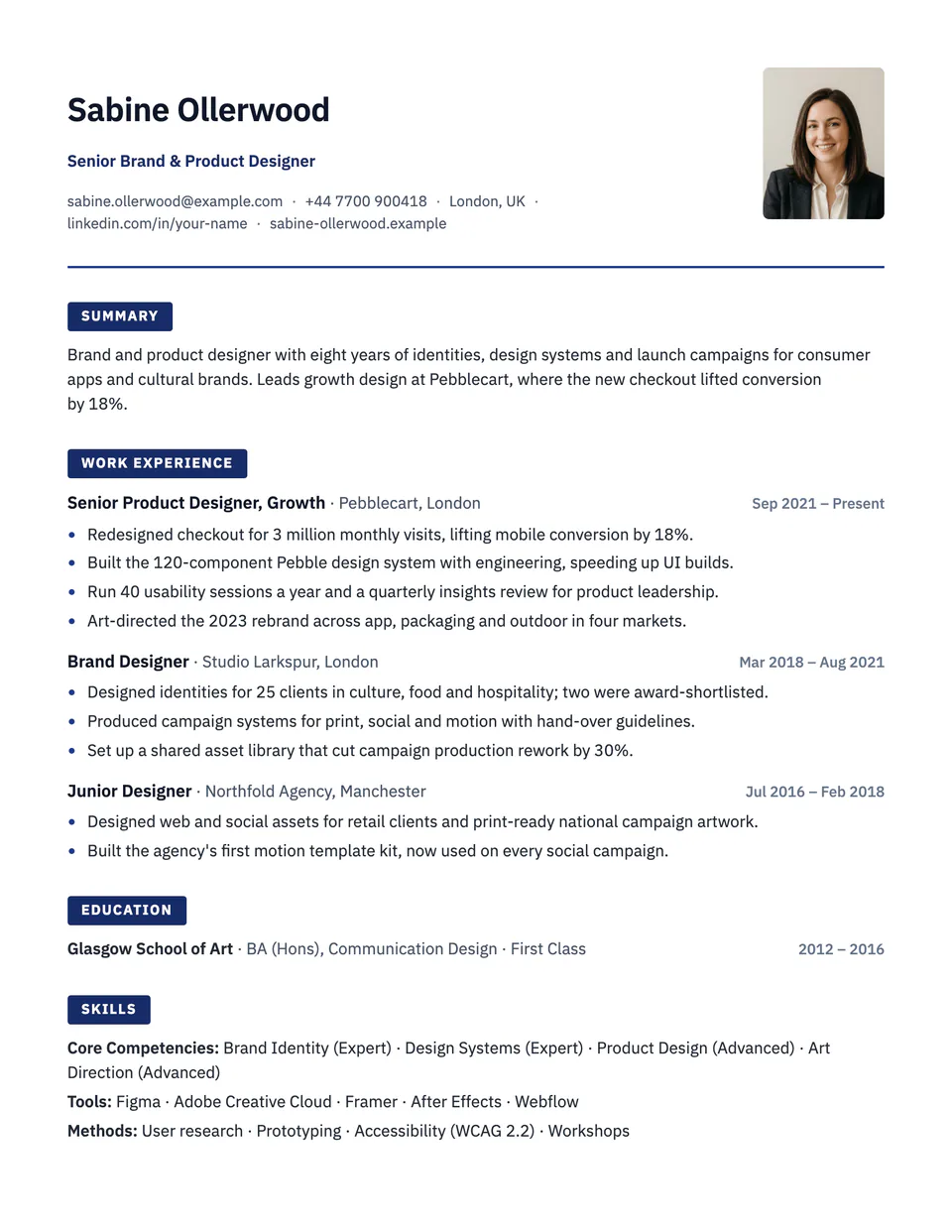
European
Passport-style photo at the top and bold section labels: the closest match to the classic German Lebenslauf.
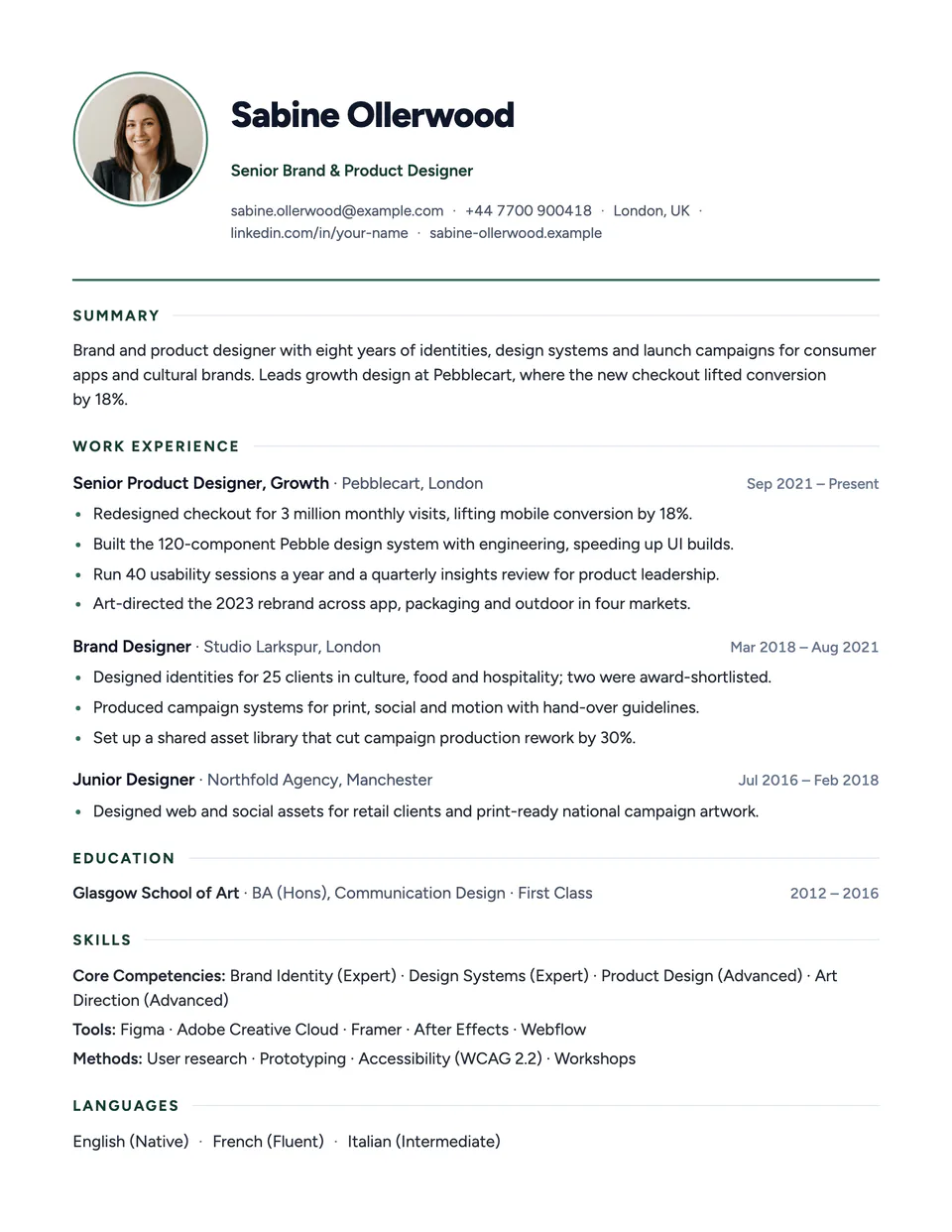
Profile
A round portrait beside your name for a more modern look, suited to customer-facing roles.
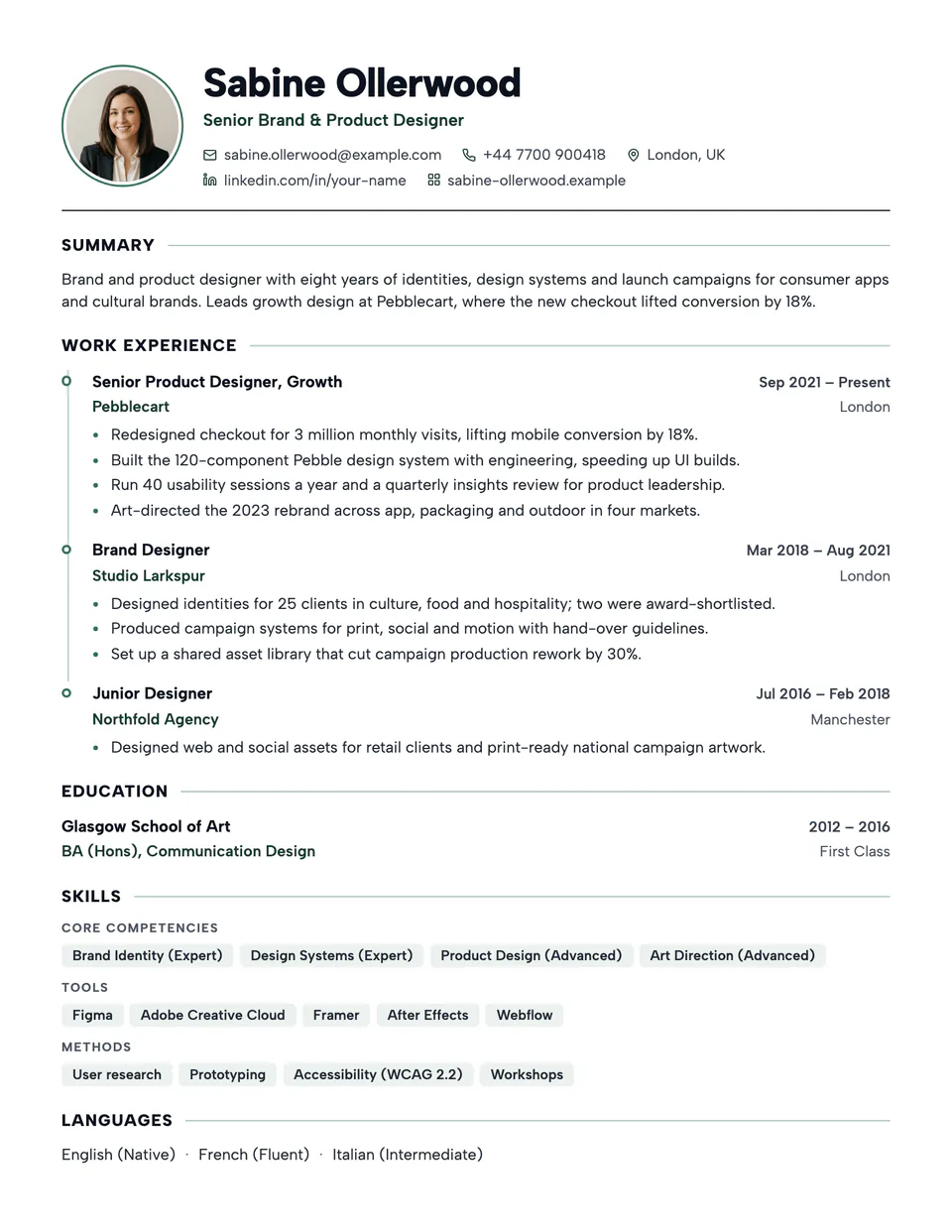
Lumen
Round photo, contact icons and a fine career line, for candidates who want some design without losing the tabular order.
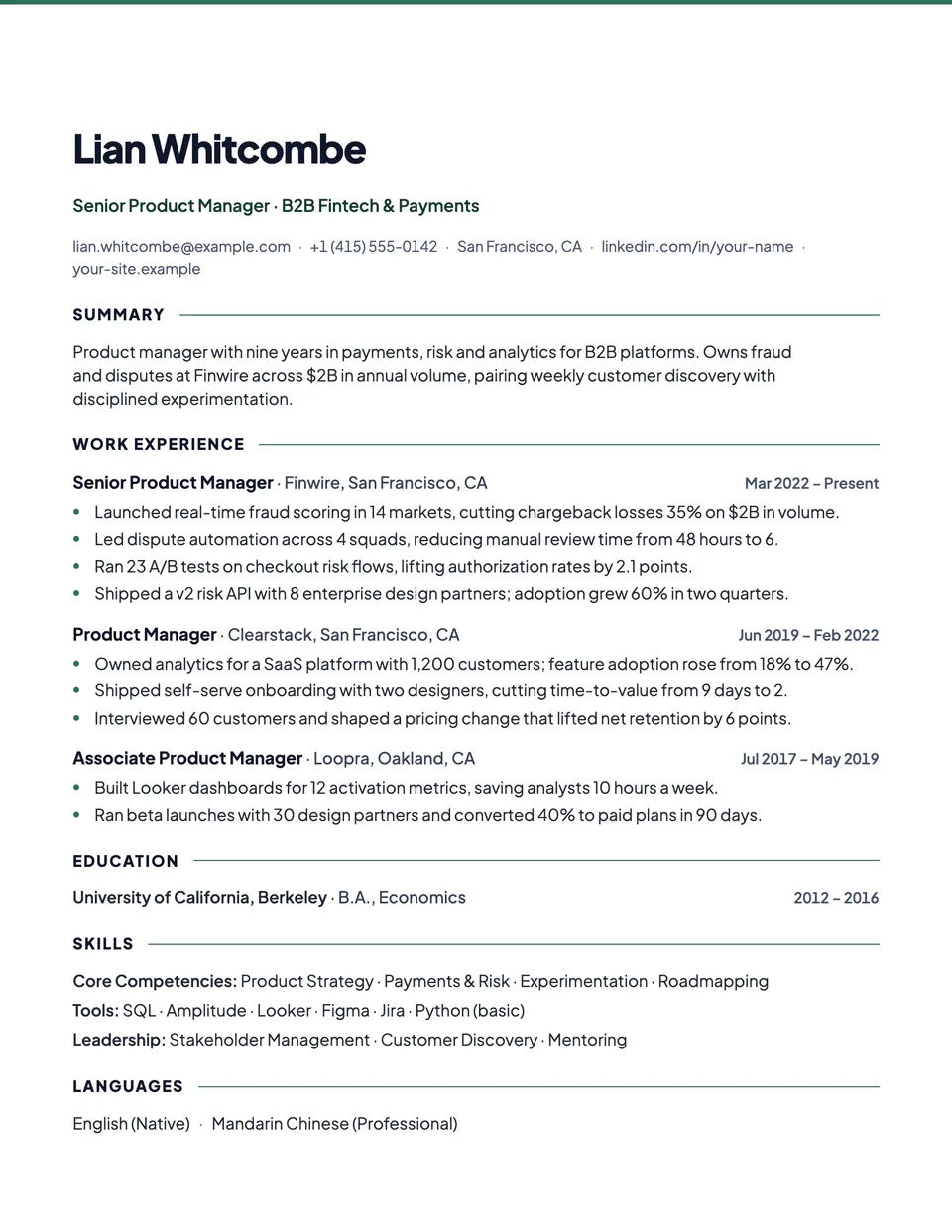
Contemporary
No photo field: the right choice for anonymised applications and international companies that ask for CVs without pictures.
Applying from abroad: language, recognition and permits
Write in the language of the job ad. EURES notes that for some applications, for example to small businesses, you should have your qualifications and work references translated into German; resume translation converts the CV itself while keeping the layout. EURES also says apprenticeships require at least B1 German at the start of training.
Recognition depends on your profession. For regulated professions, mainly in health, education, safety and social services, and for protected titles such as engineer, formal recognition is required before you can practise. In non-regulated professions you can generally work without it, although recognition may be necessary when entering from a non-EU country and can help in applications. For degrees, the anabin database shows how your university and qualification are rated, and the Central Office for Foreign Education (ZAB) issues a Statement of Comparability.
Citizens of the EU, Norway, Iceland, Liechtenstein and Switzerland have free movement. Other nationals need a residence permit for the job before they start work and generally apply for a national visa at a German mission. The Federal Foreign Office refers skilled workers to Make it in Germany, the federal government's portal for skilled workers from abroad, for the current rules.[3][7][8][9]
Common mistakes on a German CV
- Sending a US-style resume with no dates in month/year and no clear date column.
- Using a holiday snapshot or a selfie as the application photo.
- Forgetting place, date and signature at the end of the CV.
- Sending original certificates by post, or leaving out work certificates entirely.
- Leaving a weak work certificate out without a word; the agency's guide warns that this makes employers suspicious.
- Sending one generic CV to every employer.
Frequently asked questions
- Do I need a photo on a German CV?
- No. The Federal Employment Agency states that employers may not demand a photo, and the General Equal Treatment Act protects applicants against discrimination on grounds such as ethnic origin, sex and age. A professional photo is still customary, placed at the top right of the CV. Leave it out whenever the employer asks for an anonymised application.
- How long should a CV be in Germany?
- At most two A4 pages, according to both the Federal Employment Agency and EURES. Career starters and short applications, for example speculative or student jobs, usually fit on one page. Tailor the content to the posting and drop experience that does not matter for this job.
- Do I have to sign my CV in Germany?
- It is expected. The Federal Employment Agency asks for place, date and a handwritten signature with your full name at the end of the CV, and EURES reminds applicants to sign and date it. For email and online applications, insert a scanned signature into the document.
- Should I translate my degree and work references into German?
- Often, yes. EURES advises having qualifications and work references translated into German for some applications, for example to small businesses. Check the language of the job ad. For regulated professions you need formal recognition anyway, and for university degrees the anabin database or a Statement of Comparability from the ZAB helps employers understand what your qualification is worth.
- Can I use a Europass CV in Germany?
- Yes. EURES recommends the Europass format to people applying in Germany, and the Europass editor is free and available in 31 languages. It is a sound choice if you apply in several countries; for a single German employer, a tabular Lebenslauf that follows local conventions works just as well.
Sources
Statements about rules and official guidance rely on these pages. We opened and read each source ourselves on the date shown.
- [1]Bewerbung schreiben · Bundesagentur für Arbeitwww.arbeitsagentur.de/arbeitslos-arbeit-finden/bewerbungstraining/bewerbung-schreiben ·
- [2]Bewerbungskompass für Arbeitsstellen (PDF) · Agentur für Arbeitwww.arbeitsagentur.de/vor-ort/datei/bewerbungskompass-arbeit_ba093152.pdf ·
- [3]Living and working conditions: Germany · European Commission, EURESeures.europa.eu/living-and-working/living-and-working-conditions/living-and-working-conditions-germany_en ·
- [4]General Equal Treatment Act (AGG), § 1 · Federal Ministry of Justice, gesetze-im-internet.dewww.gesetze-im-internet.de/agg/__1.html ·
- [5]Trade Regulation Act (GewO), § 109 Zeugnis · Federal Ministry of Justice, gesetze-im-internet.dewww.gesetze-im-internet.de/gewo/__109.html ·
- [6]About Europass · European Commission, Europasseuropass.europa.eu/en/about-europass ·
- [7]What is professional recognition? · Anerkennung in Deutschland (Federal Government portal)www.anerkennung-in-deutschland.de/html/en/what-is-recognition.php ·
- [8]Higher education qualifications · Anerkennung in Deutschland (Federal Government portal)www.anerkennung-in-deutschland.de/html/en/Institute-of-higher-education.php ·
- [9]Entry of skilled workers (national visa) · Federal Foreign Office, German Missions in Canadacanada.diplo.de/ca-en/consular-services/visa/long-term/2678656-2678656 ·
Keep reading
Ready to apply in Germany? Check your CV first
Upload your Lebenslauf for a free check of structure, dates, contact details and length, then tailor it to the job you want.