Country guide
Polish CV format: how to write a CV for Poland
A Polish application is a concise CV and a cover letter (list motywacyjny). Two things set Poland apart: the Labour Code lists exactly which personal data an employer may ask for, and a data-processing consent clause is often recommended under the CV. This guide explains both, with the official sources.
What is the standard CV format in Poland?
A Polish CV takes one, at most two, A4 pages. It lists your name and contact details, professional experience, education, qualifications and additional skills. A photo is optional, because it is not among the data the Labour Code lets an employer require. Send it with a one-page cover letter, and add a consent clause only where the job advert asks for one.[1][2][3]
Polish CV conventions at a glance
| Topic | Usual in Poland |
|---|---|
| Name of the document | CV (życiorys), sent with a list motywacyjny (cover letter). |
| Length | One, at most two, A4 pages. |
| Contents | Personal data, professional experience, education, professional qualifications and additional skills. |
| Photo | Optional. An employer cannot make it a condition; if you add one, it is processed with your consent. |
| Personal details | An employer may ask for your name, date of birth and contact details. Marital status, nationality and current salary are not on the list. |
| Dates | No official format; month and year for each entry keeps the timeline clear. |
| Consent clause | Recommended by EURES; UODO says it is not needed for the data the Labour Code lists. |
| Cover letter | Usually one A4 page and slightly more personal than the CV. |
| References | A prospective employer may not contact a former employer about you without your consent. |
| Europass | EURES points to Europass and the public employment services platform for CV templates. |
Layout and structure of a Polish CV
EURES, the EU's job mobility portal, describes the CV Polish employers typically ask for: personal data (name, surname, address, phone and email), professional experience covering every job that gave you experience useful in the new workplace, education, professional qualifications and additional skills. It should be concise, one or at most two A4 pages.
Employers make a first selection on the basis of the documents you send, then interview chosen candidates, sometimes with a knowledge test, so the CV has to show your match quickly. To build each version around one advert, use the job-specific resume optimizer.[1]
What a Polish employer may ask for: Labour Code article 22¹
Polish law is unusually specific here. Article 22¹ of the Labour Code lists the personal data an employer requests from a job applicant; anything else you give is voluntary.
| Data | May the employer ask? | On your CV |
|---|---|---|
| Name and surname | Yes | Always. |
| Date of birth | Yes | Optional; you may provide it when asked. |
| Contact details you choose | Yes | Phone, email, city. |
| Education, qualifications, employment history | Yes, when necessary for the type of work or position | The core of the CV. |
| Pay in current or previous jobs | No, it is excluded from the employment history an employer requests | Leave it out. |
| Photo, marital status, nationality, interests | Not on the list | Voluntary; processed on the basis of your consent. |
If you share extra data, refusing or withdrawing consent cannot be a reason to treat you unfavourably or to refuse to hire you. The Labour Code also requires equal treatment when an employment relationship is established, regardless of sex, age, disability, race, religion, nationality, political beliefs, trade union membership, ethnic origin, creed or sexual orientation.
The RODO consent clause: when you need it
The EURES page for Poland recommends ending the CV with a signed consent to the processing of personal data for recruitment, citing the GDPR (RODO in Polish). The Personal Data Protection Office (UODO) takes a narrower view in its guide for employers: the practice of putting a consent to processing for recruitment purposes in the CV is not appropriate, because the data listed in the Labour Code are processed without it.
Consent matters in specific cases. Extra ordinary data you volunteer, such as a photo, are processed on the basis of your consent, which UODO says is shown by the act of sending your CV. You need a separate consent if you want the employer to keep your documents for future recruitments, for example "I consent to the processing of my data for future recruitment by [Company] for the next six months", and explicit consent for special-category data such as health. In practice: follow the job advert. If it asks for a clause, copy its wording; if it does not, the clause is optional.[1][2][3]
A skeleton Polish CV
A one-page structure with placeholder data.
Personal data
[Name Surname]
Kraków · +48 5xx xxx xxx · your-name@example.com
linkedin.com/in/your-name
Profile
Accountant with five years in shared-services finance. Month-end close, reconciliations and reporting for international clients.
Professional experience
04/2022 – present · Senior Accountant, [Company] Sp. z o.o., Kraków
Shortened the month-end close checklist and trained two new team members.
09/2019 – 03/2022 · Accountant, [Company], Wrocław
Education and qualifications
2015 – 2019 · MA Finance and Accounting, [University]
ACCA (in progress)
Additional skills
Polish (native) · English (C1) · German (B1) · SAP · Excel
Consent (only if the advert asks)
[Clause wording copied from the job advert]
Example with placeholder details, not a real person
The sample data is illustrative only.
The cover letter and how to apply
EURES describes the cover letter as the second document of a Polish application: it justifies why you chose this offer, is slightly more personal than the CV and typically takes one A4 page and is hand-signed. The employer's advert says how to apply, whether in person, by post, by email or through its own online system. Match its design to your CV with the cover letter builder.[1]
Where to find jobs in Poland
District employment offices publish vacancies on the public ePraca portal, and Polish vacancies also appear on the EURES portal. Licensed employment agencies, listed in the KRAZ register, may not charge you for finding work, apart from specific costs when referring you to work abroad. EURES lists private boards such as Pracuj.pl, Praca.pl, Indeed and Rocketjobs.pl.[1]
How to write a Polish CV in six steps
Use these steps for a first Polish CV or to adapt a resume written for another country.
- 01
Read the advert
Note the language, the requirements, how to apply and whether a consent clause is requested. The JD keyword matcher lists the terms your CV misses.
- 02
Keep it to one or two A4 pages
Most recent role first, with a short profile at the top.
- 03
Limit personal data
Name, contact details and, if you wish, date of birth. Leave out salary history; a photo is optional.
- 04
Describe results
Three to five points per job that show what you achieved, using the advert's own terms.
- 05
Add the clause only where asked
Copy the employer's wording, and add a separate consent if you want to be considered for future recruitments.
- 06
Check and send
Run the free resume checker and send the CV and cover letter as the advert specifies.
Templates that suit Polish applications
Clean layouts that keep the structure above, with or without a photo. All designs are in the template gallery.
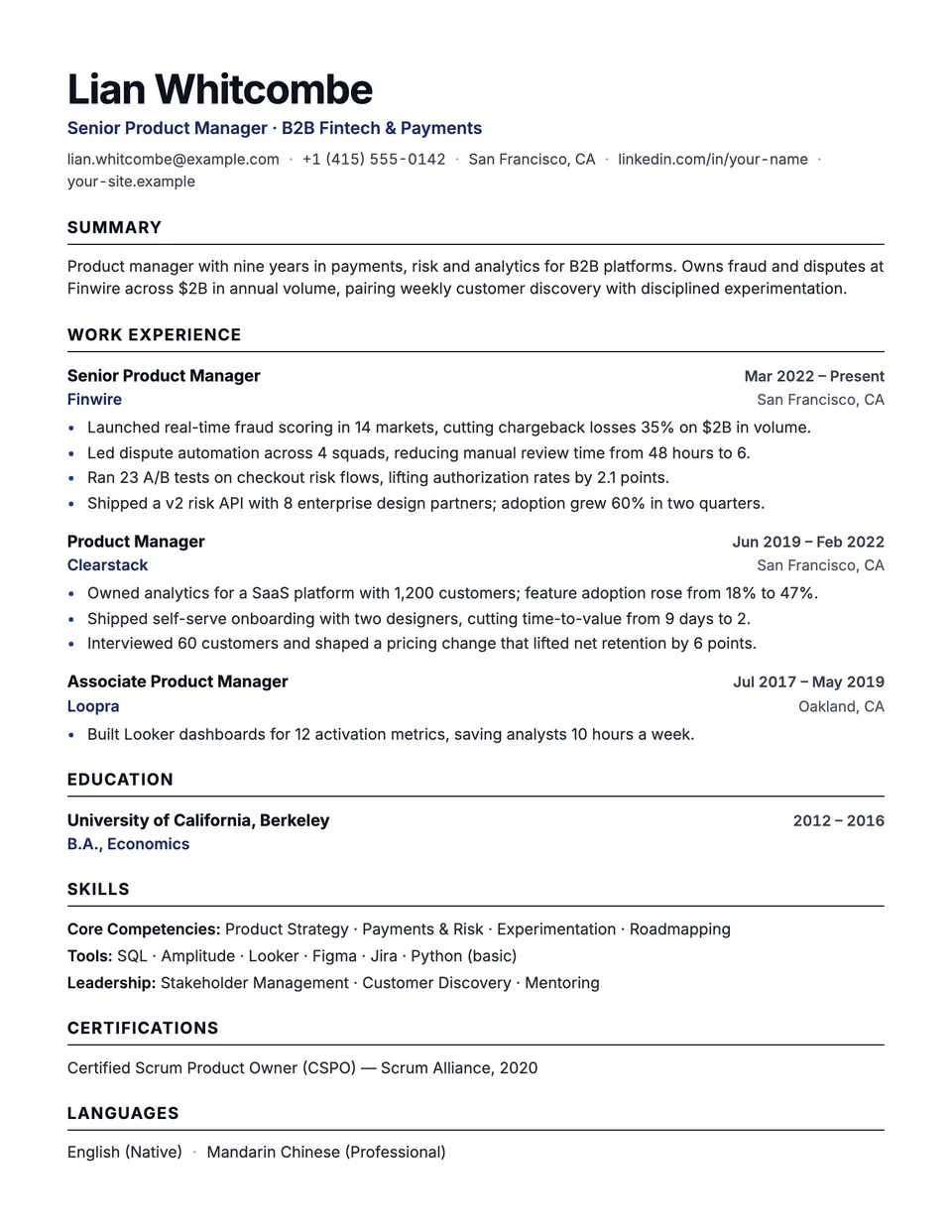
Beacon
A calm single-column layout for corporate, shared-services and public-sector roles.
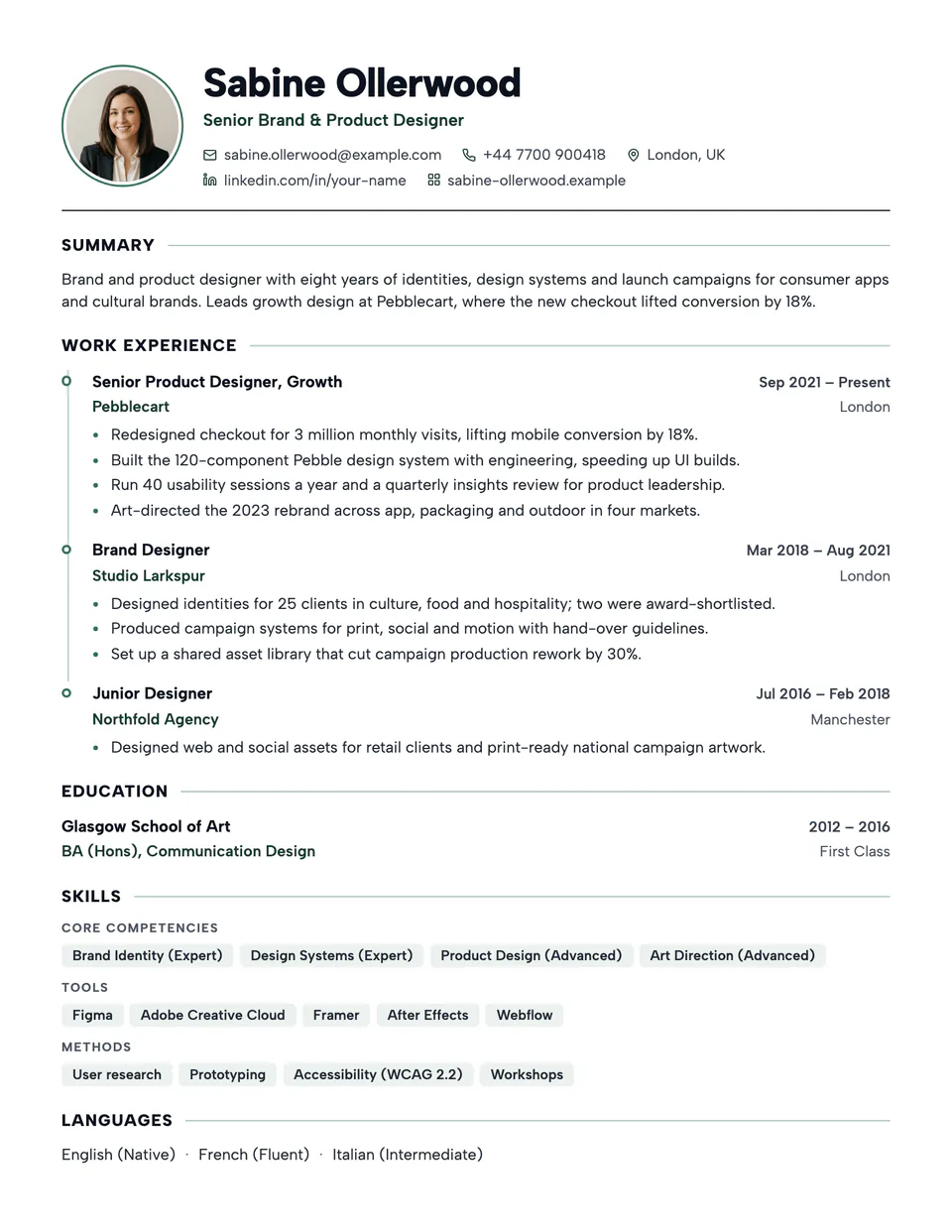
Lumen
A round photo field and contact icons, if you decide to include a professional photo.
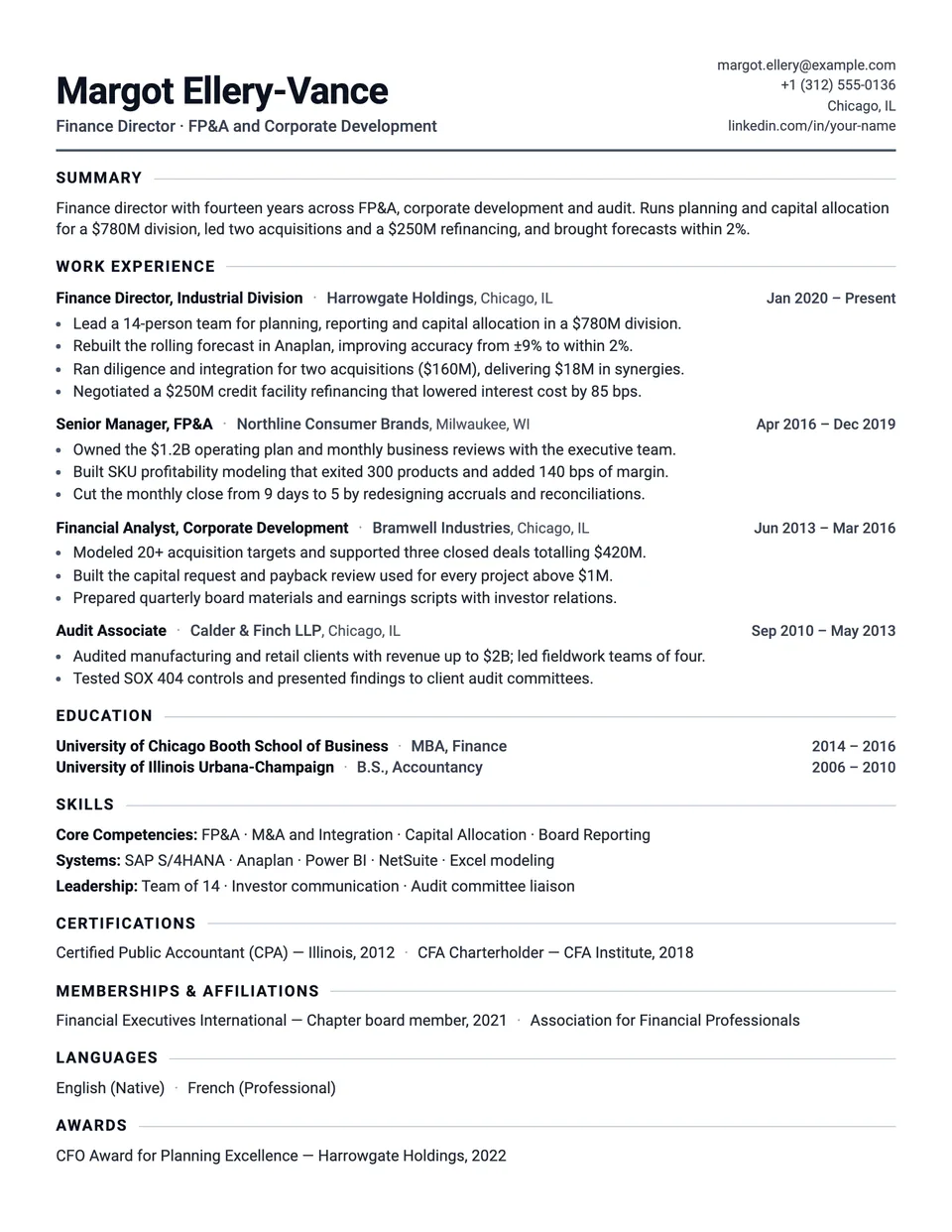
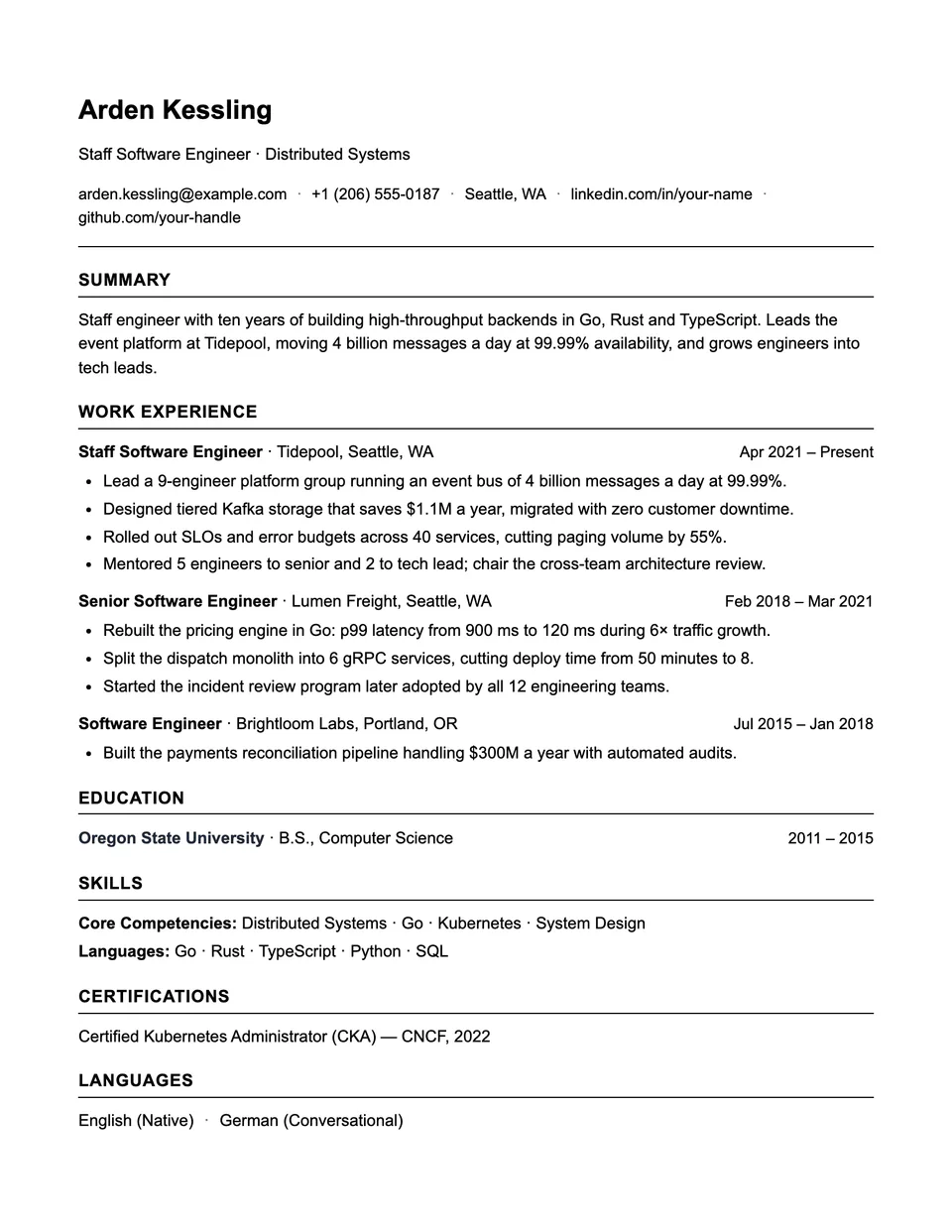
ATS Plain
The plainest layout, for employers that collect applications through online systems.
Applying from abroad: language, qualifications and permits
Write in the language of the advert; resume translation converts the CV while keeping the layout.
According to NAWA, the Polish National Agency for Academic Exchange, how a foreign qualification is recognised for professional purposes depends mainly on the country where you obtained it and whether the profession you want to practise is regulated in Poland.
Nationals of EU and EFTA member states may work in Poland without a work permit, on the same terms as Polish nationals, and register their residence for stays longer than three months. Citizens of other countries may work lawfully only with an appropriate residence document and, in most cases, a single residence and work permit, a work permit the employer obtains for them, or a declaration on entrusting work. The government's biznes.gov.pl guide sets out the current rules.[1][4][5]
Common mistakes on Polish CVs
- Going beyond two A4 pages.
- Stating current or past salaries, which are outside the data an employer may request.
- Adding a generic consent clause when the advert gives its own wording.
- Forgetting a separate consent if you want to be considered for future recruitments.
- Sending one generic CV and letter to every employer.
Frequently asked questions
- Do I need a photo on a Polish CV?
- No. The Labour Code lists the personal data an employer may request from an applicant, and a photo is not on that list. If you add one, the employer processes it on the basis of your consent, and refusing consent cannot be a reason to refuse to hire you. If you include a photo, use a recent, professional one.
- Is the RODO consent clause required on a Polish CV?
- Not for the data the Labour Code lists. UODO, the data protection authority, says putting a recruitment consent clause in the CV is not appropriate practice, although EURES still recommends one. Follow the advert: if it asks for a clause, use its wording. Add a separate consent if you want your CV kept for future recruitments.
- Should I include my date of birth?
- You may. Date of birth is one of the data an employer may request from an applicant under article 22¹ of the Labour Code, alongside your name and contact details. The Labour Code also requires equal treatment regardless of age when an employment relationship is established, so including it or not is your decision.
- How long should a CV be in Poland?
- One page, or at most two A4 pages, according to EURES guidance for Poland, which asks for a concise CV. Include the jobs that gave you experience useful in the new workplace. With a longer career, keep recent and relevant roles in detail and shorten older ones to a single line.
- Can I use a Europass CV in Poland?
- Yes. EURES points jobseekers to Europass, alongside the Public Employment Services platform, for CV and cover letter templates. Europass is free and available in 31 languages, which helps when you apply in several countries. For a single Polish employer, a concise CV tailored to the advert works just as well.
Sources
Statements about rules and official guidance rely on these pages. We opened and read each source ourselves on the date shown.
- [1]Living and working conditions: Poland · European Commission, EURESeures.europa.eu/living-and-working/living-and-working-conditions-europe/living-and-working-conditions-poland_en ·
- [2]Labour Code (Kodeks pracy), consolidated text Dz.U. 2026 poz. 1245: articles 11³, 18³a, 22¹ and 22¹a · Sejm of the Republic of Poland (ELI)api.sejm.gov.pl/eli/acts/DU/2026/1245/text.pdf ·
- [3]Ochrona danych osobowych w miejscu pracy. Poradnik dla pracodawców (data protection in the workplace: a guide for employers) · Personal Data Protection Office (UODO)uodo.gov.pl/file/1469 ·
- [4]When it is lawful for a foreign national to work in Poland · Biznes.gov.pl (Polish government business portal)www.biznes.gov.pl/en/portal/004948 ·
- [5]Recognition for professional purposes · Polish National Agency for Academic Exchange (NAWA)nawa.gov.pl/en/recognition/recognition-for-professional-purposes ·
- [6]About Europass · European Commission, Europasseuropass.europa.eu/en/about-europass ·
Keep reading
Applying in Poland? Check your CV first
Upload your CV for a free check of structure, dates, contact details and length, then tailor it to the job you want.