Country guide
Dutch CV format: how to write a CV for the Netherlands
Dutch employers want a CV that is short, specific and written for the job, sent with a one-page application letter that explains your motivation. This guide covers the expected structure, what to do about photos and personal data, and what changes when you apply from abroad.
What is the standard CV format in the Netherlands?
A Dutch CV is to the point and normally no longer than two A4 pages. It lists personal details, then education and work experience with exact start and end dates, most recent first, followed by hobbies and voluntary work. Adapt it to each position and send it with a one-page application letter that explains why you want the job.[1]
Dutch CV conventions at a glance
| Topic | Usual in the Netherlands |
|---|---|
| Name of the document | CV (curriculum vitae). A shorter "résumé" is used by some experienced candidates. |
| Length | Normally a maximum of two A4 pages. |
| Order | Personal details, education, work experience, then hobbies and voluntary work. |
| Dates | Exact start and end dates for each course and job, most recent first. |
| Photo | Optional. It is not part of the structure EURES describes for a Dutch CV. |
| Personal details | Name and contact details. Age, civil status and nationality are protected grounds; include them only if you choose to. |
| Language | The application letter in Dutch unless the advert says otherwise; follow the same rule for the CV. |
| Cover letter | One typed A4 page; motivation is one of the most important selection criteria. |
| References | Not attached. Take references and copies of certificates to the interview. |
| Europass | Not yet widely known among Dutch employers; EURES recommends the standard Dutch CV. |
Layout and structure of a Dutch CV
EURES, the EU's job mobility portal, describes the Dutch CV as professional, specific and adapted to the position. It gives a clear order of sections, which the table follows.
| Section | What to include | Tip |
|---|---|---|
| Personal details | Name, phone, email, city, LinkedIn URL. | Date of birth, nationality and a photo are optional. |
| Education | Programme, institution, exact start and end dates, whether you obtained the degree. | Start with your most recent education, including relevant courses. |
| Work experience | Employer, job title, exact dates and the tasks you carried out. | Most recent job first; add results where you can. |
| Skills and languages | Languages with level, software, certifications. | Use the terms from the job advert. |
| Hobbies and voluntary work | Brief, and only what tells the employer something useful. | Voluntary work can show the skills a job asks for. |
The order puts education before work experience. Once you have several years of experience, a shorter résumé that opens with the kind of job you are looking for is becoming more common. Whichever you choose, tailor it to the posting rather than sending one version everywhere.
Photo and personal data: what Dutch equal treatment law says
The Equal Treatment Act (Algemene wet gelijke behandeling) protects people regardless of religion, belief, political opinion, race, sex, nationality, sexual orientation and civil status, and it explicitly prohibits making a distinction when a job is offered and when a vacancy is filled. A separate act, the WGBL, applies the same prohibition to age. Other statutes protect further grounds, such as disability or chronic illness.
Because these characteristics must not influence the decision, you do not need to put your date of birth, marital status or nationality on a Dutch CV. A photo is your choice as well: the EURES guidance on the Dutch CV does not ask for one. If you think you have been treated unfairly, the Netherlands Institute for Human Rights gives non-binding judgments on whether someone was discriminated against at work.[1][2][3][4][5]
A skeleton Dutch CV
A two-page structure condensed to the essentials. All data is placeholder text.
Personal details
[Name Surname]
Utrecht · +31 6 xxxx xxxx · your-name@example.com
linkedin.com/in/your-name
Education
09/2015 – 07/2019 · BSc Business Administration, [University], degree obtained
Work experience
03/2022 – present · Marketing Coordinator, [Company], Amsterdam
Planned the monthly campaign calendar and reported results to the sales team.
08/2019 – 02/2022 · Marketing Assistant, [Company], Madrid (Spain)
Skills and languages
English (C1), Dutch (B1), Spanish (native) · HubSpot · Google Analytics
Hobbies and voluntary work
Volunteer coordinator, [local sports club]
Example with placeholder details, not a real person
Give language levels on the CEFR scale (A1 to C2). The sample data is illustrative only.
The application letter: motivation first
For qualified and highly qualified jobs, EURES describes an application letter with a CV as the standard procedure, and applications from abroad are generally made in writing. The letter is appreciated when it is in Dutch (unless the advert says otherwise), typed on one A4 sheet, and short but professional. Explain why you are applying, then why you are a suitable candidate and why you are motivated, since motivation is one of the most important selection criteria for Dutch employers. Close by saying you would be pleased to explain your application at an interview.
Dutch employers usually reply fairly quickly. If you have heard nothing after 14 days, EURES says you should not hesitate to phone. Unsolicited applications are very common, and it is not unusual to call a company beforehand with a few prepared questions. The cover letter generator drafts a letter from the job advert in the same design as your CV.[1]
Where to find jobs in the Netherlands
UWV, the public employment service, publishes vacancies and a CV database on werk.nl; registering with UWV is not compulsory. EURES notes that more than 60% of vacancies are filled informally, so networking matters, and that online applications through company websites and CV databases are the norm. Employment and recruitment agencies are widespread and often start with a test or assessment. National newspapers, LinkedIn and private boards such as Nationale Vacaturebank and Intermediair list many roles.[1]
How to write a Dutch CV in six steps
Use these steps for a first Dutch CV or to adapt one written for another country.
- 01
Read the vacancy closely
Note the language, the requirements and how to apply. The JD keyword matcher lists the terms your CV does not cover yet.
- 02
Keep it to two A4 pages
One clean column, clear headings and only the information that matters for this job.
- 03
Follow the Dutch order
Personal details, education, work experience, then hobbies and voluntary work, each with exact dates and the most recent entry first.
- 04
Decide on the optional details
Contact details are standard. A photo, date of birth or nationality are your choice.
- 05
Write a motivated application letter
One page, in Dutch unless the advert says otherwise: why this job, why you fit and why you are motivated.
- 06
Check and send
Run the free resume checker, then send the CV and letter as PDFs and follow up after two weeks.
Templates that suit Dutch applications
Clean layouts that keep the Dutch order and the exact dates readable. Browse every design in the template gallery.
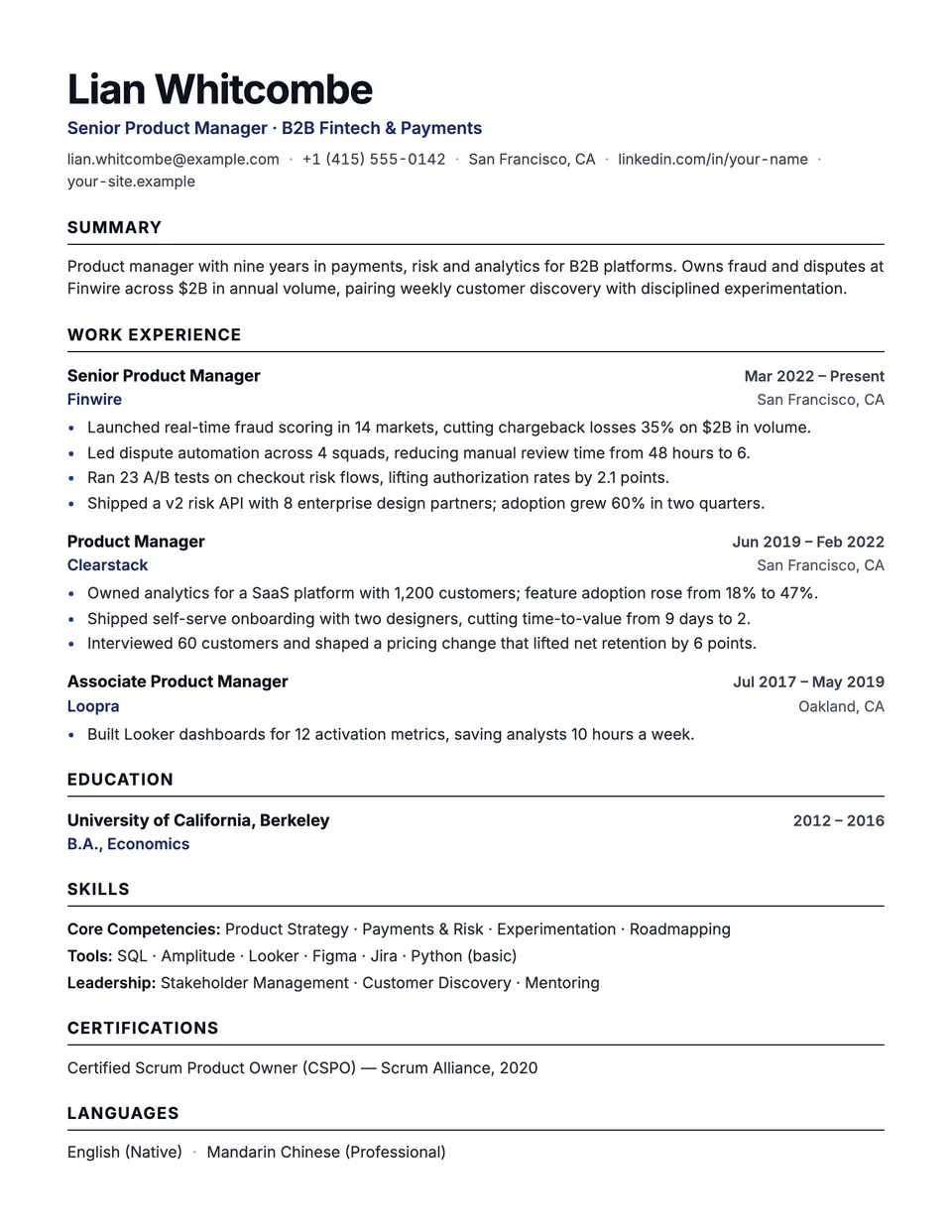
Beacon
A calm single-column layout for most corporate and public-sector roles.
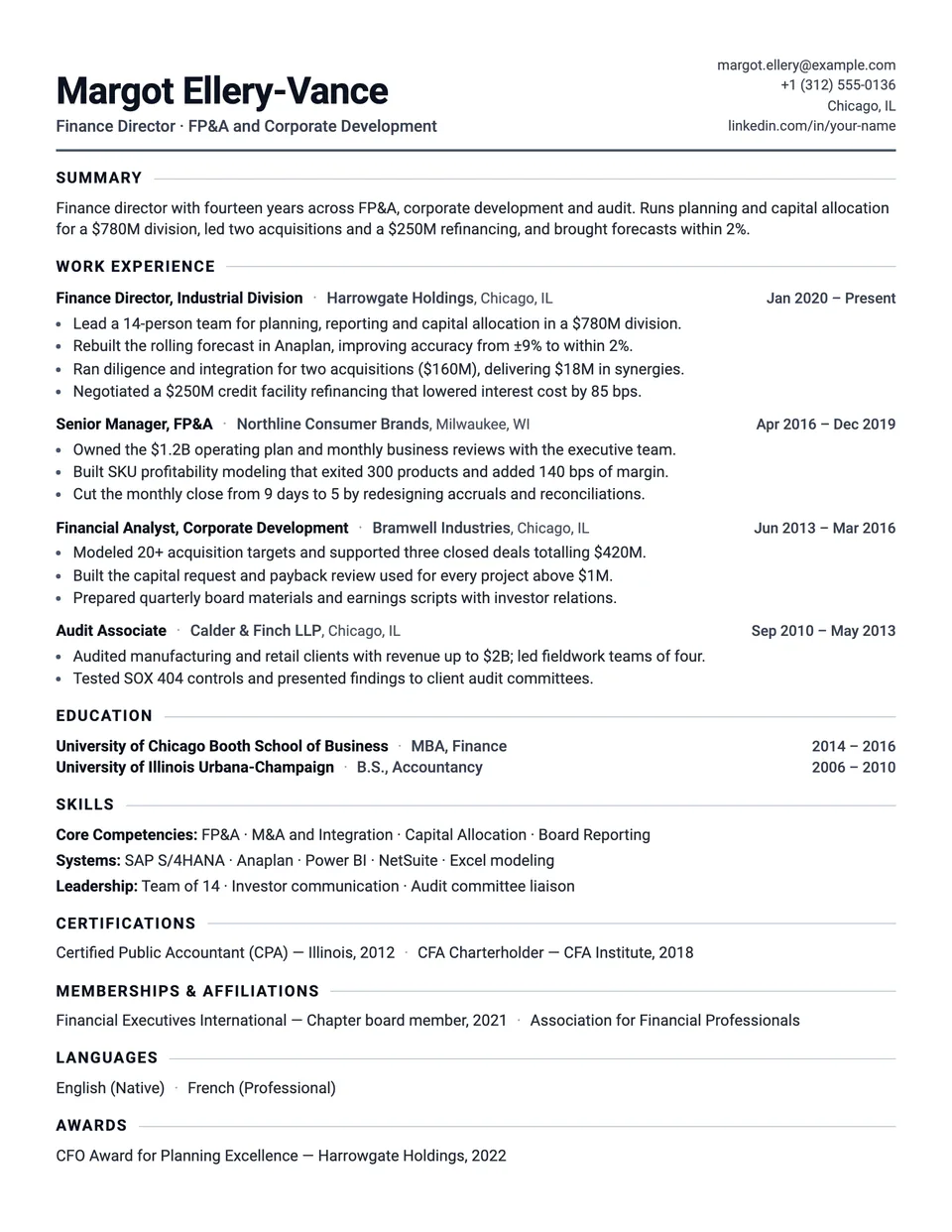
Tempo
Compact and tidy, for fitting a longer career into two pages without shrinking the font.
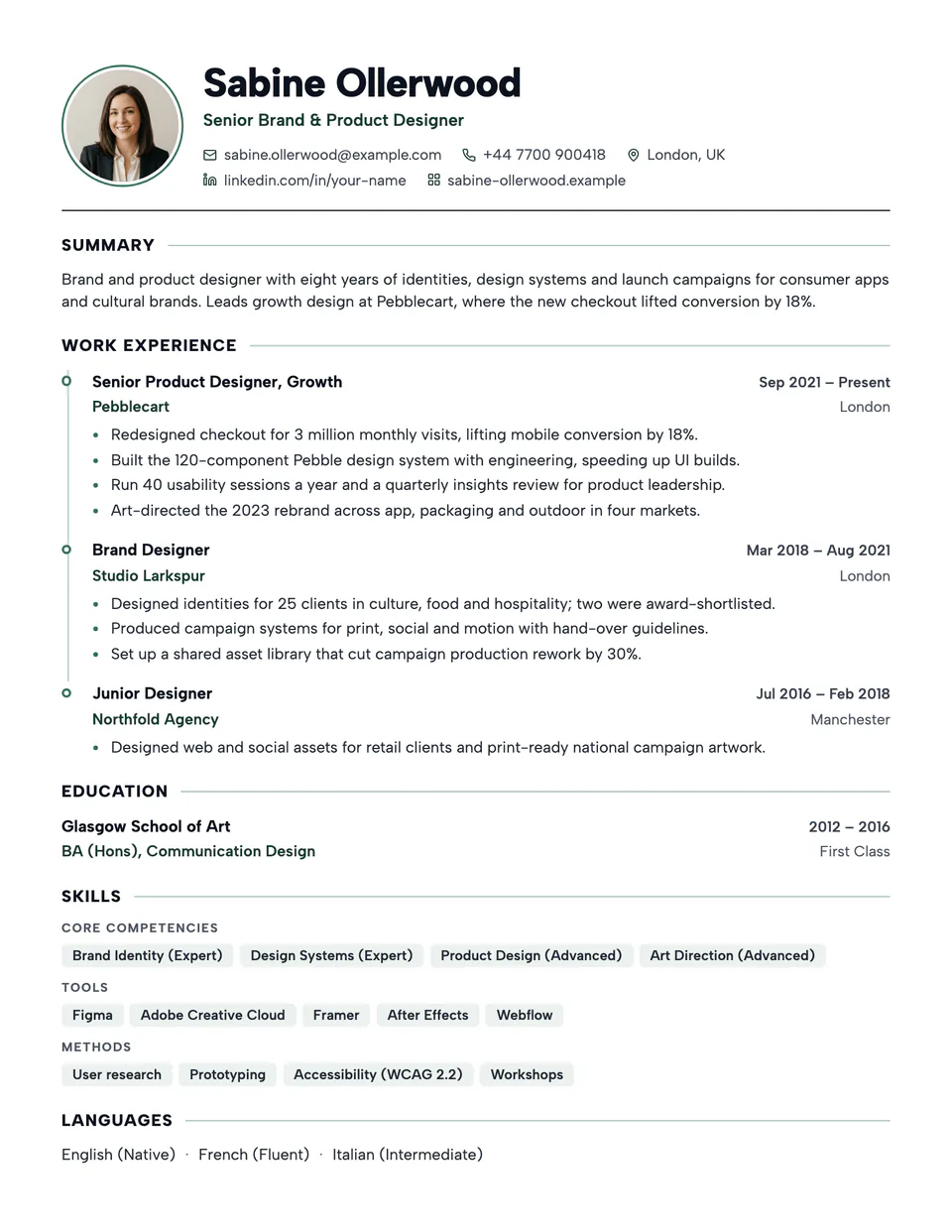
Lumen
A round photo field and contact icons, if you decide a photo suits your application.
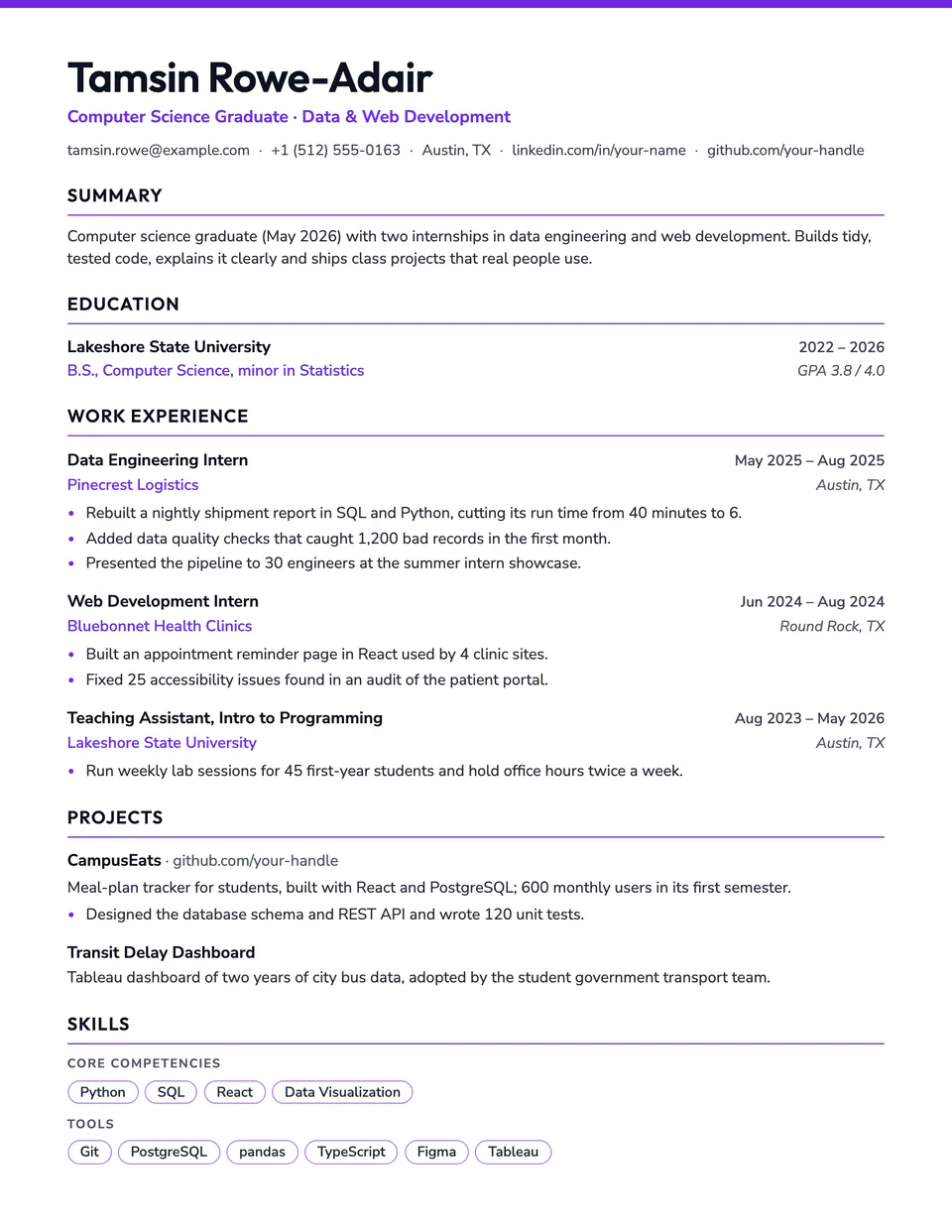
Campus
Gives education, projects and internships room, which fits the Dutch education-first order for graduates.
Applying from abroad: language, diplomas and permits
Write the letter in Dutch unless the advert is in English or says otherwise; resume translation converts the CV itself while keeping the layout.
IDW, the international credential evaluation service run by Nuffic and SBB on behalf of the government, compares a foreign diploma with the Dutch education system. An evaluation is usually not mandatory, but an employer may ask for one, and it is advice from which you cannot derive legal rights. First check whether your profession is regulated in the Netherlands (for example nurse or teacher); if so, contact the competent authority for that profession instead.
Nationals of the EU, the EEA and Switzerland do not need a residence permit to work. Other nationals need a residence permit, or in some cases a work permit. For the highly skilled migrant permit, only an employer recognised by the IND can apply. Check the IND work pages for the current requirements.[1][6][7][8][10]
Common mistakes on Dutch CVs
- Going beyond two A4 pages instead of cutting older roles down.
- Giving years only, when Dutch employers expect exact start and end dates.
- Attaching references and copies of certificates that belong at the interview.
- Sending a generic letter that never explains why you want this job at this company.
- Writing the letter in English when the advert is in Dutch and does not invite English.
- Waiting weeks for an answer instead of calling after 14 days.
Frequently asked questions
- Do I need a photo on a Dutch CV?
- No. The EURES description of the Dutch CV covers personal details, education, work experience, hobbies and voluntary work, with no photo. Equal treatment law prohibits distinctions on grounds such as race, sex and age when a vacancy is filled, and a photo can reveal several of those characteristics. If you add a photo, use a recent professional one.
- How long should a CV be in the Netherlands?
- Normally a maximum of two A4 pages, according to EURES guidance for the Netherlands. A graduate can usually fit everything on a single page. Keep only what matters for the position, be as specific as possible and adapt the content to each vacancy rather than listing everything you have ever done.
- Should I include my date of birth or marital status?
- There is no need. Civil status and nationality are protected grounds under the Equal Treatment Act, and age is protected under the WGBL. Both laws prohibit distinctions when a job is offered or a vacancy is filled. Keep personal details to your name, contact information and city; add more only if you want to.
- Can I apply in English in the Netherlands?
- Yes, when the advert is in English or invites English. EURES advises that application letters are more appreciated in Dutch unless indicated otherwise, so follow the language of the vacancy. For a Dutch-language vacancy, a CV and letter written in Dutch show that you can actually work in the language.
- Is a Europass CV accepted in the Netherlands?
- You can send one, but EURES notes that the Europass CV is not yet widely known or established among Dutch employers and recommends the standard Dutch CV for unsolicited applications. Europass itself is free and available in 31 languages, which is useful when you apply in several European countries at once.
Sources
Statements about rules and official guidance rely on these pages. We opened and read each source ourselves on the date shown.
- [1]Living and working conditions: Netherlands · European Commission, EURESeures.europa.eu/living-and-working/living-and-working-conditions-europe/living-and-working-conditions-netherlands_en ·
- [2]Equal Treatment Act (Algemene wet gelijke behandeling), articles 1 and 5 · Government of the Netherlands, wetten.overheid.nlwetten.overheid.nl/BWBR0006502/ ·
- [3]Equal Treatment in Employment (Age Discrimination) Act (WGBL), article 3 · Government of the Netherlands, wetten.overheid.nlwetten.overheid.nl/BWBR0016185/ ·
- [4]Prohibition of discrimination · Government of the Netherlandswww.government.nl/themes/migration-and-travel/discrimination/prohibition-of-discrimination ·
- [5]Netherlands Institute for Human Rights · College voor de Rechten van de Menswww.mensenrechten.nl/english ·
- [6]To work in the Netherlands with a foreign diploma · IDW (Nuffic and SBB)www.idw.nl/en/to-work/ ·
- [7]Who are we? · IDW (Nuffic and SBB)www.idw.nl/en/who-are-we/ ·
- [8]Residence permits: work · Immigration and Naturalisation Service (IND)ind.nl/en/residence-permits/work ·
- [9]About Europass · European Commission, Europasseuropass.europa.eu/en/about-europass ·
- [10]Highly skilled migrant · Immigration and Naturalisation Service (IND)ind.nl/en/residence-permits/work/highly-skilled-migrant ·
Keep reading
Applying in the Netherlands? Check your CV first
Upload your CV for a free check of structure, dates, contact details and length, then tailor it to the vacancy you want.