We Ran Our ATS Checker on 48 Resumes: What Actually Costs Points
We scored 48 sample resumes and 528 deliberately weakened copies with our ATS checker. Missing numbers cost the most, "Responsible for" bullets came second, and layout problems never showed up in the score.
By Ruubu Editorial Team11 min read
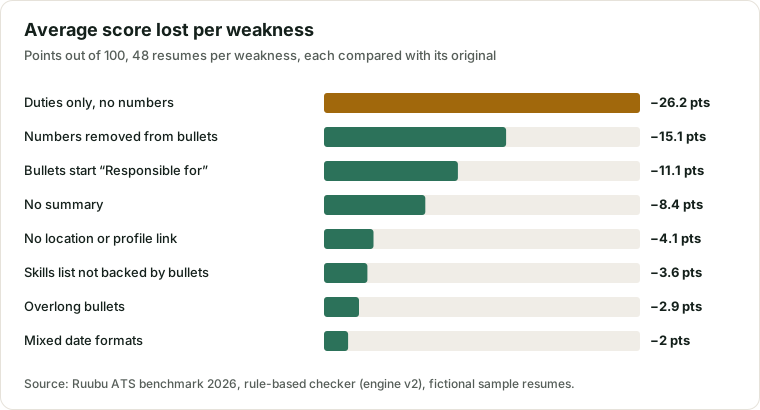
Short answer: Across 48 sample resumes and 528 copies we weakened on purpose, deleting the numbers from bullet points cost the most: 15.1 points out of 100 on average. Rewriting bullets as "Responsible for" duties cost 11.1. Together they cost 26.2 points. Tables, two columns and icons never changed the content score.
Most advice about applicant tracking systems (ATS) is opinion. We wanted numbers, so we ran our own checker on a fixed set of resumes and measured what each common mistake does to the score. The resumes are the 48 samples from our resume examples library, spread over 10 job families, plus copies of each one with a single, deliberate flaw. Every person in them is fictional, no user data was used, and every figure in this article comes from one script that gives the same output on every run.
Key findings
- Numbers matter most. Removing every number from the bullets cost 15.1 points on average (between 15 and 16). 5 of the 48 resumes fell below the 80-point "strong" band.
- "Responsible for" is the second biggest loss. Swapping each opening verb for "Responsible for" cost 11.1 points, even though every number stayed in place.
- The two together are worse than either. A resume that lists duties and gives no numbers lost 26.2 points and averaged 71.7. None of the 48 stayed in the strong band.
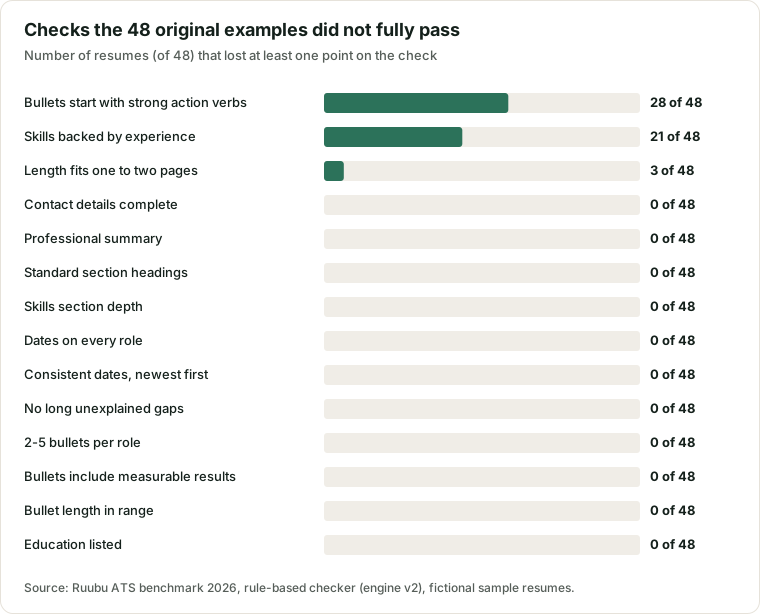
- Even polished resumes miss on two checks. Our original examples averaged 97.9, yet 28 of 48 lost points on opening verbs and 21 on skills that no bullet backs up.
- Layout problems are invisible to a content score. A table, a two-column layout or icon glyphs left the score unchanged in every case. Only the separate file check caught them, and a rule-based re-read of two-column text dropped the average from 91.4 to 58.8.
How we ran the test
The scorer is the same rule set behind our free resume checker: 14 checks that add up to 100 points, from contact details and section headings to dates, bullet length and measurable results. It is deterministic. The same resume always gets the same score, which is what makes a before-and-after test possible. We ran it without a target job title, so the optional target-role keyword check was off, as it is in the free checker.
First we scored the 48 original examples. Then we built 384 weakened copies by applying one of 8 changes to every resume, and 144 more by rendering each resume in 3 risky layouts. The changes are mechanical, so a weakness looks the same in every resume:
- Numbers removed: every amount, percentage, count and duration deleted from the bullets.
- "Responsible for": each bullet's opening verb replaced with "Responsible for", plus a "Responsible for" sentence in the summary.
- Duties only, no numbers: both of the changes above at once.
- No summary: the professional summary deleted.
- No location or profile link: the city and every LinkedIn, website or GitHub link deleted; email and phone kept.
- Skills not backed by bullets: 8 common tools that appear nowhere else added at the top of the skills list.
- Overlong bullets: the same 27-word filler clause appended to every bullet.
- Mixed date formats: the latest role keeps month and year, older roles show the year only.
Here is what one bullet from the fictional product manager example looks like before and after. Original: "Prioritized a 200-item backlog against quarterly OKRs, raising the on-time release rate from 70% to 94%." With the numbers removed: "Prioritized a backlog against quarterly OKRs, raising the on-time release rate." Rewritten as a duty: "Responsible for a 200-item backlog against quarterly OKRs, raising the on-time release rate from 70% to 94%."
Numbers carry the most weight
The measurable-results check is worth 15 of the 100 points, more than any other single check, and deleting the numbers cost every one of the 48 resumes all 15 of them. The average score fell from 97.9 to 82.7. Nothing else in the resume changed: the same verbs, the same skills, the same length.
One caveat makes this result look bigger than it would on a typical draft. Our examples are written to show good practice, and 379 of their 384 bullets (99%) already contain a number. A resume that starts with few numbers has less to lose here, and more to gain by adding them. If you are unsure where you stand, the checker counts how many of your bullets carry a figure and tells you when the share is too low.
A number does not have to be revenue. Team size, the number of accounts, tickets or patients you handled, a time you cut, a deadline you met: each of these gives a recruiter scale and gives the checker the signal it looks for.
Why "Responsible for" costs more than it looks
Replacing the opening verb with "Responsible for" cost 11.1 points on average, between 8 and 13. Most of it came from the opening-verb check, worth 10 points, and the rest from the summary check, which marks down a summary that reads like a job description. Because the numbers were still there, all 48 resumes stayed in the strong band on score alone.
Combine the two and the picture changes. With duties instead of verbs and no numbers, the average fell to 71.7 and all 48 resumes landed in the middle band (55 to 79 points). The two losses simply add up: 15.1 plus 11.1 is the 26.2 we measured. In practice they also tend to arrive together, because a bullet that describes a duty rarely has a result to count. The same example bullet as a duty with no numbers reads: "Responsible for a backlog against quarterly OKRs, raising the on-time release rate."
Even polished resumes miss on verbs and skill evidence
The 48 originals averaged 97.9 and none scored below 94; 13 scored a full 100. Only three checks ever cost them points, and the pattern is worth knowing because it is the kind of thing careful writers still miss.
- Opening verbs (28 of 48 resumes). 58 of the 384 bullets (15%) open with a duty verb such as "managed", "coordinated" or "supported". The checker gives those half credit: they describe scope, not a result. 27 of the 28 resumes that lost points here had at least one.
- Skills backed by experience (21 of 48). These resumes list skills that no bullet, project or certification mentions. It cost 59 points across the set, the largest share of the 103 points the originals lost in total.
- Length (3 of 48). A one-point deduction for resumes that come out slightly short by the checker's length estimate.
The skills result matched the weakened copies. Adding 8 tools that nothing in the resume supports cost 3.6 points on average, from 0 to 6. It is a small score change for something a recruiter may ask about in the first interview, which is why the checker names the skills it could not find in your bullets.
Smaller losses: summary, contact details, long bullets and dates
- No summary: 8.4 points on average. The summary check is worth 8 points and an empty summary earns none of them.
- No location or profile link: 4.1 points. Email and phone alone get half of the 8 contact points.
- Overlong bullets: 2.9 points. The score treats long bullets as a minor problem; a reader skimming a page may be less forgiving. Our example with the filler added reads: "Prioritized a 200-item backlog against quarterly OKRs, raising the on-time release rate from 70% to 94%, working closely with colleagues and stakeholders across several teams to keep the work aligned with wider business goals, agreed timelines and the quality standards expected by leadership."
- Mixed date formats: exactly 2 points on every resume. Easy to fix and easy to miss when older roles were copied from an old file.
Layout problems do not show up in a content score
For the last part we kept every word the same and changed only how the text sits in the file: contact details and skills in a table, a two-column sidebar layout, and icon-font glyphs in front of the email and phone number. The content score did not move for any of the 144 copies, because it is calculated from the resume's content, not from the file.
What did catch them is the separate file check that runs on uploaded and pasted text. It flagged 48 of 48 table versions, 48 of 48 two-column versions and 48 of 48 icon versions, and none of the 48 plain single-column controls. To see what such a layout can do to a parser, we also re-read each text with our rule-based resume parser, the one the checker falls back to when its AI reader is unavailable, and scored the result.
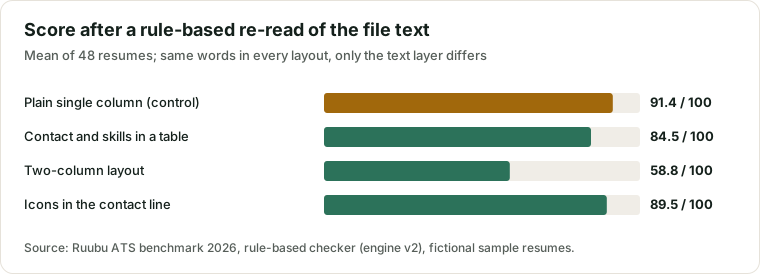
The two-column text lost 32.6 points against the plain version. Reading line by line across both columns glues sidebar skills onto job titles, and the parser found the right number of roles in only 11 of the 48 resumes. Tables cost 6.9 points and icons 1.9. Commercial ATS parsers are different software and we did not test them, but the direction is a fair warning. What counts is the order of the text inside the file, not how the page looks: when the text layer runs across both columns, a parser has to guess where each line belongs. A single-column layout removes the guess, and the template gallery marks which designs are ATS-safe.
What to fix first
- Put a number in as many bullets as you honestly can: scale, time, money, volume or rank.
- Replace "Responsible for", "Managed" and "Supported" with the verb for what changed: cut, grew, launched, built, fixed.
- Make every skill you list appear in at least one bullet, or remove it.
- Keep a short summary that leads with your strongest result.
- Use one date format throughout, newest role first.
- Choose a layout whose text reads top to bottom in one column, with contact details as plain text.
Then run your resume through the checker to see which of these apply to you; it is free and works without an account. If you are applying for a specific role, paste the job ad into the job description keyword matcher as well. Keywords were deliberately left out of this test, because without a job ad there is nothing to match against. For wording ideas by role, the resume examples show finished resumes that pass these checks.
What the numbers do not tell you
This is a test of our own rules. A higher score means a resume follows the practices those rules encode; it does not predict interviews, and we have no data on hiring outcomes. Employers' applicant tracking systems parse and rank resumes in their own ways, and recruiters read them with their own priorities. Treat the score as a checklist that is quick to apply, not as a verdict.
About the data
- Resumes: the 48 English sample resumes published on our resume examples pages (10 job families, 144 roles, 384 bullets). All names, employers and figures in them are fictional and were written by Ruubu. No user resumes and no production data were used.
- Scorer: Ruubu's ATS score, engine version 2, 14 checks totalling 100 points, without a target job title. Bands as shown in the checker: strong from 80, decent from 55.
- Weakened copies: 384 content copies (8 changes × 48) and 144 layout copies (3 layouts × 48), 528 in total. Each change is applied by code, the same way to every resume, and each copy is compared with its own original.
- Layouts: rendered as plain text the way a file's text layer reads, checked with the checker's file-layout rules and re-read with its rule-based parser. Our AI reader was not part of the test, because its output is not deterministic.
- Limits: the originals are polished and number-heavy, so they mostly show what a mistake costs a strong resume. Removing numbers also removed product names that contain digits, which cost a fraction of a point on skills evidence in a few resumes.
- Download: the aggregated results (no per-resume rows) are available as a CSV file. The benchmark was run in 2026-10; the script produces the same file on every run.
Free, no account needed. The same 14 checks as this test.
Check your resume